
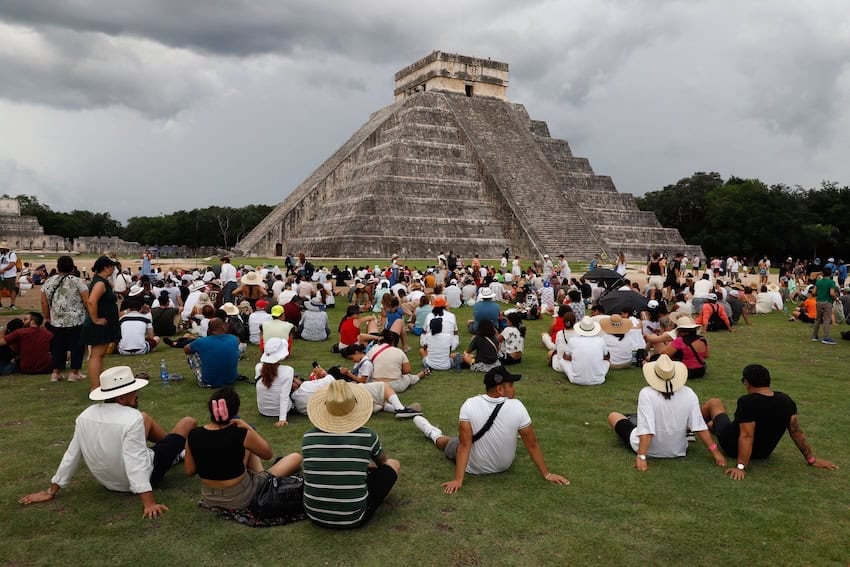
Thousands of people gathered in the esplanade in front of the great pyramid of Kukulcán in the Chichén Itzá archaeological site in the state of Yucatán on Monday and Tuesday to witness the famous descent of the serpent. The spectacular light and shadow phenomenon takes place during the spring and autumn equinoxes each year when afternoon sunlight hits the pyramid at a particular angle. As a result, the silhouette of a serpent is projected on the wall of the north balustrade of the structure known as El Castillo. The intricate design of El Castillo, also called the Temple of Kukulcán, allows for the projection of seven isosceles triangles of light which appear to the observer as a luminous and magical serpent moving down the pyramid toward the carved serpent head near its base. This fascinating interplay of light and shadow — known as the hierophanies of the equinoxes — typically lasts from 10 to 30 minutes. This year, the National Institute of Anthropology and History (INAH) implemented a special operation to receive tourists beginning on Sunday as the interplay of light and shadow was visible from Sunday through Tuesday. El Castillo was built in a geometric pyramid shape with nine truncated levels, superimposed and progressively smaller with a small temple at the top. Central staircases on each of the four sides, each with 91 steps. allowed access to the temple. In total, there are 364 steps, but including the platform on which the pyramid rests, the result is 365, precisely the length of the Maya civil year. “It reminds us of the admirable precision with which the ancient Maya observed the movement of the sun and the cycles of the seasons,” the INAH said in a statement, adding that the calculations were fundamental to Maya agriculture. INAH said the instant of the equinox this year occurred at 3:51 p.m. on Monday. In all, INAH recorded more than 7,000 visitors at Chichen Itza from Sunday through Tuesday. Because autumn starts before the rainy season ends, there are often clouds at the equinox hiding the effect. This year was no exception, but there were enough breaks in the cloud cover for the visitors to get good looks at the phenomenon. Last year, Chichen Itza surpassed Teotihuacán and Tulum as the most popular cultural tourism site in Mexico, according to the Tourism Ministry. With reports from La Jornada Maya, National Geographic and Yucatán Magazine
More than 7,000 ignore clouds to gather at Chichén Itzá for the equinox
Full Article
Original Source
Read the full article at Mexiconewsdaily →KhanList aggregates and links to publicly available news content. We do not host full articles from third-party sources. Always verify important information with original sources.