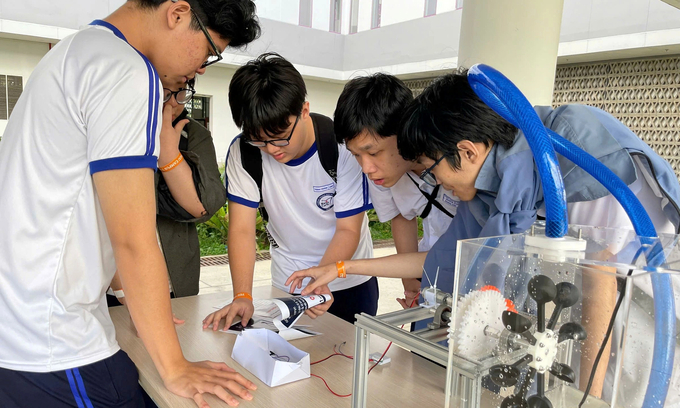
Science, technology, engineering and mathematics (STEM) programs have attracted more than half of Vietnam's university applicants this year, highlighting rising interest in technology-driven careers amid expanding government support for strategic industries. According to the Ministry of Education and Training, nearly 467,600 of more than 874,800 university applicants have registered for STEM majors in the 2026 admissions cycle, accounting for 53.45% of all candidates.Applicants submitted nearly 2.37 million STEM-related preferences, representing about one-third of all university applications.The ministry said on July 15 that computer science and information technology were the most popular STEM fields, attracting more than 154,000 applications, followed by the natural sciences with over 43,700.It is the first time the ministry has released detailed data on STEM applications.Education experts said the surge reflects a shift in students' career choices after years in which economics and social sciences typically attracted a larger share of applicants.The growing interest also comes as the government accelerates efforts to strengthen the country's science, technology and innovation capacity and develop a highly skilled workforce for strategic industries under the Politburo's Resolution No. 57. Highschool students in Ho Chi Minh City attend the STEM day event held by Vietnam - German University in January 2025. Photo by VnExpress/Ha An Bui Hoai Thang, head of the Training Office at Ho Chi Minh City University of Technology under Vietnam National University-Ho Chi Minh City, attributed the trend to a combination of supportive government policies, rapid technological advances and improving employment prospects.He said Resolution 57 has heightened awareness of the importance of STEM, while the rapid adoption of artificial intelligence and other emerging technologies has made careers in these fields increasingly attractive to young people.Another factor is the Government's scholarship policy under Decree 179, which took effect on July 15.The decree provides annual scholarships ranging from VND37 million to VND55 million (US$1,407-2,091) for outstanding students enrolled in basic sciences, key engineering disciplines and strategic technology programs.Eligible students must meet admission score requirements and rank among the top 30% of entrants in their respective fields. Scholarships are renewed annually based on academic performance.The scholarship scheme forms part of broader efforts to expand and upgrade Vietnam's STEM workforce as the country seeks to develop capabilities in strategic technologies under Resolution 57.The Ministry of Education and Training aims to increase the proportion of university students enrolled in STEM disciplines from the current 29% to 35% by 2030.More than 771,000 students are currently studying STEM subjects nationwide, according to the ministry. It has also approved 90 talent-training programs at 23 universities to strengthen links between higher education, scientific research and strategic technology development.About 22,250 students are expected to receive government scholarships from September this year, with the number projected to rise to around 30,000 in 2027. The program will be supported by an annual budget of roughly VND1.3 trillion (US$50 million).According to Professor Nguyen Van Hieu, vice president of Phenikaa University and rector of Phenikaa School of Engineering, Decree 179 will encourage more talented students to pursue STEM by improving perceptions of science and technology careers while strengthening incentives for high-achieving applicants.However, experts said scholarships alone would not be enough to build the highly skilled workforce needed for the country's long-term development.Tran Manh Cuong, vice rector of VNU University of Science, said financial support should be accompanied by greater investment in lecturers, laboratories, research facilities and teaching infrastructure, particularly in the fundamental sciences, to ensure universities can produce graduates capable of mastering and developing future technologies.
More students choose STEM as Vietnam ramps up drive for skilled workforce
Full Article
📰 Original Source
Read full article at E →KhanList aggregates and links to publicly available news content. We do not host full articles from third-party sources. Always verify important information with original sources.