
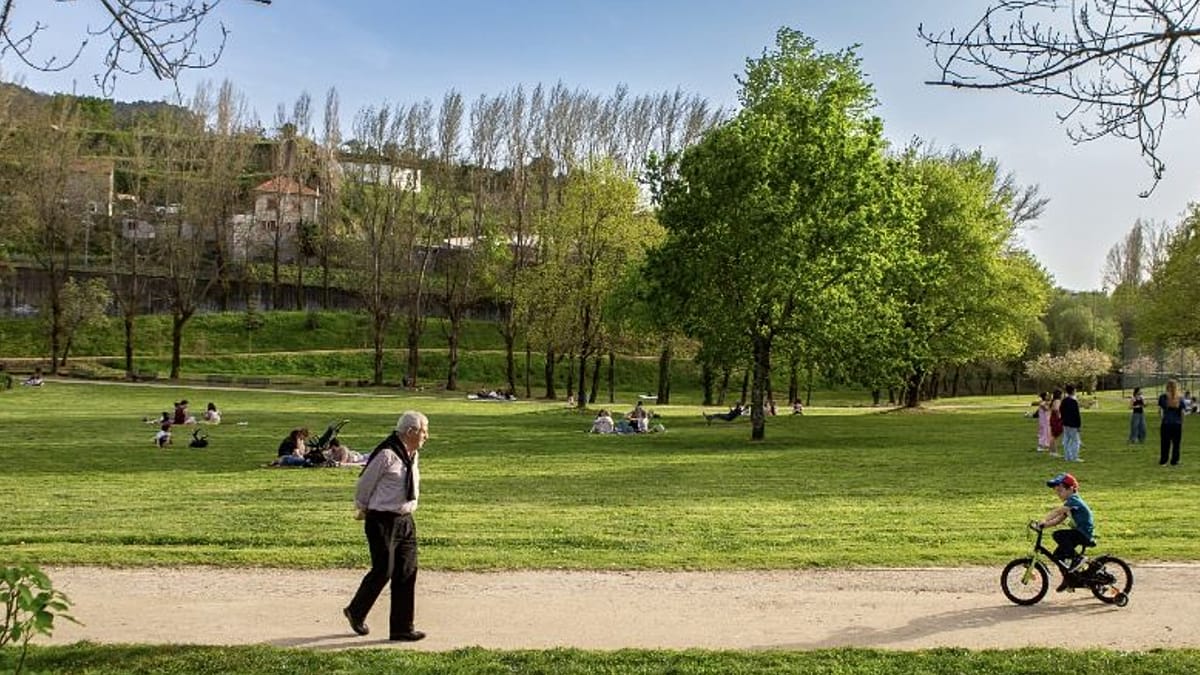
Guimarães, the current European Green Capital, is the second Portuguese city to receive this title, after Lisbon. ADVERTISEMENT ADVERTISEMENT The Minho city in northern Portugal beat Heilbronn in Germany and Klagenfurt in Austria to become European Green Capital for 2026. The European Commission assesses candidates in seven areas: air quality, noise, water, biodiversity and green spaces, waste and the circular economy, climate mitigation and climate adaptation. Behind this recognition lies more than a decade of work on green corridors, the restoration of waterways and cutting waste. Known as the cradle of the nation, the city’s historic centre has been a UNESCO World Heritage Site since 2001. It is in this centuries‑old centre, built in stone and now facing summer temperatures of 40 degrees Celsius, that the municipality is trying to preserve liveable conditions, across an area of 241 square kilometres and home to around 166,000 people. The initiatives for the Green Capital year are coordinated by the Guimarães 26 Mission Unit, based at the Landscape Laboratory, set up in 2014 by the municipal council together with the University of Minho and the University of Trás‑os‑Montes and Alto Douro. For Carlos Ribeiro, head of the Landscape Laboratory, redesigning cities has now become a public health issue. "We are seeing an increase in diseases linked to heatwaves. So we need to transform our cities. We need to design cities with a better quality of life. And these cities are cities with strong connectivity between green areas but, more importantly, they are cities where people actually use those green areas, the parks," he explains. The city is developing a green infrastructure strategy based on a radial model, a network of corridors that stretch out from the centre to connect parks, waterways, farmland and forests. The stated goals include increasing green cover, promoting biodiversity and reducing urban heat islands. Water is central to this effort. The rivers Ave and Vizela are used for leisure as well as for cooling. Low‑impact paths for pedestrians have now been created along their banks. This is because in summer temperatures in Guimarães can easily reach 40 degrees Celsius. "We know we are facing climate change and we need to act on it. That is why in recent years we have been preparing the city for climate change and trying to improve connectivity in order to enhance green areas and bring temperatures down. We have managed to reduce temperatures by two degrees. So we know we need to create more green parks, more green areas, and then we need to improve this kind of solution," says Carlos Ribeiro from the Landscape Laboratory. The two degrees are not a rough estimate. Researchers from the Landscape Laboratory and the University of Minho, working with universities in Texas and Colombia, used a decade of satellite images to measure the impact of the city’s green interventions. Published in September 2025, the study shows that land surface temperatures fell by up to 2.49 degrees Celsius in areas where green roofs and urban gardens were introduced. However, the authors warn that stronger environmental policies will be needed to sustain the progress achieved so far.
More parks, rivers and green corridors: how Guimarães is preparing for extreme heat
Full Article
Original Source
Read the full article at Euronews →KhanList aggregates and links to publicly available news content. We do not host full articles from third-party sources. Always verify important information with original sources.