
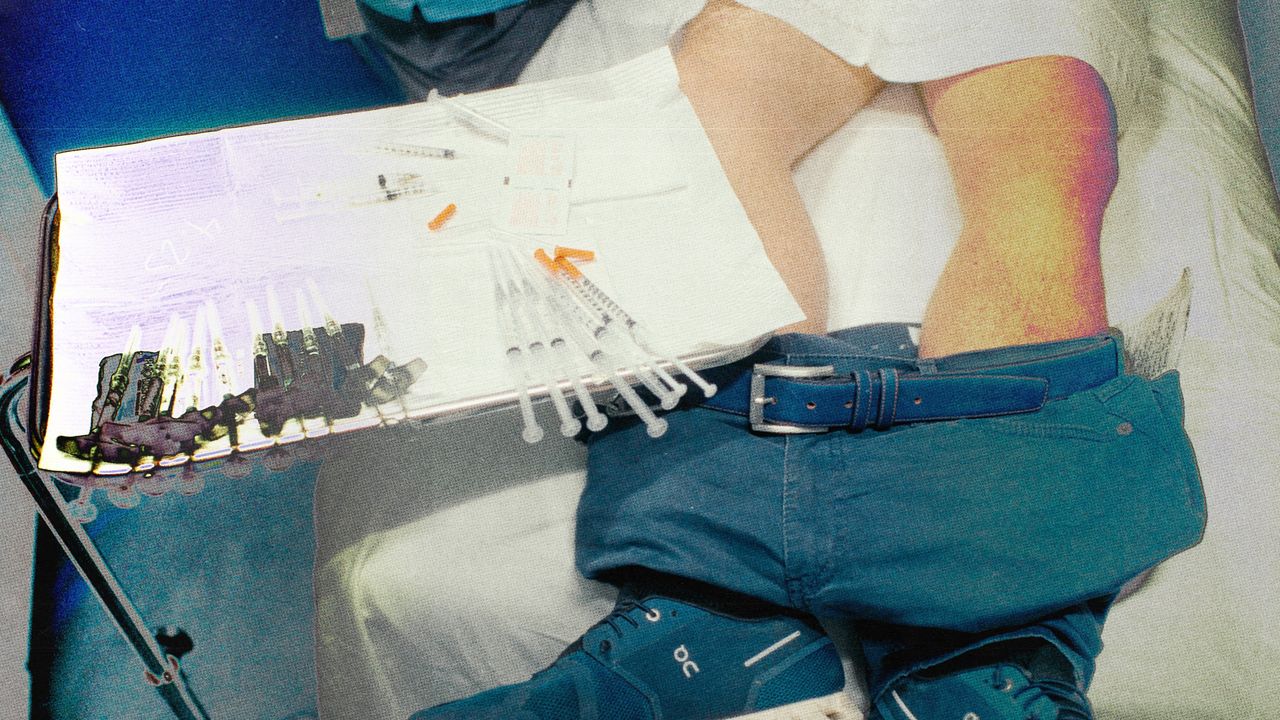
The new documentary Manhood tracks medspa patients—from a gay ex-OnlyFans star to a father of five—in their pursuit for bigger penises. Director Daniel Lombroso shares his theory on what they’re really after.Courtesy of Outerboro FilmsIn Monty Python's The Meaning of Life, Eric Idle sings, “Isn’t it awfully nice to have a penis?”But, according to the new documentary Manhood, the feeling is not universal. In the film men look between their legs with nothing but shame, regret, and self-pity. The subjects members— particularly their perceived smallness—are problems to be solved.Manhood Director Daniel Lombroso. Courtesy of Outerboro FilmsEnter Bill Moore, a Dallas-based medspa operator, whose PhalloFILL penis filler procedure can supposedly add meaningful girth without surgery. The film follows his eager patients, including Ruben, an aspiring comedian and father of five, and David, a gay ex-OnlyFans star whose penis was botched by a previous filler procedure.Director Daniel Lombroso spent years filming Moore and his patients, , slowly building trust until they opened up and (quite literally) bared all to the camera. Watching Manhood, it is clear that getting penis filler is never just about being bigger. To the patients, this procedure represents an escape from middle-aged ennui, a break from a difficult past, or a life preserver for a sinking marriage. The fast-growing, nationwide penis enlargement industry is happy to help, at $6,000 worth of filler injections per dick.GQ sat down with Lombroso, fresh off Manhood’s breakout premiere at SXSW, to find out how he convinced a male enhancement spa to let him film inside, why the penis filler industry is booming, and who’s already getting rich off it. Manhood is available to stream on November 17.GQ: I watched the film last night with my fiancée. She was just cringing the entire time, and we were both wishing we had blinds or something for the window. There’s some pretty gnarly sights in the film, and I’m sure you saw more making it. Are you squeamish?Daniel Lombroso: That’s a great question. I think the most squeamish moment is Ruben bombing at stand-up on stage, more so than the botched penises. But, it’s funny. In real life, I am incredibly squeamish. It’s hard for me to look at surgery. It’s hard for me to look at someone using the bathroom or throwing up. There’s something about when you’re making a film, when you’re behind a lens, it gives you a level of separation. It’s sort of a mediator between you and the world. I shoot a lot of my own work, and on this project I shot some and worked with an incredible cinematographer, Vittoria Campaner. So there’s something about having that intermediary between you and the world that gave me comfort and helped me get through it. The hardest moment was the penile reconstruction, but we did not put most of that in the film.That’s the final surgery?Yeah. David, the person who gets botched, had his penis fully degloved like a banana. They had to peel back the layers and scoop out the permanent dermal filler that’s living in nodes in the shaft of his penis. That was one of the most gruesome experiences of my life. We decided to spare the audience that horror. And David is okay, thank God.You were able to just sit there through that whole surgery and man the camera?It’s tough. That was the toughest one. I also used to work at The New Yorker and I made a film on the Brazilian butt lift, which was similarly gruesome. I mean, that is one of the most gruesome cosmetic surgeries in the world. It’s a fat transfer procedure. They suck out the fat from where you don’t want it, your stomach or your arms, and stick it in where you do want it, your butt.I filmed and watched that, and edited it on my New Yorker computer in The New Yorker newsroom for six months, and I would see David Remnick walk by and be curious and confused, and continue with his day. So it’s not my first time being in those environments, and they are hard for me personally. But something about making a film, it just gives you this level of separation that helps you get through it.I think it’s important for people to be braced with these images. It is shocking to me how difficult it is for people to look at just a regular penis, especially straight men and older straight men. Gen X and above feel like they’re getting hit with an atomic bomb when they see a penis. Younger men, queer men, and women have always been fine, but I cannot tell you how many pitch meetings we went into where, like, the female executives love the film, the queer executives love the film. Then it gets to a straight guy at the top who is hit with one dick, and certainly one botched dick, and is out. Or he has to make sure on the record that everyone knows that he doesn’t have that problem. That happened in quite a few meetings. So I think it’s important to confront people with those images.Your previous documentaries have skewed toward very serious stuff: the alt-right, your grandmother’s experience in the Holocaust. What made you want to do penis enlargement now?My business partner Kerry [Mack] joked that this is the first time I don’t have a Holocaust connection. We were looking for a penis enlargement-to-Holocaust connection, but we couldn’t find one.I started this film three and a half years ago. At the time, we were all inundated with stories about the male loneliness epidemic. It felt almost like a cliché. I know you’ve covered it super well, and I’m sure we both grew up on Vice. It’s also something that’s really hard to show, because you don’t necessarily want to… “Condone” is the wrong word. “Platform” is also the wrong word. I hate when that word is used. But it is a cultural phenomenon that needs to be covered and discussed, and it’s very hard to do it.I couldn’t really find a good way. Around that time, I read about the explosion in penile enhancement, and specifically, penile girth enhancement. I was less interested in penis enlargement than using that as a canvas to explore this burgeoning cultural discussion. So I called, like, every urologist in the country doing versions of it. There’s the Penuma, which is a really gnarly implant.That has some pretty horrible complications that I’ve read about.Yeah, Ava Kofman wrote a great story about the Penuma, which, like, pokes through and makes you bleed. I spoke to the creator of the Penuma. I spoke to people doing more permanent dermal fillers. And all of them were reticent. You know, the way I make films is I embed for many years in these environments. When I made [the alt-right documentary] White Noise, I lived on the road with white nationalists for three or four years. And for this film, I lived in clinics for two years.So I had to find a practitioner who was open. And finally I got to Bill Moore, this very classic American character. He’s a businessman, not a doctor, and he said, “Come on down to Dallas.” So I booked a one-way ticket, and I would just sit in the waiting room and introduce myself to different patients. With a story like this, it’s really the only way. These men are so ashamed, they’re not gonna open up to a random reporter who calls them. So I knew I would have to put in a lot of time. I would just sit there, usually with my camera in a different room, and introduce myself. Sometimes they’d say, “Come back,” some would say no, some would say yes.On those first two shoots, I met a megachurch pastor getting his penis enlarged. He’s very famous, and I cannot say who it is. A border patrol agent in the film. A father of five, an OnlyFans star, someone with brain cancer.The men in this movie are, to put it lightly, extremely exposed. How hard was it to convince them to have that level of access, and to show their life and their bodies in that way?Super hard, and I try to be very patient. You want to push your way in at the right times and with the right people, but this is not the kind of project where you want to be coercive in any way. The last thing you want is someone saying that they were forced to appear naked in a film. So all of these men consented in different forms. Some said, “Change my voice.” Some said, “Anonymize my face.” Some said, “Just shoot my dick.” Some said, “You can shoot my face, but not my dick. I can talk about having a small dick, but don’t show it.”There was kind of every version and permutation. But when I started to look for the main characters who could carry a film, I needed someone who was comfortable with me filming their family. Usually I’m doing vérité, like direct cinema. Really in their lives for at least a year and a half. I feel like this is front of mind for everyone now because of the Lance Oppenheim Nathan Fielder movie [You Can See Everything]. But you need someone who’s willing to invite you into their home and play the game with you, and Bill was willing to do that from the beginning.Ruben was the next person who signed on. He’s a father of five on his second marriage. And it doesn’t go the way he might have hoped. The hardest one, I think, which speaks to your question, was David Smith. David is a pseudonym. He’s an OnlyFans star, and he had never told his story before. You would not know this from watching the film, but it actually took the entire production to get him to show his face. It was such an incredible story. I’ve never heard someone talk so openly about their botched penis and growing up evangelical and the horrors of being a male porn star.We had a very small budget, but we saved a tiny bit of money up until the SXSW deadline. We were about to work with a face replacement company in France because that was his wish, and we thought it spoke to the theme of shame. We were starting to explore, do we hire an actor? And around that time we said, “You know what?” I used to work at The New Yorker, where you don’t really screen things. But I said, “Let’s just take a chance.” So we flew David to New York. We said, “You have no editorial control.” None of the subjects in any of my work ever have any editorial control, including my grandmother. But let’s just show him the film and see what he thinks.And he was so blown away, he cried in the room. He called his brother, and has since opened up to his family about everything. He’s touring with the film. He came to SXSW. That took until literally a week before the premiere at SXSW, and it’s an ongoing process. He continues to become more and more open.So seeing his story on screen gave him the courage to open up and put his face on it?Yeah. I mean, it’s funny. He was a porn star. You’d think that he had such a level of exposure that he would be comfortable with this. But I think this speaks to the film. Somehow talking about your body is easier than talking about your feelings. Having to talk about his shame, his insecurity, his issues with faith, and with his parents is super, super hard for him. He needed to see the final cut to decide to go forward with it. It was the biggest gamble of my career and, thank God, it paid off.It was amazing to see him be so honest about it. Something I’ve found talking to guys in similar situations is that I always expect them to be really nervous. But sometimes, they’re almost relieved to finally get to say these things out loud. They have a really strong desire for this stuff to be out there, and to “normalize” these feelings and these procedures. Did you experience that?That’s a great point. So many of the men—this takes me back now—like, I was more nervous than them. I felt like I was being potentially intrusive. I didn’t want to appear coercive in any way, as I mentioned. I wanted them to feel comfortable. But many of them felt grateful to have what you might call a third space to talk about how they feel, because most of them are not opening up to their partners, believe it or not. I don’t know how they come home with a soup can and explain that. And many of them are paying cash. There’s no credit card transaction fee. Many of them are finding ways to anonymize what they’re doing.Courtesy of Outerboro FilmsBut at the same time, they want to talk to someone about it, which is so strange. They just don’t want the people that are part of their daily life to know, but they want Bill to know, and I think Bill deserves a lotta credit for that. He’s a queer man treating these oftentimes right-wing Texans, holding their dicks and enlarging them and making them feel comfortable.And they wanted to talk to me, and if they wanted it to be off record, that was fine. If they wanted to be on record, that was fine. I think for many of them that was a relief. It’s so common when you work on intense stories that people start to see you as a friend or a collaborator. People see you as someone who understands their plight, and I think whenever I felt like it was starting to get there, I would remind them I’m a journalist. The world is gonna see this. Anything that is private or uncomfortable, just make sure you’re comfortable sharing before it goes in front of the world.They’re happy to be asked. They’re happy someone cared to ask these questions in the first place.These guys feel so alone. Going back to White Noise, my first film, the single biggest motivator for joining those white nationalist movements wasn’t ideological conviction. I mean, some of them are gnarly racists or antisemites, but a lot of them just, like, want to be part of a club. I saw that in a lot of these men too. They just feel isolated. They want someone to talk to, and felt relieved that Bill was there to listen and that I was there to listen.A lot of these guys are doing this without their wives or girlfriends or partners knowing. They believe that their partner is unsatisfied with them as they are and loves their newly-enlarged penis. But as we see in the film, the women in their life are saying, “I don’t understand why you did this. I don’t like it. I find it kinda weird.” How do you explain that kind of cognitive dissonance?I think men, and particularly straight men—I say this as a straight man who probably struggles with this myself—have an underdeveloped sense of self oftentimes.I’ve done these types of stories for ten years now. When I’ve interviewed women or gay men, they’ve had to think about who they are and their place in the world from such a young age. Especially queer men, from their earliest memories or certainly when they started to understand their sexuality, have had to grapple with who they are and how they appear publicly. I think that because there’s this lack of communication or lack of internal dialogue in a lot of these men, they’re internalizing so much constantly, and they’re not reaching out to those around them.The reason I got so excited about Tuben as a character is he felt emblematic of everything we were talking about during Trump’s last re-election. You have the. disaffected conservative man who maybe voted for Trump. He would never tell me. He wouldn’t say whether he did or he didn’t, but he thinks all politicians are corrupt, and he’s living in this world on his phone that goes from Andrew Tate to porn to Nick Fuentes.And, then here comes along a doctor, or not even a doctor, that says, “All of the things that you’re feeling can be fixed with this shot.” If you’re Ruben and you’re already feeling so alone and you haven’t spent your life thinking about who you are and your place in the world, you see a chance to fix all of your problems.And when Ruben and Lana, his partner, had deep conversations, or when Ruben is on stage doing comedy, connecting with an audience, he feels so much better about himself. But then when he’s back to his phone, he’s feeling horribly alone, like he needs to change something. I think that’s something we all feel.Totally.When I’m talking to my fiancée about how I’m nervous about this or that, I feel great. I feel connected. But then I go back to my phone, and I feel like shit again. So yeah, the ones who have those conversations are in a much better place.Something I loved about the characters you focused on in the film is you have almost two poles of the male internet. You’ve got Ruben, who’s straight, middle-aged, into Joe Rogan and the podcasting world and the Texas comedy scene. And you’ve got David, who’s coming from the gay OnlyFans scene. It almost makes it feel universal, like no matter what kind of man you are, this type of insecurity can find you.That was by design. Every kind of man is getting this. Anecdotally speaking, Bill says that about two-thirds of the patients are straight and one-third are queer, which is surprising. Sometimes he even says three-quarters are straight, and anecdotally from my experience, that’s accurate. I’ve seen patients as young as early 20s. I mean, David was in his late teens when he got botched, or maybe right around 20 years old. He’s 24 in the film.Wow, he’s that young?Yeah. I also filmed with men in their 70s. I’ve spoken to practitioners who’ve done penis enlargements for men in their 90s.Men have been trying to enlarge their penis all the way back to the days of the cavemen, as the movie says. But now there’s this extra layer of social pressure, and technology makes it possible. It doesn’t mean that it’s safe, but it makes it possible. Every kind of man is doing this, and I felt like I needed an avatar for both.You have the guy who’s completely seduced by bullshit online. We all know that guy. I have friends I went to college with who are that guy now. Certainly people from high school who are that guy. And then David is a little bit more heartfelt coming from OnlyFans and dealing with the scars of his experience.In the film, it seems like every patient who pursues this has their penis insecurity interwoven with some other huge emotional battle, trauma, or struggle in their life. Did you encounter anyone who was seemingly doing great? Someone with amazing self-esteem, a great life, but who just really needed this procedure for isolated, contained reasons? Or was it always bound up in these bigger questions?There’s always something bigger. No pun intended. I really tried not to be reductive. For Bill, it was a partner who called him a “little dick motherfucker” 15 or 20 years ago, and then he started changing every part of his body. He has fake balls. He has silicone balls. He has his [fake] pecs, all of it. For David, it was growing up evangelical. For Ruben, it was dealing with abuse and being Mexican-American and things like that.But there are ordinary people. Believe it or not, the most ordinary person I met was the megachurch pastor. He claimed he was just doing it for his wife, who he loves very much. I hope that that’s true. But almost everyone else would start that way, and then you know how it goes. It’s the old Errol Morris trick: you just kind of stay quiet and let them continue. Then they’d be like, “Oh, and also it’s this, and that, and this kid who said this fucked up thing to me 15 years ago. And by the way, my wife and I don’t have sex anymore.”A lot of the people in this industry really want this to be “normalized.” They’re constantly talking about bringing awareness to this and eliminating shame from people who want it. They often make the comparison that it’s totally normal for a woman to get a breast augmentation or a BBL, and it should be just as common and accepted for men to get these procedures. Do you feel like that’s an accurate comparison, or is there something unique and singular about these penis enhancements that makes them different?Look at implants. Whenever Dolly Parton got hers, they were sort of the medical frontier. I’m sure whoever was the version of me and you at the time was dealing with the same sort of fun, gonzo stories.And there was probably a Dr. Loria at that time [a penis enlargement provider in the film] who was botching breast implants. It’s a lot safer now, and we know how those work. This is a—maybe unregulated isn’t the right word—but under-regulated frontier. You have people like Dr. Loria operating with impunity in Florida.This is a guy who designs his own proprietary blend of who knows what. He literally will not tell me. It’s some kind of silicone oil. He says he’s “a hobbyist pharmacist,” and he likes to come up with his own proprietary solutions which he creates in Florida at his office. And the results you see in the film are egregious. I have yet to talk to a Loria patient who has had a positive outcome, and he is still practicing in the state of Florida.The movie intentionally tries to leave that in a gray zone. But even the better technologies like hyaluronic acid, which is lip filler, the FDA has never said that you can inject that into someone’s dick. [But] it hasn’t said you can’t. It’s fine for off-label use. It’s all sort of the Wild West right now, and I think people don’t realize that the American medical system has all these gray areas and openings.Bill is not a doctor. He just has to be under the supervision of a doctor, meaning a doctor came to his facility at some point and sanctioned it. Where I see the trouble is that all of these urologists who are trained to do really important medical procedures, like someone struggling with ED or who has issues after prostate cancer, they see a way to make money doing this. I saw literally dozens of urologists flock to Bill because they realize they can make a few thousand dollars in twenty minutes doing penile enhancement. Is that what they should be doing with their time? Probably not. Is that a way that they can make a lot of money? Certainly.You see Bill on his boat and with the Aston Martin, and business looks good for him.Business looks good. And sorry, one last point is that the penis is different also because it’s invisible. Men already don’t talk about their feelings, as you and I know. But other types of female work are visible. The media has been objectifying women from the beginning of time.This is something that almost feels personal to men. They’re not telling their partners. Many of them say they’re doing it for themselves. Some of them literally tell me they just want it to poke bigger through their pants at the gym, or they want to show it off in the locker room. So it’s a personal choice, I think, in a way that I’m skeptical of, that’s also different from other medical procedures or kinds of plastic surgery.Every man is a universe within himself. If a close friend of yours confided in you that they were experiencing these thoughts and considering this type of procedure, what would you tell them?[long breath]I don’t know if you can put “long breath” in the transcript, but… I believe in a kind of documentary filmmaking that doesn’t impose a takeaway. I think we now live in this streamer era where movies are designed to be “two screen” documentaries. It’s a Netflix term, where you can fold laundry [while watching], and they tell you every third of the movie what it’s about and what the takeaway is. The movie is not pro-penis enlargement. It’s not anti-penis enlargement. It’s using that as a canvas to explore all of these things and I think that’s where I like to start. That said, I would not recommend my friends do it. Bill tried to get me to do it, by the way.Whoa.Many times. And I am willing to do anything for my stories, like be in bed with Nazis for years or whatever the fuck. I was not willing to do that. The simple fact is that this is a medical gray area. No one knows how safe it is. Filler migrates, and the problem is in your penis.Whoever that friend is, I would be like, “What issue are you having in your marriage, with your kids, with your self-esteem, with your body?” And I would really welcome the chance to get close to that friend again, you know? As you get older, people are around less, people have kids, people are also more isolated. They’re in their family. And those moments actually can lead to incredible breakthroughs when your friend is like, “I’m scared that my dick is not good enough.”I would have just been gifted with the most exciting conversation that I’ve had in months, and I would welcome that. We would go on a hike, or have a beer, and talk about why he doesn’t like his dick. I think we as a society would be better if we did that more often.Not a subscriber? Join GQ to receive full access to GQ.com.Charlie Sosnick is a freelance writer based in New York, covering internet subcultures, men’s health, and food. He has self-published three books and written three short films. ... Read More
More Men Are Getting Penis Filler Than You Think
Full Article
Original Source
Read the full article at Gq →KhanList aggregates and links to publicly available news content. We do not host full articles from third-party sources. Always verify important information with original sources.