
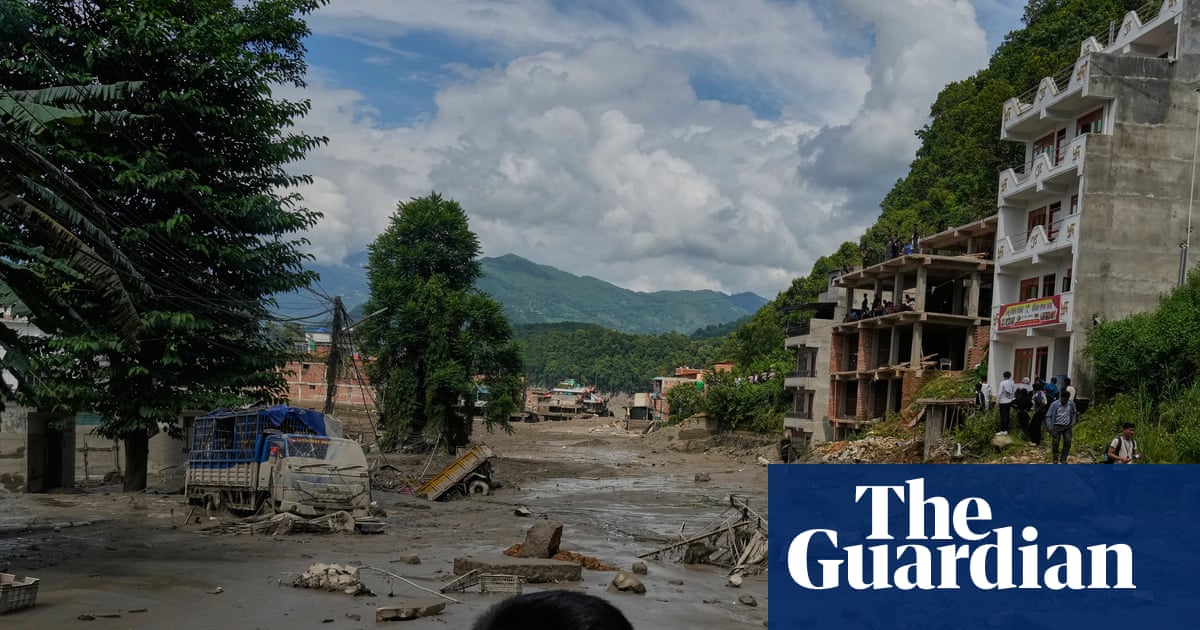
Good morning. Over the weekend, rescue workers in Nepal and Tibet raced to find people who are still trapped in villages affected by catastrophic flash floods. As of this morning, the death toll stands at 903, and more than 4,000 people are missing.For those of you reading this in a place where life continues as usual, the scale of devastation is hard to fathom. In a matter of minutes, a torrent of mud and debris engulfed entire villages, snapped bridges and swept away people’s homes and families. Some survivors are marooned on top of buildings that rescue workers can’t reach. Others are trapped in tunnels beneath the ground. Many have no idea if their loved ones are still alive.The floods exemplify a wider threat. The delicate processes that have shaped our climate for centuries are unwinding at a terrifying pace. Scientists are still investigating the precise sequence of events that caused these floods, but as the planet heats up and glaciers melt, events like this will keep happening.The Guardian has been covering the floods extensively – you can read our visual guide to the disaster, and our latest report on it here. For this morning’s newsletter, I spoke to our south Asia correspondent Hannah Ellis-Petersen, who is on the ground in Kathmandu. She’s been speaking to survivors and reporting on the rescue operation since Thursday. That’s after the headlines.Weekend roundup UK politics | PC Andrew Harper’s killers will remain in prison after Andy Burnham announced changes to the early release scheme that will see anyone convicted of unlawful killing, including all forms of manslaughter, excluded from the scheme. Milo Yiannopoulos | Far-right British media provocateur Milo Yiannopoulos has been deported from the US back to the UK by Immigration and Customs Enforcement (ICE) in connection with what the agency said was expired authorisation to be in the country. US-Iran | Iran has launched retaliatory strikes on airbases in Jordan after the United States attacked Iranian rocket launchers on an island in the strait of Hormuz, the first such strikes in a month. Iceland | In a blow to Brussels, Iceland has held a referendum that has narrowly rejected the government’s proposal to hold accession talks with the EU. Nepal-Tibet disaster | A headteacher in Nepal evacuated 900 children from a school moments before a deadly wall of water struck their town amid the devastating flash floods that have killed almost 800 people and left thousands missing. In depth: An ‘absolute catastrophe’‘Everything was either submerged in mud, or mangled’ Photograph: cnsphoto/ReutersAt 8:37am on Wednesday morning, an enormous chunk of ice from a glacier in the Himalayas broke off and crashed on to a mountain near the border between Nepal and Tibet. It caused a fearsome avalanche of ice and rock, which surged downstream into the Bhotekoshi and Trishuli rivers, submerging villages and sweeping roads away.At first, the scale of damage was unclear. Nepal is prone to natural disasters, and many of the villages affected by these floods are extremely remote. Early satellite images of the region were obscured by thick clouds of dust, and scientists initially assumed that an earthquake must have caused the flood, rather than a glacier collapse. By Wednesday night, as more images and reports emerged, it became clear that the floods were an “absolute catastrophe,” Hannah says. On Thursday, she boarded a flight to Kathmandu, the capital city near the destruction.When Hannah arrived in Bidur, a small city two hours from Kathmandu, on Friday morning, most of its buildings had been destroyed, their carcasses exposed like matchsticks. A team of rescue workers in yellow hard hats were working to clear the roads. “There was a bank, an ATM machine, and a truck that was lying on its side,” she says. “Everything else was either submerged in mud, or mangled.”The race to save livesThe Nepali army has been organising the rescue operation from a military base in Bidur. Large sections of the road that links Bidur to villages higher in the valley have been washed away, so rescues are happening by air, and the sound of helicopters is nearly constant. Every two to three minutes, a chopper lands, deposits survivors, and sets off again. The mud is so thick in some places that helicopters have struggled to land. Rasuwa, an area where entire villages were destroyed, was still inaccessible when I spoke to Hannah on Sunday afternoon. “The ground zero of the floods has still not been reached by journalists, and is only just being reached by the army,” she says.Hundreds, if not thousands, of people have been rescued, and hundreds of people are now waiting outside the army base in Bidur scanning lists of survivors posted on the walls. At hospitals in Kathmandu, health workers have put up photos of bodies that are so disfigured their families have struggled to identify them. Authorities have begun burying human remains because there isn’t enough mortuary space to prevent them from decomposing. “I’ve spoken to people who have up to 12 relatives who have gone missing,” says Hannah, who visited hospitals in Kathmandu on Saturday. “And there’s no phone signal in the more remote villages. So another big cause of suffering is this huge uncertainty.”Thousands still missingSo far there are 4,247 people who are missing, according to Nepal’s disaster agency (592 of whom are foreigners, including 43 Australians, and 48 from the UK, including 15 reported missing in China). Among them are 933 workers from Nepal and neighbouring countries who were working on hydroelectric power projects along the river. These rely on vast tunnel systems that are built deep into the ground, and rescue teams have to dig through mud and bore through tunnel walls to extricate trapped workers. On Saturday, the Nepali army had a small breakthrough when it successfully inserted a pipe into a tunnel at a hydroelectric site in Trishuli, allowing air to be pumped into the tunnel. In the early hours this morning, rescue efforts were “intensified” at the site, with a team of 90 people deployed.The army is racing against time to rescue the living. “People are stuck in areas that have no drinking water, or access to food. They’re completely cut off,” Hannah says. The picture of devastation has emerged more quickly in Nepal than in Tibet, where the Chinese government retains a tight grip on information. On Friday, as the official death toll in Nepal rose to 538 people, China estimated that just five people had died in Tibet. The Chinese authorities have since revised their numbers, and estimate that at least 16 people are dead and 546 missing.The long road to recoveryIt will take months to clear away the mud, and some people will never find their relatives’ bodies. Some were pushed so far down the river that they have washed up in India. “People have lost everything,” says Hannah. “I saw one woman clutching a bottle of cooking oil, because it’s the only thing she had left.” Climate stories in the global south often struggle to break through, so it’s encouraging that these floods have been covered so widely. But when the news cycle has moved on, Nepal will be left with the enormous task of rebuilding. It estimates that cost could be between $4bn to $5bn, almost a tenth of its economy.“It’s getting increasingly difficult for Nepal to pick itself up,” Hannah tells me. In Kathmandu, buildings destroyed by the 2015 earthquake, which killed nearly 9,000 people, are still in ruins. The EU has committed €2m to Nepal to help with the floods, and Britain has committed £5m. There’s also been a lot of focus on the need for better early monitoring systems. All of this matters. But as Sunil Acharya, a climate policy specialist based in Kathmandu, wrote in this interesting Opinion column, it also obscures a more fundamental problem: systems to monitor these events were designed for yesterday’s risks, not today’s extremes. Nepal’s warning systems were destroyed before they could alert people near the source of the flood.Looming over all this is the fact that nations like Nepal, which has contributed a minuscule amount to historic greenhouse gas emissions, will suffer the worst effects of the climate crisis. It needs far more assistance to cope with the consequences of richer nations’ actions. And it needs those nations to rapidly cut their emissions, before the crisis gets worse.The week to come Tuesday | Justice secretary Alex Norris is due to present the government’s revised plans for the prisoner early release scheme, which includes a headroom review aimed at freeing up more space in the system. Thursday | In the first UK visit by an EU leader of Andy Burnham’s tenure, the prime minister is will host talks with French president Emmanuel Macron. Saturday | Officials from Jamaica will visit the UK to lodge a petition with King Charles to seek legal guidance from the privy council on the country’s request for reparations over Britain’s involvement in the slave trade, on the anniversary of the 1781 Zong slave ship departure from West Africa. What else we’ve been enjoying‘I’ve had a very hectic career’ … Mario Balotelli on his football career. Photograph: Luca Bruno/AP After 15 years of headlines, it’s hard to say anything new about the trials and tribulations of Mario Balotelli. But Emanuele Giulianelli’s excellent interview with the controversial star brings it all to life again. Dipo Faloyin, newsletters team The worst place to be in England is “left behind”. I enjoyed this thoughtful column from John Harris on the places Andy Burnham’s devolution agenda risks leaving out. Hettie I’ve really enjoyed learning in the past week about the impact Dolly Parton’s Imagination Library. Esther Addley warmly remembers the time Parton came to Rotherham for the UK launch of the project. Dipo skip past newsletter promotionafter newsletter promotionSportOllie Robinson of England celebrates taking the wicket of Azan Awais of Pakistan. Photograph: Tom Jenkins/The GuardianCricket | Joe Root has called on his players to “celebrate in a sensible, grown‑up way” after they secured a first multi‑game series win since 2024 by beating Pakistan at Lord’s to take a 2-0 lead with one to play.Football | Cole Palmer eventually made the home win safe after Brighton rallied from 3-0 down, with João Pedro scoring at both ends.Cricket | Yorkshire have been cleared by the Cricket Regulator after a formal investigation into a £1.75m payment the county made to a company controlled by the club’s chief executive, Sanjay Patel, for the sale of the Northern Superchargers Hundred franchise.The front pages Photograph: The Guardian“Burnham keeps PC’s killers in jail but fears grow over prison capacity”, is the Guardian’s front page today, while the Mirror writes “Killers told: You’ll do your time”. The Times writes “Early release blocked for manslaughter prisoners”, while the Mail’s take is “More dangerous criminals set to be freed early”, and the Telegraph says “Burnham to free high-risk criminals”.The i Paper splashes “Harry should pay for security costs in UK, say two-thirds of public in poll”, the Express leads with “‘I fear Andrew’s staff won’t co-operate with police’”, and the FT has “Big Tech profits enjoy $160bn paper boost from stakes in other AI groups”. The Sun’s headline is “United for dad”.Today in Focus Photograph: The GuardianBlack Box: episode 6 – Shut it down?For decades, Eliezer Yudkowsky has been trying to warn the world about the dangers of AI. Now people are finally listening to him, but is it too late? Guardian journalist Michael Safi looks into the world of artificial intelligence, exploring the dangers and promises it holds for society.Cartoon of the day | Tom Gauld Illustration: Tom GauldThe UpsideA bit of good news to remind you that the world’s not all badThe number of people living with dementia around the world is forecast to nearly triple to 153 million by 2050. Photograph: Joe Giddens/PAResults from a 15-year study suggest that statins, the cholesterol-busting drugs, can lower the risk of dementia by 15%. In the largest study of its kind, researchers tracked more than 132,000 people in Denmark between 2006 and 2021. Those who started on statins during the study period were 10% less likely to develop dementia. Those taking them early reduced their risk by 15%. The results were similar in women and men. The number of people living with dementia globally is forecast to nearly triple to 153 million by 2050. But, experts believe almost half of dementia cases could be prevented or delayed.Sign up here for a weekly roundup of The Upside, sent to you every SundayBored at work?And finally, the Guardian’s puzzles are here to keep you entertained throughout the day. Until tomorrow. Quick crossword Cryptic crossword Wordiply
Monday briefing: Nepal and Tibet’s floods are a warning for the future
Full Article
Original Source
Read the full article at Theguardian →KhanList aggregates and links to publicly available news content. We do not host full articles from third-party sources. Always verify important information with original sources.