
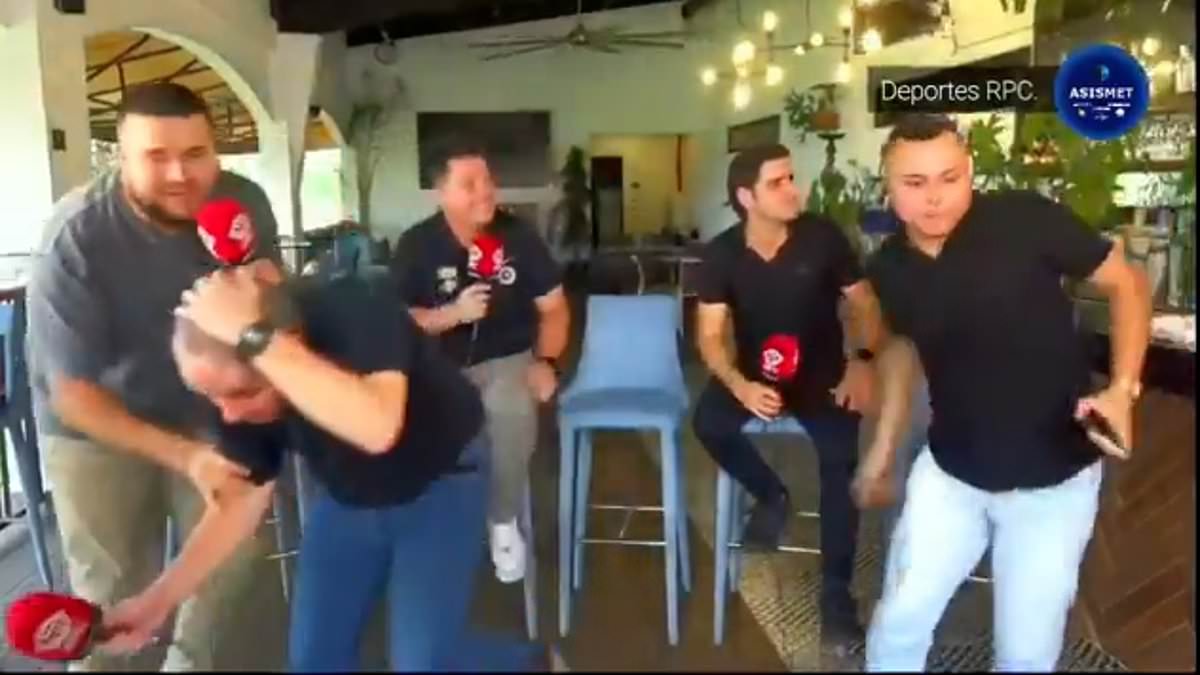
Sports broadcasters were forced to drop their microphones and run for safety while live on TV, as a huge 7.7-magnitude earthquake struck Panama. The powerful earthquake hit the region on Friday at around 1pm local time, sending tremors across the southern coast of the Central American nation and more than 80 aftershocks. It struck the small town of Pitaloza Arriba in the central Herrera province and had a depth of 10km. The US Tsunami warning system issued alerts for the eastern Pacific, including Mexico and Chile, but these have since been lifted. There have been no reports of fatalities, but at least two people have been injured. A video captured the moment sports broadcasters were forced to flee as the earthquake shook the entire building they were inside and eventually cut off the lights. The five male presenters initially look at each other, confused as the walls and light fixtures behind them visibly start to shake. But as the tremors continued and became more aggressive, some quickly put down their microphones, others simply taking the equipment with them, and jumped up to get out of the building to safety. Five sports broadcasters were sat on stools live on TV when a 7.7-magnitude earthquake struck They were seen looking puzzled and confused as the walls and light fittings began to shake and sway aggressively Within minutes, they had fled with their microphones to safety The US Geological Survey initially estimated it to be a magnitude-8.0 quake before revising it down to 7.7. The powerful earthquake collapsed buildings and roads in the centre of the country yesterday, with the shallow tremor felt across the Central American nation of around 4.5million people, according to the National Civil Protection System. The head of emergency operations Rene Garcia said that there had been no reports of fatalities so far. In Panama City, about 200km from the epicentre, there were scenes of panic as people rushed to evacuate from the city's emblematic skyscrapers. Salomon Andion, 46, had to evacuate his 15-storey building for the second time following aftershocks. He said: 'I was scared because the shaking was very strong and prolonged. 'Heavy objects like dressers, the bed, and all the kitchen items were shaking.' One video shared widely on social media showed water falling from the rooftop pool of a building more than 20 stories tall. Cars were trapped underneath the rubble as the 7.7-magnitude earthquake struck the city of Penonome St John the Baptist Cathedral in Penonome was severely damaged during the tremours Another showed a bridge over the Panama Canal shaking violently, but remaining upright as vehicles travelled across it. Panama's President Jose Raul Mulino said: 'We are facing a major disaster,' adding that some roads had 'completely collapsed.' Juana Alveo, a 38-year-old cashier at a store in the city of Penonome in central Cocle province, said: 'It was horrible, like nothing we ever experienced. My daughter was trapped in school.' The two injuries were reported by people trapped in different collapsed structures - one near a church in Veraguas, the other in a collapsed hotel in Cocle, authorities said. US Secretary of State Marco Rubio wrote on X on Friday that he was 'closely monitoring' the situation, with his office 'rapidly mobilizing resources and personnel to assist,' at the Panamanian government's request. The Panama Canal Authority said shipping through the channel, which connects the Pacific and Atlantic oceans, was unaffected and operating 'as normal'. Mulino travelled to Penonome to coordinate the disaster response. Health Minister Fernando Boyd said that the most affected areas were the provinces of Herrera and Cocle, as well as Los Santos. Rubble from the damaged buildings blocked roads in Panama after Friday's earthquake One building entirely collapsed on one side, leaving cars buried beneath the debris He said the town of Tonosi in Los Santos was completely cut off, adding: 'We are trying to figure out how to get there by air, because it's impossible by land.' Panama City's international airport, a major hub for the region, was temporarily closed. Several flights were diverted to other airports as a precaution, according to the Civil Aeronautics Authority. The leaders of Colombia, Ecuador and Guatemala all sent messages of solidarity and offers of aid. Earthquakes are rare in Panama and usually occur in the western Chiriqui province, bordering Costa Rica. Former president Ricardo Martinelli posted pictures on Instagram of his house in the town of Sona in Veraguas province, which had completely collapsed. A church and a hotel in Penonome also suffered extensive damage, images shared on local media showed. More than 80 aftershocks, one above magnitude 6.0, were recorded by the local geosciences institute. President Mulino called for calm, posting on X: 'What happened should not be used to generate alarm and disorder,' adding that he had called for a report on the damage. The education ministry announced the suspension of classes in schools nationwide. The Panamanian quake is at least the fourth quake this year in Latin America surpassing 7.0 in magnitude, after devastating back-to-back earthquakes in Venezuela's Guaira in June and a powerful earthquake in western Colombia in August.
Moment sports broadcasters flee on live TV broadcast as 7.7-magnitude earthquake hits Panama
Full Article
Original Source
Read the full article at Dailymail →KhanList aggregates and links to publicly available news content. We do not host full articles from third-party sources. Always verify important information with original sources.