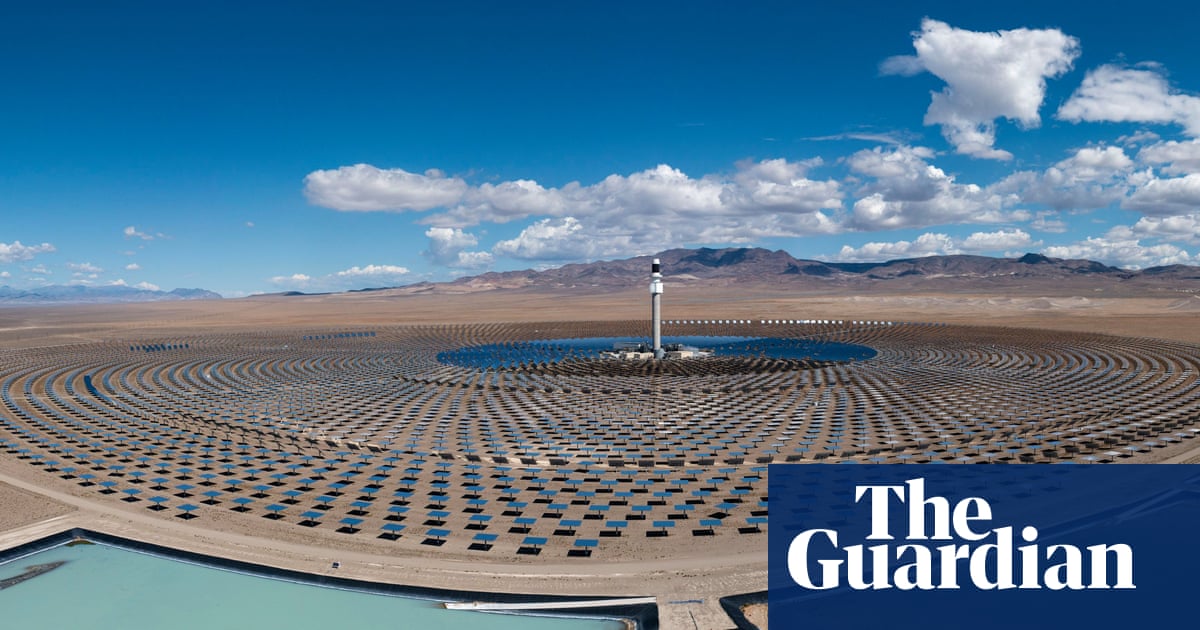
In the deserts of the United Arab Emirates a sprawling clean energy project, stretching across an area roughly the size of 12,600 football fields, will play host to a breakthrough allowing solar energy to power the equivalent of half a million homes through the night.The Gulf state has been steadily combining 5.2GW of solar power capacity with 19GWh of battery storage to create the largest battery scheme in the world.Meanwhile, about 7,500 miles away, at the US’s National Renewable Energy Laboratory facility in Colorado, researchers and engineers are making some of the smallest batteries the world has ever seen. A fraction of the size of the grid-scale lithium-ion batteries used to store renewable energy, they have been designed to power electronic tags that will track the 3in-long (about 7.5cm) young from salmon and eel species.As traditional lithium-ion batteries push boundaries in size and scale, alternative battery types could provide the same vital role in harnessing low-carbon energy – but without the scramble for critical minerals such as lithium, cobalt and nickel that have raised concerns for environmental protection and vulnerable communities.The Polar Night ‘sand battery’ in Pornainen, Finland, can cover almost a month of the small town’s heating demands in summer and nearly a week’s in winter, cutting oil use by storing energy as heat. Photograph: Polar Night EnergyUnlike lithium-ion batteries, which have a finite number of charge/discharge cycles, many of these alternative battery technologies can be used indefinitely and recycled when the units reach the end of their 20-year service life.Already developers are turning to a large range of materials to store renewable electricity when it is available and use it to power everything from wearable technology to heating networks, factories and missiles.Here are some of the energy storage innovations raising eyebrows.Liquid airLate last year, on the site of a former coal plant in Trafford, the former mayor of Greater Manchester marked the start of construction on a long-awaited energy storage project that could usher in the “re‑industrialisation” of the county.Andy Burnham said the development of the Trafford green cluster, which includes the Carrington “liquid air” cryobattery, could mean “this decade is the most exciting since the Victorian period for Greater Manchester”.In simple terms the Carrington project, developed by the British startup Highview Power, aims to capture renewable energy when it’s abundant and store it as liquid air. In theory, a “cryobattery” can store energy for hours, days or even weeks.The science is more complicated: Carrington uses surplus renewables to cool air to -196C, which reduces it to a liquid one-700th of the volume. It can be kept in this state until renewable energy is scarce and market prices begin to rise. Then the liquid is allowed to become a gas once again, rapidly expanding through a turbine that generates electricity without the emissions typically associated with gas-fired power plants.The project has faced a number of delays but once it begins operations, slated for the end of the year, it will deliver 300MWh of storage and an output of 50MW for six hours – or enough clean, renewable energy to power almost half a million homes.Andy Burnham (third from right) said the Trafford green cluster could make this decade ‘the most exciting since the Victorian period for Greater Manchester’. Photograph: Highview PowerMolten saltWhile in Manchester energy is being stored at sub-zero temperatures, in the Nevada desert the opposite approach has been taken.Here, 10,000 panes generate electricity for the Crescent Dunes scheme, which for the past 10 years has harnessed the sun’s power to heat a reservoir of potassium and sodium nitrate to 560C.This temperature can be maintained for 10 hours after the sun has set, before the stored thermal energy can be converted into electricity by using the heat to drive a traditional spinning turbine. The system effectively stores clean electricity as heat in a process known as molten salt storage.These molten salt batteries provide the primary power sources for most modern guided missiles and nuclear weapons by acting as “reserve batteries” that hold energy until the pyrotechnic heat generated when the weapon is launched activates the release of energy.skip past newsletter promotionafter newsletter promotionAt the Crescent Dunes project in Tonopah, Nevada, molten salt is heated to generate electricity. Photograph: Jim West/UCG/Universal Images Group/Getty ImagesIn the 2020s Denmark proved molten salt storage technology could provide an answer to the dilemma of decarbonising heavy industry, too. The leading wind power nation unveiled a 1GWh large-scale molten salt battery project earlier this year, which can store clean electricity for up to two weeks by heating the salts to approximately 600C. When needed, the hot salt is circulated through a generator that produces high-temperature steam that can be used directly in industrial processes.SandMuch like renewable electricity can be stored by heating salt, clean energy can be stored in sand.In the small town of Pornainen in southern Finland, thousands of tonnes of sand help store energy used to heat schools, libraries and town halls. This should allow the district to end the use of oil in its local heating network completely and reduce the use of wood chips by about 60%.The sand battery uses about 2,000 tonnes of crushed soapstone to store clean energy in the form of heat to provide 1MW of thermal power and a storage capacity of 100MWh.In summer, the sand battery, which stands about 13 metres tall and 15 metres wide (43ft x 49ft), can cover almost a month’s heat demand in Pornainen – and in winter, close to a week. It is about 10 times larger than an earlier version launched in the country in 2022, underscoring the potential of sand batteries to play a greater role in cutting emissions across the country.In Pornainen, Finland, 2,000 tonnes of crushed soapstone is being used to store clean energy in the form of heat. Photograph: Polar Night EnergySweat techIn Japan, researchers at the Tokyo University of Science are investigating how human sweat could be a viable energy source to power wearable technologies.By treating the body as an energy source capable of providing continuous power, the researchers hope to solve the problem of how to fuel the sensors that underpin wearable devices without tiny batteries that make them bulky and need constant charging.In response they have developed a thin wearable patch that generates electricity directly from human sweat. It uses an enzymatic biofuel cell to capture the chemical compounds – especially lactate – released in sweat and convert them into power. When sweat comes into contact with the cell, the enzymes embedded in the patch trigger a biochemical reaction, releasing electrons.This means electricity can be generated without the need for any external power source – during everyday activities such as walking, exercising or running errands.
Molten salt and human sweat: the weird batteries that could store renewable energy
Full Article
📰 Original Source
Read full article at Theguardian →KhanList aggregates and links to publicly available news content. We do not host full articles from third-party sources. Always verify important information with original sources.