
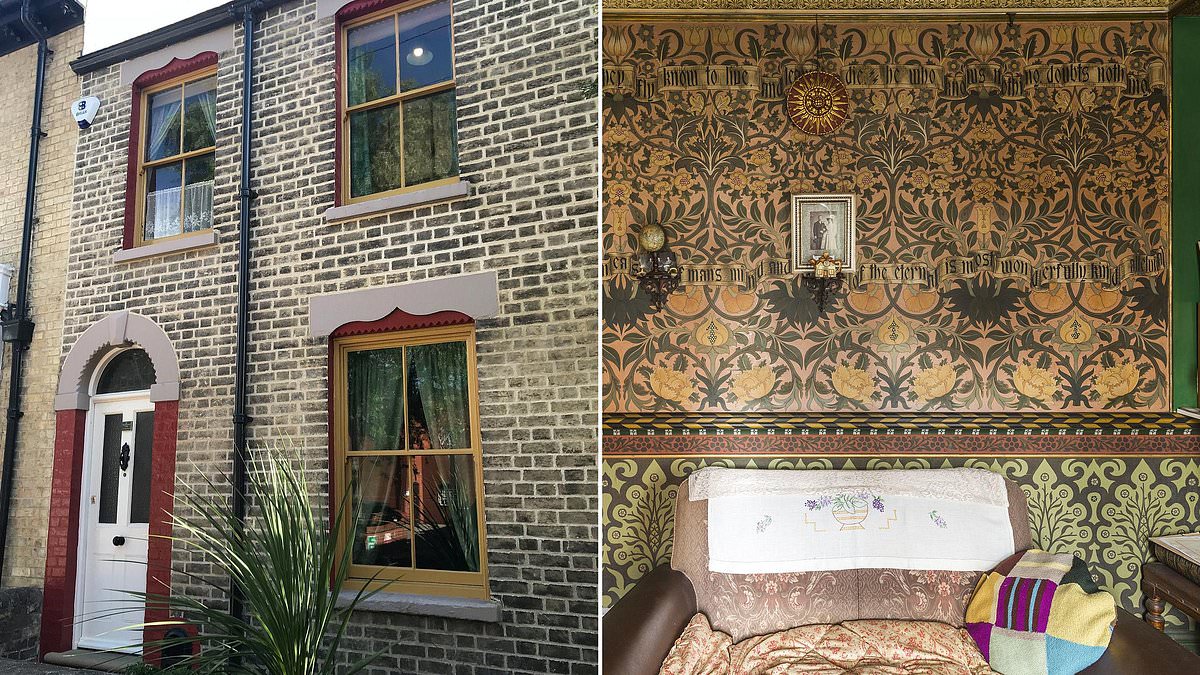
Published: 09:00 EST, 23 November 2026 | Updated: 09:00 EST, 23 November 2026 While time transformed the face of many things over the past century, one unassuming two-bedroom terraced house in Cambridge stood still. Once belonging to the working-class labourer David Parr, the home has remained an artsy time capsule of a colourful Victorian era – adorned with the intricate patterns and resplendent designs that kept the devoted workman up through the night in candlelight to create over four decades. Meanwhile, Parr's days were spent decorating the mansions of his elite clients in Cambridge with William Morris's popular designs. But while Morris's wallpaper became enshrined in history, Parr's patterns fell into obscurity, for more than 80 years after his death in 1927. After his achievements were preserved for nearly a century by his granddaughter, Parr is finally receiving recognition as he becomes the first working-class Victorian art-workman to be awarded a blue plaque. Director of the David Parr House & Gallery Charity Annabelle Campbell said: 'The plaque recognises the importance of the art-workman within the successful Victorian decorative arts economy. Decorator David Parr is to be the first ever working-class Victorian art workman to be honoured with a blue plaque at his home at 186 Gwydir Street, Cambridge The interiors are adorned with patterns and colours in the style of William Morris David Parr worked tirelessly on his two-bedroom terraced home from 1886 until his death in 1927 A fireplace in St Mary's Passage, Camrbridge, the workshop of David Parr, the Vcitorian designer and decorator who transformed the mansions of the wealthy 'It also recognises the vision and aspiration of a working-class family man.' She added: 'The Victorians used the term 'art-workman' for the skilled painters, carvers and craftsmen who turned designers' ideas into finished work, usually as employees of a decorating firm.'Their work demanded greater accuracy and artistry, yet they sat at the bottom of a hierarchy of client, designer and firm, and were rarely named.' Parr bought his two-bedroom terraced home at 186 Gwydir Street in the city in 1886 and worked on it tirelessly until his death in 1927. Parr, who together with his wife Mary Jane raised their three children Mary, David and Sarah at their house, kept a notebook in which he recorded the transformation of the house.Alongside the painted decoration, items of joinery designed and built by Parr also survive, alongside the original curtain rails, the late 19th century toilet and the 1920s oven, which provide an almost complete picture of a house of this period.The plaque will be unveiled on February 8, 2027 on the anniversary of the day Parr signed the mortgage of his home. The David Parr House & Gallery Charity acquired the house following his granddaughter Elise Palmer's death, and it opened to the public in 2019. Inside, 19th- and 20th-century decorations are preserved alongside Elise's items to give the house a homely feel. Parr's craftsmanship and artistry were recognised in 2020 as Historic England awarded the building a Grade II* listing Parr painstakingly recreated some of the designs he had been using during his day job as decorator to the rich and famous David Parr was a working-class Victorian decorator in Cambridge who took his work home with him – and created a masterpiece of his own to live in No part of the house is undecorated, with the artistry of Parr evident throughout the two-bedroom property Ms Campbell said: 'David Parr's life was transformed by his apprenticeship and the varied and significant opportunities it opened up. 'As a highly skilled art-workman employed by FR Leach & Sons, he was one of a class of unnamed workers who brought to reality the designs and schemes of the great figures of the Arts and Crafts movement, most notably William Morris and George Bodley.' The Gwydir Street home's blue plaque follows its recognition of excellence by Historic England which awarded the building a Grade II* listing in 2020. The David Parr House & Gallery Charity is in the process of crowdfunding £6,000 to pay for a ceramic plaque to be made by a local artist as well as a short film which documents its creation. David Parr: Victorian decorator paid a pittance to transform the interiors of lavish mansions he could but only dream of living in David Parr (pictured) decorated houses and colleges around Cambridge and used his expertise and knowledge to decorate his own home with minute detailDavid Parr was a working-class Victorian decorator in Cambridge who took his work home with him – and created a masterpiece of his own to live in.Decorators of that era were often paid a pittance to design and decorate interiors and exteriors of private mansions of the rich and famous and Cambridge colleges.After completing his day job, Parr would return to his humble two-bedroom terraced house and work tirelessly into the night by candlelight to decorate it.It took him 40 years to painstakingly decorate the walls and ceilings with scrupulous detail.He turned his own home into a masterpiece with all the craftmanship and artistry he had acquired through his employment.Parr kept a notebook in which he meticulously wrote down the cost of materials, how long it took him to complete each task and how much it would have cost in labour.According to the notebook some jobs took him as much as 85 hours and others more than 30 years.He was a great fan of Morris's patterns and used some of them to design his own home. The Cambridge house was bought by Parr in 1886 and he didn’t stop working on it until his death in 1927. His granddaughter Elsie Palmer lived at the house for 85 years soon after his death and left it largely unchanged.
Modest terraced home of Victorian labourer David Parr who secretly covered its walls with stunning William Morris designs is awarded blue plaque
Full Article
Original Source
Read the full article at Dailymail →KhanList aggregates and links to publicly available news content. We do not host full articles from third-party sources. Always verify important information with original sources.