
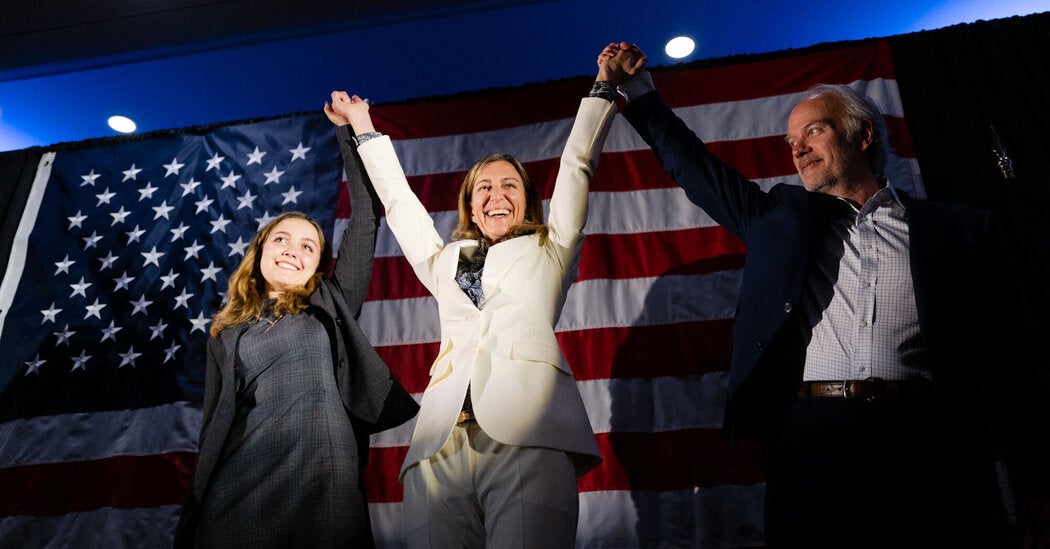
AdvertisementSKIP ADVERTISEMENTVictories by moderates in competitive or Republican-leaning states and districts paved the way for large new Democratic majorities likely to be shaped by their priorities.Elaine Luria, a moderate Democrat, reclaimed a House seat in Virginia that she lost four years ago.Credit...Quinn Glabicki/The New York TimesNov. 4, 2026, 8:32 p.m. ETFor much of the midterm campaign, progressive Democratic insurgents commanded the spotlight in the fight to wrest control of Congress, defeating establishment incumbents in primaries, drawing enthusiastic crowds and promising to reorder their party’s priorities and remake American politics once they got to Washington.But the path to Democrats’ sweeping victory this week, when they seized control of both chambers of Congress, was paved overwhelmingly by moderates who had spent months persuading voters in Republican-leaning states and competitive congressional districts that they could be trusted to govern and would deliver dissatisfied voters a practical alternative to President Trump.Their success has fundamentally altered the balance of power among Democrats in Congress, handing Representative Hakeem Jeffries, the presumptive next speaker, and Senator Chuck Schumer, the would-be majority leader — both New York moderates viewed with disdain by the left — majorities built around lawmakers who campaigned not as left-wing heroes but as pragmatic populists. They promised to lower costs, improve health care and restore trust in government, not necessarily to deliver the sweeping transformations championed by the party’s ascendant liberals.For Mr. Jeffries, himself a centrist who has long balanced competing factions of his caucus, the arrival of more moderate Democrats could strengthen his hand in setting an agenda focused on economic relief and achievable legislative victories. But it also sets up a potential confrontation with progressives who helped energize the party’s base and now expect their own priorities to be reflected in the new majority’s agenda.“It is clear that it is moderates in these swing districts who flipped the House, who put the gavel in the hand of every committee chair and the speaker,” Elaine Luria, one such Democrat who reclaimed a House seat in Virginia that she lost four years ago, said in an interview.The scale of moderate gains was reflected in the growing ranks of the centrist groups on Capitol Hill. The Blue Dog Coalition, a caucus of moderate and conservative Democrats in the House, announced on Wednesday that it had added at least 14 to its ranks, nearly doubling in size, and other centrist groups including the New Democrats and Problem Solvers strengthened their numbers substantially.Many of their newly elected members have already made clear that they expect Democrats to pursue achievable results rather than sweeping ideological ambitions. And given the scope of Democrats’ majority in the House, the relatively smaller bloc of left-wing members may be limited in its ability to insist that its priorities be met.“We’ve got to do things incrementally,” said Rebecca Cooke, the self-described moderate who defeated Representative Derrick Van Orden in what was a Republican district in western Wisconsin. Rather than pursuing Medicare for All, she called for a more modest expansion to cover vision, dental and hearing, as well as the restoration of Affordable Care Act subsidies that Republicans allowed to expire at the end of last year.“We have to show that when people vote for Democrats, they can feel it in their bones and feel it in their pocketbooks that things have changed,” Ms. Cooke said in an interview. And she called for prioritizing cost-of-living relief over aggressive investigations of the president and his team.“Accountability for this administration can come later,” she said. “We have to focus on delivering for the American people right away.”In the Senate, where Mr. Schumer’s fate has been an open question, he will continue to face pressure from progressives demanding sweeping policy changes, who notched significant wins with the election of Abdul El-Sayed in Michigan and Troy Jackson in Maine. But the addition of newly elected Democrats from solidly conservative states — including Adam Hamilton of Kansas, Josh Turek of Iowa, Annie Andrews of South Carolina and James Talarico of Texas — will bolster the influence of an already centrist-leaning Democratic Caucus.As top Democrats warned that Republicans should brace themselves for an onslaught of investigations, Mr. Talarico was cautioning that voters were not necessarily looking for such action.“They didn’t send us to Washington for political retribution,” he said on CNN.Mr. Schumer brushed aside questions about the divides within the party, saying they were merely a matter of messaging.“If you listened to our candidates, whether they were progressive or more moderate — when we had some of each because we’re a big-tent party — they were saying the same things,” Mr. Schumer said. “You talk about it in Maine differently than you talk about it in Kansas, but it was all the same message, and we will be united as a caucus focusing on those issues.”Still, navigating between an emboldened left and a more robust center is likely to be one of the defining challenges of Mr. Jeffries’ speakership.ImageJames Talarico on Wednesday, after winning his Senate race in Texas.Credit...Haiyun Jiang/The New York TimesHaving broken through in conservative territory across the country — flipping House seats in Kentucky, North Carolina and Wisconsin while capturing Republican-held seats in states including North Carolina, Ohio, Iowa, Kansas and South Carolina — newly elected Democrats will now have to answer to constituents in districts that remain fundamentally conservative.Their political survival, and the durability of the party’s power, will depend on convincing skeptical constituents that Democrats have improved their lives, potentially giving leaders a powerful argument for prioritizing affordability measures over ideological battles or an aggressive impeachment agenda.ImageJosh Turek, a Democratic state lawmaker, flipped Iowa’s open Senate seat on Tuesday.Credit...KC McGinnis for The New York TimesDavid Axelrod, the veteran Democratic strategist who helped engineer Barack Obama’s presidential victories, warned that Democrats face a difficult balance between holding Mr. Trump accountable and delivering economic relief, pointing to the president’s failure to prioritize the concerns that helped him get elected in 2024.“Americans are weary of that, and I think they’re also weary of the habit of politicians to weaponize problems instead of solving them,” he said in an interview.But he maintained that there would not necessarily be a conflict between the incoming crop of Democrats from conservative-leaning places and the progressive wing of the party.“They are pragmatic; in some cases they’re pragmatic populists,” Mr. Axelrod said of the new class. “But they are very connected to their communities and are going to be ramrods for progress.”Even with control of both chambers, Democrats will need Republican support in the Senate to enact much of their agenda. That, too, is likely to empower centrists who favor incremental proposals over sweeping legislation that would probably be blocked in the Senate or vetoed by Mr. Trump.Ms. Luria suggested that Democrats should be prepared to work with the president, arguing that his desire to recover politically from the election could create opportunities for compromise.“I am really convinced that Trump cares more about his legacy than anything, and he has got to bounce back from this massive defeat last night,” she said. “I just won’t be that shocked if he embraces the things that Democrats put on his desk.”Still, when Mr. Jeffries met privately with Mr. Trump’s son-in-law Jared Kushner this year, he endured a savage backlash from the left for doing so.He said on Wednesday that he had yet to speak with the president, and was circumspect about whether he would work with him or even meet with him in the Oval Office.Democrats are open to bipartisanship, Mr. Jeffries said, if it could bring about meaningful change to the lives of Americans who are struggling and “stressed the eff out” about the cost of living.Michael Gold and Annie Karni contributed reporting.Robert Jimison covers Congress for The Times, with a focus on defense issues and foreign policy.Olivia Diaz is a congressional reporter and a member of the 2026-27 Times Fellowship, a program for journalists early in their careers.Related ContentAdvertisementSKIP ADVERTISEMENT
Moderate Democrats Increase Their Numbers, and Their Clout
Full Article
Original Source
Read the full article at Nytimes →KhanList aggregates and links to publicly available news content. We do not host full articles from third-party sources. Always verify important information with original sources.