
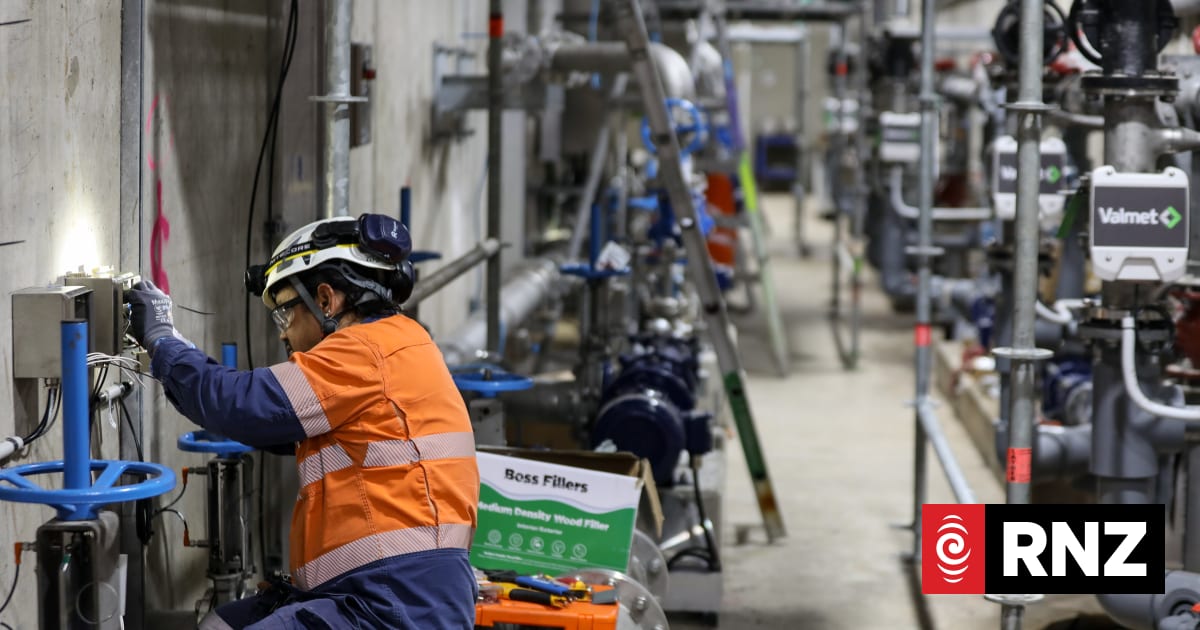
The lower levels of Wellington's Moa Point plant were completely submerged in sewage in the early hours of 4 February, as a catastrophic failure for the plant and the city unfolded. For the first time, RNZ has been able to see inside the troubled plant, and the race to fix it as summer looms."This area we had about three and a half metres of flooding," Steve Hutchison says.Tiaki Wai's director of the Moa Point recovery is showing us through a thin, but critical corridor known as the sludge gallery.A maze of pipes and pumps in this room, which transports some of the sewage material out of the plant, was drowned in brown sewage water in the early hours of 4 February.Yellow tape high on the back wall marks the flood line."Pretty much all of the pumps have had to be replaced, the wiring has also had to replaced, so all the cabling and instrumentation wiring," Hutchison says.Tangled wires droop from orange cabinets outside the downstairs control room, where 80 percent of electrics failed in the flooding - thousands of metres of wiring requiring replacement."Has there been any thought about moving the electrical equipment up higher," a journalist asks."It's certainly been thought, and you're not the first person to think it, but practically it's just not possible - there's just not enough room, up above ground," Hutchison explained, saying standby generators and storage stanks were located there."It's a very very constrained piece of land to put a major wastewater treatment plant on," Hutchison says.All eyes are on next week's date, marked for when sewage treatment will restart.He says there's "still a chance" the long awaited restart for sewage treatment at Moa Point might be delayed beyond next Thursday, though he's optimistic that won't happen."Still working through our final commissioning checks, so there's still a chance that something comes up that we need to delay that date, but as of today we're still optimistic around the 12th of November."About 120 workers and experts from overseas have been on-site fixing the plant over the past nine months.Moa Point recovery director Steve HutchinsonRNZ / Baz MacdonaldNot a time for celebrationChief operating officer Charles Barker says it's been a huge job, but he's not celebrating anything."It's a massive effort and we're not celebrating it, because there's nothing to celebrate about getting the plant back, but it is good to recognise the work that people have put in here."An Independent Crown Review found systemic failures of leadership by Wellington City Council, Wellington Water and the plant's operator Veolia ultimately led to the disaster, and that crucial warning signs were missed.Chief operating officer Charles BarkerRNZ / Baz MacdonaldIn May, officials said the total cost would be $53.5 million, over $40m of which will be paid through insurance, with $10.9m of ratepayers' money going toward a problem pipe, known as the sewage bypass pipe.The pipe is partly outside and we're shown through tangled bush and trees where the design flaw, as it's been deemed by officials, is located.It's where flows during heavy rain interacted, causing a chokepoint with air bubbles which led to the flooding.The bypass juncture responsible for the flood.RNZ / Baz MacdonaldEven with sewage treatment starting this month, a complete fix of the plant won't happen until late 2027 when that bypass pipe is repaired."To remediate the bypass it is probably very likely we'll have to shut down the long outfall, which means we will have to use the short outfall for a period time - we'll do everything we can to keep that to an absolute minimum," Barker says.He's "very confident" that with the repairs that have already been done, the plant wouldn't flood in the same way, or same extent again.From November the sewage coming out won't be fully treated, but will reach that in February, Barker says.RNZ / Baz MacdonaldHe was keen to stress residents can swim much of the time now."There's this really misconception that's in the community, that somehow you can't be in the water at the moment. If you look at LAWA [Land, Air, Water Aotearoa], the vast majority of the days in LAWA are green - it's green today, you can swim and do all your activities in the beach, that's the health advice."What does change from November to February, is that increasingly Moa Point is not a factor in any of those equations."A Taiki Wai warning on Lyall Bay beach.RNZ / Baz MacdonaldBut despite the officials' timelines and milestone dates, residents on the South Coast say they still lack confidence to swim or walk on the beach."It's probably since last summer, we haven't really swam here since last summer, which sucks. The dogs don't really swim, after a rain or something we probably give it three to four days before we even bring the dogs along here," Freya Newton said.Clemmie Newton agreed. She said despite the officials' assurances about swimming, signs warning about untreated sewage are still signposted at the beach.Wellington Water and Wellington City Council are facing fines for the disaster.Despite this, Clemmie Newton said there wasn't a lot of "trust" or "faith" from many in the community that the plant would operate in a better way."That something so catastrophic can happen, and it doesn't appear there's been repercussions to that, and responsibility over what's happened, for the local people, but mostly for the local environment. It's concerning."The Moa Point Wastewater Treatment Facility.RNZ / Baz Macdonald
Moa Point: Inside the sewage plant that catastrophically flooded
Full Article
Original Source
Read the full article at Rnz →KhanList aggregates and links to publicly available news content. We do not host full articles from third-party sources. Always verify important information with original sources.