
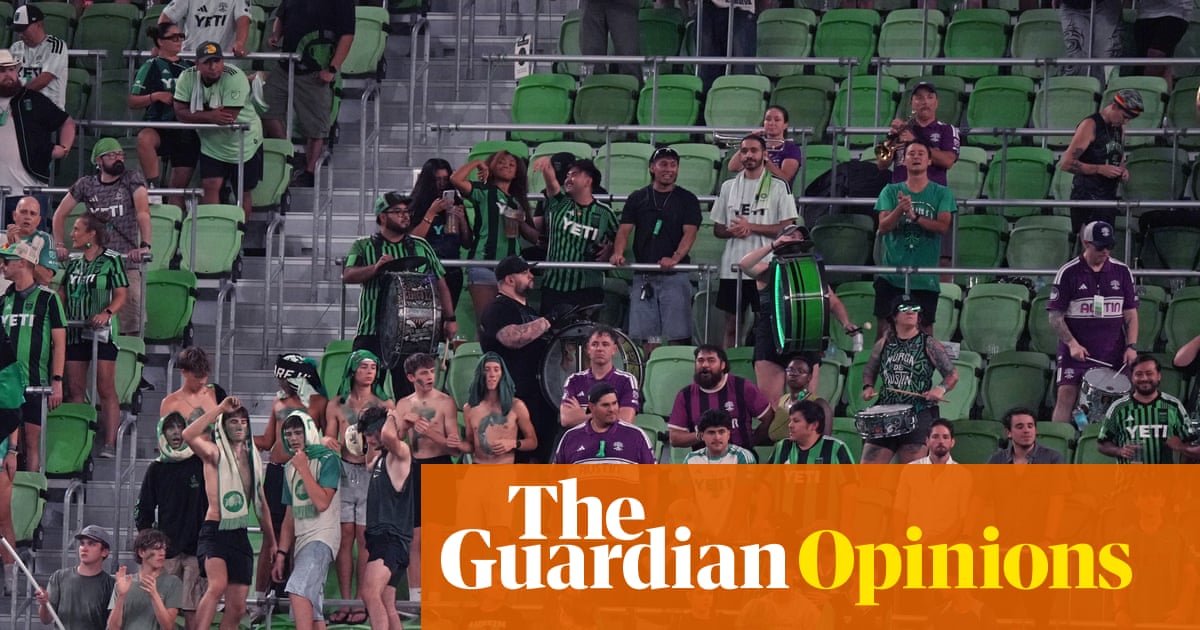
On 26 September, Daniela Silva was expelled from Austin FC’s match with San Diego FC for wearing a T-shirt reading “Abolish ICE”. She says she was banned from Q2 Stadium for a year (Austin FC said that the ban was issued by the Austin Police Department, not the club, and that they offered to rescind it but that Silva declined).This happened, really, truly, and you cannot make this up, during Austin FC’s Hispanic Heritage Night. It also happened six days after Immigration and Customs Enforcement (ICE) agents shot a Venezuelan delivery driver, 28-year-old Wilber Garcés Pérez, in the torso in Austin, sparking protests in the city.The club’s Hispanic Heritage Night included folk dances and highlighted local nonprofits serving the Hispanic community. “For Austin FC, celebrating Hispanic Heritage Month means celebrating the many cultures and communities that help make Austin what it is,” the club’s website still declares.And yet, a fan sporting a T-shirt with a very reasonable response to the ongoing assault on the Hispanic community of Austin, and indeed the nation, was banished.The club referred to Major League Soccer’s fan code of conduct, which prohibits, among other things, “Displaying signs, symbols or images for commercial purposes or for electioneering, campaigning or advocating for or against any candidate, political party, legislative issue, or government action.” It’s the same policy MLS has cited in several other instances.That’s where Austin FC supporter groups Los Verdes and La Murga de Austin took issue, releasing a joint statement. “Opposition to ICE is not an abstract political debate for many of our members and neighbors,” it read. “It is about what is happening here, in our community, and about their safety, dignity, and ability to move through it without fear. In the days since, members of our community have questioned whether they feel safe and welcome returning to Q2. That should matter to Austin FC. The club has a responsibility to communicate clearly that our Hispanic and immigrant communities are welcome and safe at Q2.”At the club’s home game on Saturday, a 4-1 loss to runaway league leaders Nashville SC, La Murga de Austin walked out in protest of Silva’s ejection, clearing out much of the supporters section. Its banner, reading “NO ICE IN THIS MELTING POT”, was taken down.“We love this club. But love is not silent,” La Murga said in a statement. “We are asking Austin FC to speak out – publicly, with conviction – against the injustice ICE is inflicting on the communities of Austin. The same communities the club says it supports. The same communities whose faces fill your marketing, whose voices fill your stadium, whose hands and hearts make this place what it is.”The club told the Guardian it is engaging with supporters on the topic. It may well be that Austin FC’s hands were tied by league regulations. It’s just that those rules are unjustifiable and, in this climate, possibly even untenable.MLS has priors when it comes to these ideological confrontations with its own fans. In 2015, it ordered the removal of “Refugees welcome” banners at Toronto FC games. In 2019, the league had to walk back its ban on the Iron Front symbol, first used by anti-Nazi paramilitaries in the 1930s and since broadly appropriated by the antifa movement – which has always been more of an idea than an actual organization but was nevertheless deemed to be political by the league. At the other end of the ideological spectrum, a man in a Make America Great Again hat was ejected from St Louis City’s stadium during a game last year.In the weeks after the war between Israel and Hamas began in 2023, MLS banned both Israeli and Palestinian flags in its stands as a measure it called “temporary” but which, three years on, remains in place. A carveout exists, however, for Columbus Crew fans, who were awarded an exemption to fly a single Palestinian flag after the club signed Palestinian striker Wessam Abou Ali. Fans of the teams who field the league’s eight Israeli players can fly a single Israeli flag.Meanwhile, when Latino Nashville fans stayed away from their stadium in droves for fear of ICE arrests on their way home from games, the league did permit a banner reading “We’re not all here” to note their absence. The subtext was self-evident.Herein lies the trouble. The rules feel squishy because there is no one way to coherently and consistently keep political speech out of stadiums. The notion of apolitical sports, idealized by some as a kind of how-things-used-to-be paradigm that never existed, is a fantasy.skip past newsletter promotionafter newsletter promotionMLS isn’t alone in trying to make it a reality. Most of the other American major leagues try just as hard to stay neutral in any matter that may cost them a few dollars by upsetting fans, or draw the ire of their overwhelmingly conservative owners. Then again, few sports seem to have hardcore fans as politically engaged as those in American soccer.I’d also argue that the approach is counterproductive. Banning T-shirts with mainstream messages draws far more attention than just treating fans as adults with a worldview, who don’t need to be policed.MLS loves to highlight its hardcore fans when it sells itself to new audiences. Yet it also wants to sanitize them, rather than just accepting that most of them skew progressive and will proclaim their values accordingly.A league cannot cleanse itself of the inconveniences of reality outside its facilities, especially when that reality is expressly hostile to as many as 30% of its fans, per its own count. Pretending that it can only leads to ugly episodes like the one in Austin. Not to mention a disillusioned and mistrusting fanbase. Leander Schaerlaeckens is the author of The Long Game: US Men’s Soccer and Its Savage, Four-Decade Journey to the Top, or Thereabouts, which is out now. He teaches at Marist University.
MLS’s political speech policy is untenable – just ask Austin FC fans
Full Article
Original Source
Read the full article at Theguardian →KhanList aggregates and links to publicly available news content. We do not host full articles from third-party sources. Always verify important information with original sources.