
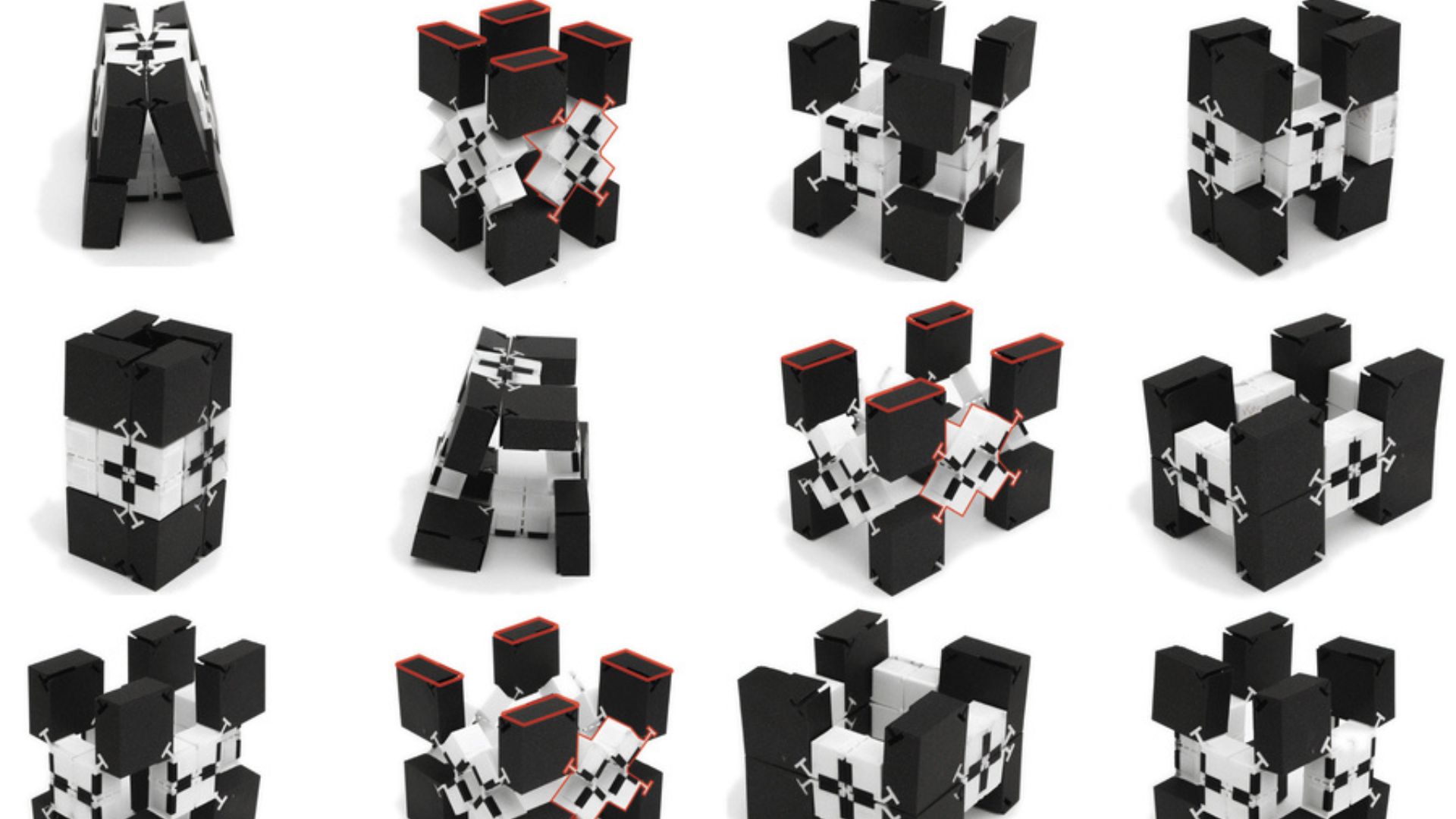
MIT has created an innovative system that lets physical objects change shape easily. Dubbed “bifur-circuits,” these are 3D-printed, modular metamaterial building blocks retain continuous electrical conductivity regardless of how they are bent, twisted, or reconfigured. Standard metamaterials usually get stuck in a few rigid forms. But MIT’s new modular system allows single objects to snap into dozens of stable configurations without losing power or signal. Tested through over 10,000 compressions with zero loss in conductivity, the technology has already been used to make interactive items like a game controller. Potential uses include interactive rehabilitation tools, adaptive soft-robotics grippers, and reconfigurable emergency shelters designed to automatically respond to changing post-disaster environments. “Metamaterials can make complex mechanical assemblies easy to manufacture just by using repeating units. Our work expands on this design space. If we think of mechanical metamaterials as building blocks, then our work is one way to take advantage of their geometry to embed intrinsic intelligence into hardware, which could open many possibilities,” said Marwa AlAlawi, a mechanical engineering graduate student and lead author. Changing configuration with no external wiring The development depends on a quirk of physics called mechanical bifurcation, which is a sudden shift in structural behavior past a physical tipping point. Mechanical bifurcation drastically expands structural reconfigurability, so adding just one extra unit creates numerous new spatial combinations. By embedding flexible conductive materials at key pivot points, this process lets components connect as they rotate. Each movement creates a distinct electrical circuit between neighboring blocks, changing shapes and even automatically tracking its own transformation. Integrated flexible conductive materials allow the blocks to maintain continuous, wire-free electrical connections across every transformation. This lets the overall structure sense its exact physical shape without external wiring or bulky mechanical sensors. Researchers demonstrated the practical potential of these sensing metamaterials using dynamic, shape-shifting objects. Like a chair that converts into a storage table or flattens for stowing while transmitting its real-time configuration to a display. “The conductive material was a constraint we had to work around in the design process, and it dictated how the sensing between blocks would happen,” AlAlawi stated. On the top row are two types of connector blocks that link units together. They are internally routed with conductive material. Credit: MIT Built to last Integrating live electricity into moving, bending plastic is tricky. Flexible conductors often break under stress, but the MIT team overcame this issue by pairing custom software with multimaterial 3D printing. The blocks were fabricated using a multimaterial 3D printer via a custom CAD simulation tool. The durability of bifur-circuits was proven through 10,000 compression tests without any loss of electrical connectivity. Power flows through the geometry of the blocks themselves. “Bifur-circuits are one step toward developing mechanical building blocks with integrated intelligence. It would be interesting to build on this work and come up with building blocks that allow us to create a structure with any form or shape we want, and which are structurally stable and can be actuated,” AlAlawi noted. This technology unlocks broad real-world applications across multiple industries. Examples include interactive smart furniture that updates a connected display as it changes modes, as well as reconfigurable robotic grippers and solid-state antennas that dynamically reshape to adjust frequencies in shifting environments.Get the latest in engineering, tech, space & science - delivered daily to your inbox.Mrigakshi is a science journalist who enjoys writing about space exploration, biology, and technological innovations. Her work has been featured in well-known publications including Nature India, Supercluster, The Weather Channel and Astronomy magazine. If you have pitches in mind, please do not hesitate to email her.
MIT’s shape-shifting smart devices could power smart furniture, morphing robots
Full Article
Original Source
Read the full article at Interestingengineering →KhanList aggregates and links to publicly available news content. We do not host full articles from third-party sources. Always verify important information with original sources.