
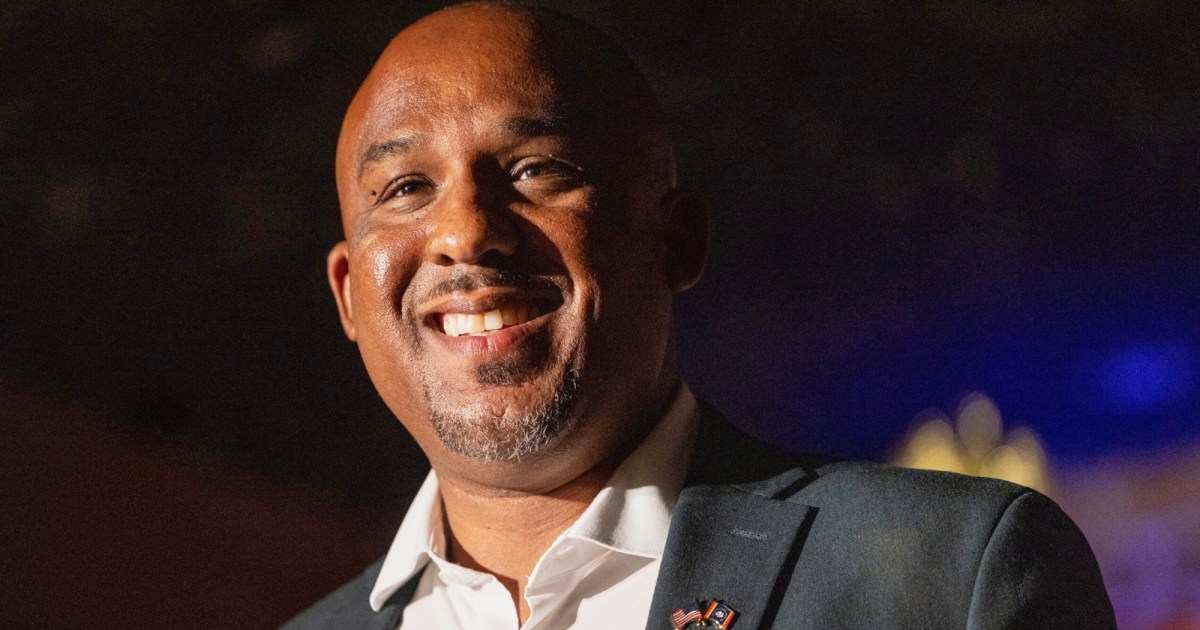
Mississippi Democratic Senate candidate Scott Colom speaks to supporters during his election watch party in Jackson, Mississippi, November 3, 2026.Eric Shelton/Mississippi Today/AP Get your news from a source that’s not owned and controlled by oligarchs. Sign up for the free Mother Jones Daily. One of Election Day’s most surprising results still isn’t final: the extraordinarily close Mississippi Senate race between Republican incumbent Cindy Hyde-Smith and Democrat Scott Colom, who could become the state’s first Black senator since Reconstruction. As of Wednesday afternoon, the difference between the two candidates is under 100 votes, with Colom leading and over 95 percent of ballots counted. Mississippi, a ruby-red state, has the largest proportion of Black residents in the country, at about 37 percent, who account for a similar percentage of eligible voters. But it is also historically one of the most repressive states for Black voters. The state’s Republican leadership has repeatedly redrawn maps that dilute Black voters’ power. And according to The Sentencing Project, a nonprofit working toward nationwide decarceration and addressing racial disparities in the criminal justice system, in 2024, at least 43,700 Black Mississippians—over five percent of the state’s Black adult population—could not vote due to felony disenfranchisement, compared to a national average of 1.7 percent of all adult citizens. But my colleague Ari Berman reported on Wednesday that Black voter turnout has skyrocketed across the South this election cycle, due in significant part to mobilized frustration over the April Supreme Court decision that effectively dismantled the Voting Rights Act, Louisiana v. Callais, setting the stage for a string of extreme partisan gerrymanders and other crackdowns on access to voting. And just as in many other states, economic affordability is one of the most pressing issues in the campaign. Colom has promised to fight to raise the minimum wage—which has remained at $7.25 per hour since 2009, vote to cancel Medicaid cuts to keep rural Mississippi’s hospitals open, push for a pause on new data center construction until companies agree to pay for their own power and hire Mississippi workers, and to “protect the right of Mississippi communities to have the final say on whether data centers come into their communities.” According to the Mississippi Clarion Ledger, the election results must be certified by November 13. With the race as close as it is, thousands of uncounted provisional ballots—typically filed by residents who were previously marked inactive on voter rolls or who didn’t bring their voter ID—could swing the outcome either way. Colom’s campaign told the paper on Tuesday that there were around 15,000 affidavit ballots yet to be counted. (Mississippi is also the only state with no automatic recount law.) But Colom’s performance in a state where Hyde-Smith won reelection by 10 points in her last race—and which voted for President Trump by a 23-point margin in 2024—is a striking sign for future elections in both Mississippi and the nation.
Mississippi’s Unbelievable Blue Turn
Full Article
Original Source
Read the full article at Motherjones →KhanList aggregates and links to publicly available news content. We do not host full articles from third-party sources. Always verify important information with original sources.