
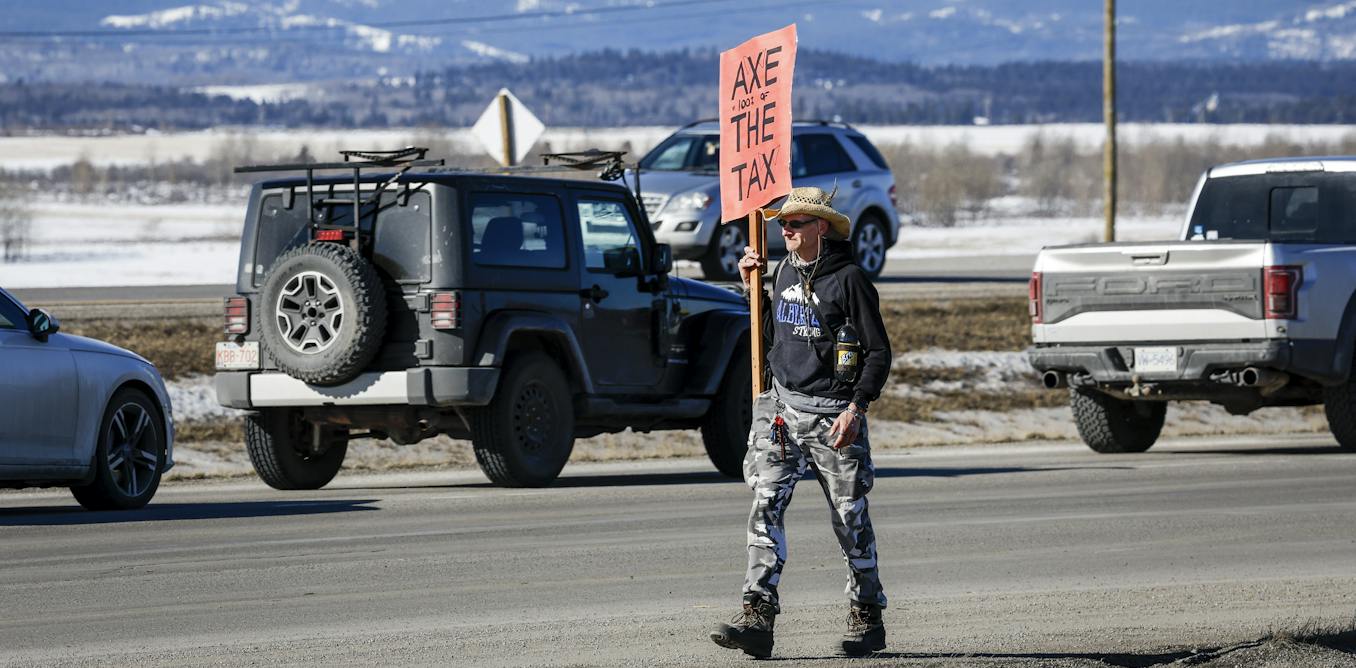
Anti-carbon tax protesters wave signs and chant slogans as they block a westbound lane of the Trans Canada highway near Cochrane, Alta., in April 2024. THE CANADIAN PRESS/Jeff McIntosh Published: November 8, 2026 10:04am EST Canada’s consumer carbon tax is dead and buried, repealed in 2025. Given the divisive politics that surrounded the carbon tax, many are probably happy never to think about it again. However, research we published last month offers important lessons about how toxic politics threatens the quality of Canada’s public policies and democracy. Before it was repealed, we asked Canadians what the carbon tax was costing them at the pump. We found that Conservative voters were living in a different world. Compared to neighbours with similar fuel consumption — who would have been taxed roughly the same — they estimated it was costing them hundreds of dollars more every month. Our research, combined with numerous academic studies of the British Columbia carbon tax, drives home a sobering conclusion: a policy that was fair, effective at fighting climate change and even put money into most taxpayers’ pockets died because Canadians simply didn’t believe any of that. Anti-carbon tax protesters wave signs and chant slogans as they block a westbound lane of the Trans Canada highway near Cochrane, Alta., in April 2024. THE CANADIAN PRESS/Jeff McIntosh What the research found We undertook a series of public opinion surveys to better understand Canadians’ perceptions of their carbon tax costs and rebates, and how those impacted opposition to the carbon tax. Our study, recently published in the Climatic Change journal, asked them how much they thought the carbon tax was costing them. In 2022, we asked 1,000 Canadians across five provinces detailed questions about their families’ fuel consumption, including their gasoline expenditures and utility bills. We also asked them how much they believed the carbon tax was contributing to transportation and heating fuel prices, and how much they thought their family was paying in carbon taxes monthly. We investigated perceptions of carbon tax rebates in an earlier study. Survey respondents shared their postal codes and the number of adults and children in their household (subject to our promise not to reveal their personal information). With that information, we could calculate each respondent’s annual household rebate. In reality, those who were consuming more fossil fuels for transportation and home heating were paying proportionately more in carbon taxes. Yet we found that Canadians’ beliefs about their carbon tax payments did not reflect their actual fossil fuel consumption. This was especially true for how much Canadians thought the carbon tax cost them at the pump, which was the main flashpoint for opposition to the policy. A member of our research team, Chloé Boutron, previously reported that Canadians have remarkably accurate knowledge of gasoline prices in their community. In other words, it wasn’t that Canadians didn’t understand how much they were paying for gas, but rather how much of that cost was due to the carbon tax. By contrast, people’s perceptions of their heating costs was roughly correct. Fuel prices are displayed as a person fills up their car with gas at a station in Montréal in March 2026. THE CANADIAN PRESS/Christopher Katsarov Politics shaped perceptions Our study found that Canadians’ beliefs about carbon tax costs and benefits largely came down to their politics. The perceived impact of the carbon tax on gasoline and diesel costs was strongly predicted by a single factor: which political party the respondent voted for in the previous federal election. Compared to Liberal voters with similar fossil fuel consumption and therefore similar actual carbon tax costs, Conservative voters perceived they were paying almost $5,000 a year more in carbon taxes than their Liberal counterparts did. Political party also predicted what people thought about their rebates. Conservative voters reported receiving lower carbon tax rebates than voters from other parties within the same province. We also found that perceived, rather than actual, costs best explained voters’ opposition to the carbon tax. When respondents received a mock-up of their household’s carbon tax rebate form, both Liberal and Conservative voters estimated their rebates more accurately. But after realizing that their rebates were higher than they thought, Conservative voters were more likely to report that meant they were paying more in carbon taxes than they were getting back. Accurate information backfired amid a hyper-partisan policy debate. Read more: The carbon tax needs fixing, not axing — Canada needs a progressive carbon tax Risks of misinformation In some respects, misapprehensions about the carbon tax isn’t surprising. It was a new policy, with opaque costs. But those misunderstandings were amplified. Conservative politicians offered selective statements that could easily mislead voters — for instance, ignoring the existence of rebates or focusing on the carbon tax at a time of rising consumer costs, even though its contribution to inflation was minuscule. Conservative Leader Pierre Poilievre speaks during a news conference in Mississauga, Ont., in December 2024. THE CANADIAN PRESS/Nathan Denette Already misleading messages then were further simplified via memes widely shared by right-of-centre allies on social media. The impact of misinformation was facilitated by a growing partisan divide and decline of shared news sources. And it worked. Conservative party support rose in tandem with carbon tax opposition after 2022, ultimately prompting the Liberal Party to abandon its own policy leading into the 2025 election. With that track record, there’s every reason to expect future application of the carbon tax playbook will not be limited to climate policy nor to a single political party. Want to write? Write an article and join a growing community of more than 236,400 academics and researchers from 5,654 institutions. Register now
Misinformation won: How divisive politics doomed Canada’s carbon tax
Full Article
Original Source
Read the full article at Theconversation →KhanList aggregates and links to publicly available news content. We do not host full articles from third-party sources. Always verify important information with original sources.