
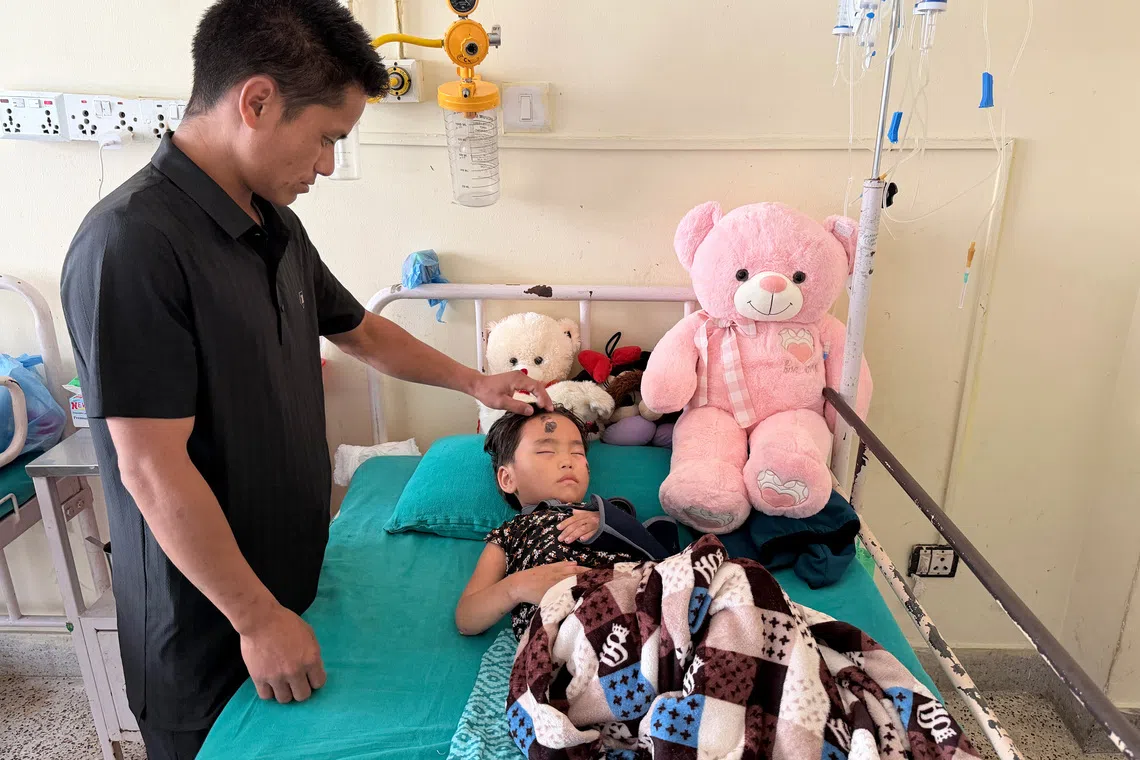
KATHMANDU – When Manisha Magar stirred in her sleep in the paediatric ward of the Tribhuvan University Teaching Hospital, her mother quickly cupped the five-year-old girl’s cheeks with a blanket. “The bruises on her face are still healing and I don’t want her to pick at the scabs,” said her mother Geeta Magar, as the groggy toddler seized the moment to cuddle closer to her. “Look how tightly she’s holding me,” Geeta said, pointing to Manisha grabbing her arm. Manisha is something of a “miracle child” in the paediatric ward for having emerged largely unhurt from a town entirely destroyed by catastrophic flash floods in Nepal on Aug 26.For almost three days, the child had been stuck in the muddy sludge that had washed into Timure, a small town in Rasuwa district at the Nepal-China border. A police officer had rescued her after Geeta and him heard a tiny voice mumbling “mummy, mummy” from behind two collapsed pillars. When he followed the voice, he found Manisha, crouched against a lopsided pillar, her arms crossed in front of her, in a foetal position.“She was conscious when they found her. We could not stop crying in relief. She could not stop crying when she saw her mother,” said Lokbahadur Magar, her father, who works in hydropower tunnel construction but had not gone to work that fateful day. The couple had been sleepless and feeling “half-dead” for days after they had been unable to grab the youngest of their three children when the river suddenly surged and washed away a section of their house where Manisha was. The girl was rescued 2km from where their house had stood. Amid the more than 1,000 dead and 5,000 missing in the floods – including more than 500 foreign tourists, trekkers and pilgrims – astounding rescues like Manisha’s kindle hope in the devastated Himalayan country.The flash floods triggered likely by a glacial lake outburst in Nepal have swept away and devastated villages and communities near the border with Tibet and all along the river basins of the Bhotekoshi and Trishuli. Debris flow and silt travelled nearly 100km and impacted populated areas downstream as well. While the government has not specified a precise tally of villages destroyed, around 90,000 people are estimated to have been affected – their houses and workplaces washed away along with schools, hospitals and hotels. Photos of missing people pasted on the wall at the entrance of Tribhuvan University Teaching Hospital in Kathmandu, Nepal. ST PHOTO: DESMOND FOOThe families of those missing are still searching for them. Even as more than 13,000 people have been rescued, the number of those being recovered alive is shrinking with every passing day. Survival stories provide hope amid the devastating flash floodsBodies are being recovered kilometres downstream. Remarkably, so are some survivors.On Sept 5, 10 days after the flood, the Nepal police and Armed Police dramatically rescued 64-year-old Chandrika Shrestha in Betrawati Bazaar, a once-bustling trading town where almost 300 houses are buried under the debris. Images of the bleary eyed but glorious survivor as she was rescued from the fourth floor of a house and revived in Bidur municipality are splashed all over Nepali media. Shrestha was found unconscious and partially trapped in mud, according to a post by Dipa Dahal, press and research adviser to Nepal Prime Minister Balendra Shah. Shrestha was given preliminary treatment before being airlifted to Kathmandu.Moved, Shah issued a statement: “This news gives hope to the entire country and sends a message that our search and rescue efforts remain unrelenting.” The same day – on Sept 5, the Nepali army and South Korean disaster experts rescued a Chinese man Lu Haitao from a 225-metre tunnel in the Upper Trishuli-1 hydropower project.The authorities said the disoriented Lu, whose body was caked with mud, had no visible injuries and his vitals were stable, but showed signs of mild hypothermia.Every person still alive after days under the debris helps to reignite the country’s energy, while underlining a continuing responsibility. “I am glad the authorities are still looking. How can we abandon people using every ounce of their energy to stay alive?” asked Gopal Tamang, a security guard in the teaching hospital, showing The Straits Times a news clip of two Nepali workers rescued from deep inside another collapsed hydropower tunnel, nine days after the floods. In the video shared by the Nepal Electricity Authority, cheers erupt as army personnel in hard hats lift one of the men to the surface from the damaged Upper Trishuli 3A hydropower project. The survivors are mechanical foreman Sanjay Sah and supervisor Kabir Maharjan. Sah, remarkably lucid even after nine days stuck in a dark tunnel, was unclear how many days had passed. He told security forces that when the disaster hit, he was trapped as he was trying to get everyone else to safety. Emergency responders continue to look for more than 900 trapped workers, engineers, and supervisors across at least 12 damaged hydropower projects. Clutching his phone like he was witnessing a miracle, the security guard in Kathmandu described each rescue as “nothing but god’s small blessings” to a suffering people.
‘Miracle child’ reunited with mum and dad in Kathmandu hospital days after Nepal’s flash floods
Full Article
Original Source
Read the full article at Straitstimes →KhanList aggregates and links to publicly available news content. We do not host full articles from third-party sources. Always verify important information with original sources.