
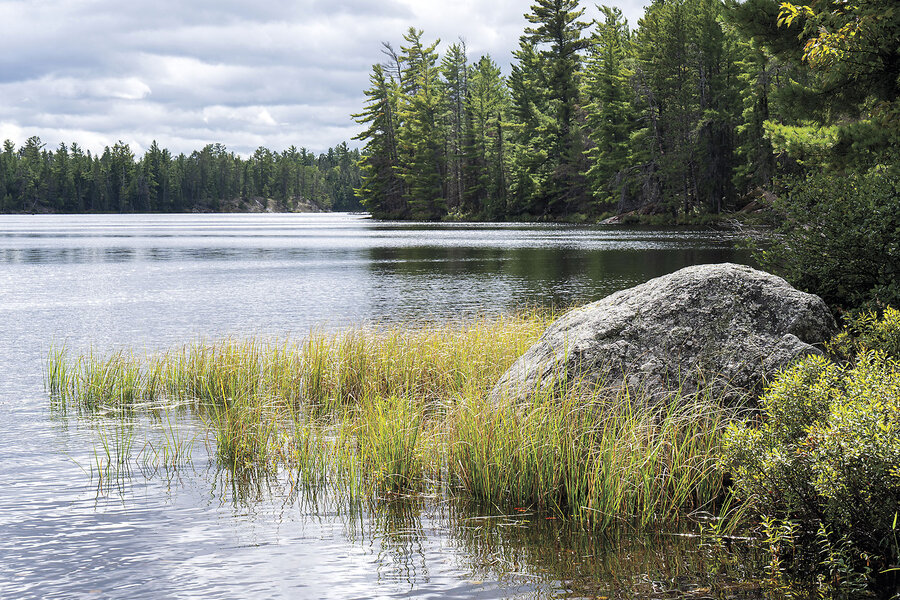
ELY, MINN. | Oct. 28, 2026, 12:52 p.m. ET | 11 min read Around 1.1 billion years ago, North America tried to rip itself in half. The attempt was unsuccessful, of course – otherwise, there would be an ocean where Lake Superior is today. But the Midcontinent Rift, as it is known, across northern Minnesota caused magma to bubble up from the Earth’s mantle, bringing with it vast amounts of copper, nickel, and other critical minerals for which countries all over the world are now furiously digging, to power everything from the latest iPhone to electric vehicles.Fast-forward a billion or so years from the time of Minnesotan volcanoes, and something else happened on this stretch of land: The ice sheets covering the area began to recede, leaving divots that soon filled with fresh water. Today, the Boundary Waters Canoe Area Wilderness (BWCAW) on the Minnesota-Canada border holds more than 1,100 lakes across more than 1 million acres – a mosaic of water and woods that remains one of the most pristine, untouched natural environments within the Lower 48.Now, in 2026, the people and elected officials in what at this geological moment is called Minnesota are debating how humans should balance these two acts of wonder. Together, iron-ore mining and wilderness exploration have long defined both the economy of the “Northwoods” as well as its intertwined identity. But when a mining company came to town two decades ago wanting to drill into the metal-rich Duluth Complex on the edge of the BWCAW and bring back hundreds of mining jobs with it, the tiny city of Ely at the edge of the wilderness started to undergo a Midcontinent Rift of its own. Now, this fissure has reached beyond northern Minnesota, stretching to both St. Paul and Washington, as the Trump administration prioritizes the domestic development of everything from artificial intelligence to energy to critical minerals, often at the expense of wilderness areas. Alfredo Sosa/StaffBlack granite (left), granite with minerals, and pink granite samples extracted at different depths are shown at the offices of Twin Metals Minnesota. This year, Republicans in Congress and President Donald Trump overturned a 20-year moratorium on mining upstream from the BWCAW. In August, Minnesota Democratic Gov. Tim Walz responded with an executive order that again banned mining here. But Governor Walz’s term is ending, and in Minnesota, executive orders expire 90 days after a governor leaves office. So what happens next hinges on November’s elections. Minnesota House Speaker Lisa Demuth, the GOP gubernatorial candidate, has said she supports the mine. Though the Democratic gubernatorial candidate, Sen. Amy Klobuchar, whose father and grandfather were both from Ely, voted against the GOP resolution in Congress, she has not said whether she would issue a similar executive order. The state legislature could consider a permanent ban in the new year, but that also isn’t straightforward in an area where the classic debate on industry vs. nature doesn’t fall along clean partisan lines.Swiping a flat palm over a wall-size map of the BWCAW inside the Ely Outfitting Co., rental shop owner Jason Zabokrtsky shows the interconnectedness of this patchwork of lakes. This isn’t one pond out in the middle of a field, he explains, but rather, a whole system of water flowing north toward Canada. Alfredo Sosa/Staff“We’re not against mining," says Jason Zabokrtsky, owner of Ely Outfitting Co., standing with rental canoes. "Mining is important to society today. The problem is, some places are too valuable and too vulnerable to put one of these mines.” “Once [pollution] is in the water, it’s unstoppable. It’s a permanently damaged watershed,” says Mr. Zabokrtsky. “We’re not against mining. Mining is important to society today. The problem is, some places are too valuable and too vulnerable to put one of these mines. Just because we support mining doesn’t mean we have to support it everywhere, in every place.”Duluth Complex’s untapped potentialThe main streets of downtown Ely hold blocks of outfitting shops such as Mr. Zabokrtsky’s, with racks of canoes spilling onto sidewalks. Restaurants and hotels welcome tourists for one last warm meal and a sleep indoors before they spend days or weeks in the BWCAW. But just one mile away, on the outskirts of town, sits the remnants of the Pioneer Mine: the area’s last iron-ore mine, which closed in 1967 and is now a museum to the town’s mining heyday of the late 19th and early 20th centuries.“People are very nostalgic,” says Becky Rom, national chair of Save the Boundary Waters, an organization working to permanently protect this area from mining. “You still find people who say our economy has three stools: logging, mining, and tourism. But what we have actually become is an amenity-based economy.” Alfredo Sosa/Staff“You still find people who say our economy has three stools: logging, mining, and tourism," says Becky Rom, national chair of Save the Boundary Waters. "But what we have actually become is an amenity-based economy.” Ms. Rom is a third-generation resident of Ely: Her father owned an outfitting shop, and her grandfather died working in a mine. This is not uncommon here on the northern edge of the Iron Range, where many locals had fathers or grandfathers who worked underground before subsequent generations pivoted to tourism. But from Pioneer Mine, it’s possible to catch a glimpse of what many hope will be Ely’s mining resurgence. The orange tip of a building emblazoned with the symbols for elements including copper and nickel peaks above the trees, on the other side of Miners Lake: the operational headquarters for Twin Metals Minnesota.Next to its office sits a 17,000-square-foot warehouse with shelves from floor to ceiling of rock drilled from the potential mine site. Altogether, it’s 1.5 million feet of core, says Dean DeBeltz, Twin Metals’ vice president for external relations and project operations.“That’s how much core we’ve drilled to really build the model to understand the deposit,” he says. And what they found over the past decade of drilling is what geologists and other mining companies have long suspected. When Mr. DeBeltz sprays the cores with water, flecks of light brown – copper and nickel – rise out of the dark gray rock. Alfredo Sosa/StaffJulie Lucas, executive director of MiningMinnesota, and Dean DeBeltz, vice president of external relations and project operations for Twin Metals, stand outside the company’s office. Twin Metals hopes to open an underground mine near the Boundary Waters Canoe Area Wilderness. Minnesota’s Duluth Complex is considered the largest undeveloped deposit of these critical minerals in the world. Twin Metals believes it holds about 95% of all nickel in the United States, 88% of the country’s cobalt, and more than one-third of its copper. There have been efforts to pull these minerals from the ground since the Bureau of Land Management issued the first drilling leases here 60 years ago. But the leases were passed between different companies amid falling copper prices and logistical difficulties. (The area’s ore is considered “low-grade” because the minerals Twin Metals would want to keep are only 1% of the overall rock.)The financial incentives, however, have shifted. Critical minerals are increasingly needed for everything, including the global transition to clean energy, and the price of copper recently hit an all-time high. By 2040, nickel demand is expected to double; copper’s is expected to grow by 30%. Still, the U.S. currently imports 45% of the copper it consumes and 41% of the nickel. This is the central argument from Twin Metals Minnesota, a subsidiary of the Chilean mining conglomerate Antofagasta PLC that now holds the leases: We need to drill here as a matter of national security. Alfredo Sosa/StaffCore samples, labeled by depth, are shown at Twin Metals’ office. “It’s easy for us to say, ‘We don’t need it, we can get it from China.’ But look now at the price of diesel,” says Julie Lucas, executive director of MiningMinnesota, a pro-mining group, referring to the Iran war’s impact on global oil supply. “These are the basic building blocks of our world.”Proponents also see this mine as the building block of Ely’s future. Once the mine is fully operational, Twin Metals says it will offer 750 full-time jobs and likely create 1,500 additional “spinoff” jobs – something Ely’s economy, currently built around seasonal tourism, desperately needs, says Mr. DeBeltz. A fourth-generation miner, he had 61 students in his high school graduating class, while his father’s graduating class had 130. His daughter’s was in the 30s. “There’s no one answer,” says former Ely mayor and current GOP state Rep. Roger Skraba, who is running for reelection in November and has worked in the BWCAW as a fishing guide. “Mining helps. It helps a lot. It gives this community a chance.” He says he tried, but failed, to recruit different industries to Ely (with its population of just over 3,200) during his eight years leading the city. That Ely’s tourism economy took a hit this summer during extensive wildfires inside the BWCAW, he says, is more proof that the city needs diversification. Alfredo Sosa/Staff“There’s no one answer," says Roger Skraba, a Minnesota Republican state representative, in front of the old Pioneer Mine shaft house. "Mining helps. It helps a lot. It gives this community a chance.” “Is the woods more important than keeping a community thriving?” Mr. Skraba asks. “That’s the question.”“Like no other place”Many locals opposed to the Twin Metals mine abutting the BWCAW say they support mining and know what it means to northern Minnesota. Trina Swanson, a Democrat running for northern Minnesota’s 8th Congressional District that includes the BWCAW, says taconite iron-ore mining “is so tied to our identity in this district and what we’ve given back to our country.” She has visited the planned Talon Metals mine for copper and nickel farther south to learn more about the project there. But the location of Twin Metals, she says, is a deal-breaker.“The Boundary Waters is like no other place in this country,” says Ms. Swanson, adding that this issue has come up across the campaign trail, even at events a 3 1/2-hour drive south at the other end of the 8th’s sprawling district. “It’s just too special of a place, and unique of a place, to risk for mining.”Ms. Swanson knows rural Minnesotans need jobs – she’s speaking to the Monitor from the largely vacant main street in Virginia, Minnesota, just past massive holes in the Earth from iron-ore mines that have laid off hundreds of workers in recent years. But she questions Twin Metals’ long-term economic arguments. The mine projects only 25 years of operation, and as Minnesota Democratic Sen. Tina Smith notes, the minerals harvested here will likely be sent to China for processing and then sold to the highest bidder. A Harvard study from 2020 found that while there would be an economic bump during the first few years of the mine’s operation, it would have a negative effect on the economy over the long term.But Republicans, including the incumbent Ms. Swanson is challenging, reiterate that this mine is about competing with foreign supply chains and creating local jobs. “Mining is our past, our present, and our future – and the future looks bright!” wrote Rep. Pete Stauber in April, after the U.S. Senate used an unprecedented rules maneuver to pass his resolution (by one vote) overturning President Joe Biden’s 20-year mining ban. Alfredo Sosa/StaffAaron Kania (left) talks to residents Greg Adkisson and Gloria Gervais in Eagles Nest Township. Mr. Kania is a former U.S. Forest Service district ranger and the Democratic candidate for the local state house district seat. “I thought I’d be talking about healthcare and the price of gas on the trail. But people bring up mining,” says Aaron Kania, a former U.S. Forest Service district ranger who is the Democratic candidate running to unseat Mr. Skraba in the state legislature.As Mr. Kania drives around Eagles Nest Township, about 15 miles west of Ely, knocking on half a dozen doors over the course of a few hours, there appears to be little consensus. A man who identified himself as Gary, but declined to give his last name, tells Mr. Kania that the mine should be here because Minnesota’s regulations are “nuts” and they could probably mine for these minerals in an environmentally safer way than elsewhere in the world. Over the sound of a lake lapping the shore of his backyard, Greg Adkisson, who retired from the now-closed LTV taconite iron-ore mine south of here, tells Mr. Kania that the project shouldn’t go forward because he has seen a mine’s pollution up close. Alfredo Sosa/StaffGranite rocks dot North Hegman Lake inside the Boundary Waters Canoe Area Wilderness. Mr. Kania nods, but his own position on this issue is hard to parse. When asked what he would do if elected and a mining ban comes before the state legislature, as Mr. Walz’s executive order has requested, Mr. Kania says he would need to see the legislation first. “We need to protect our water,” he says. “We also need jobs here.”History and prehistoryThat the Boundary Waters remains this wild is as much a factor of the modern federal government as it is prehistoric glaciers. The entire BWCAW sits inside the Superior National Forest, established by President Theodore Roosevelt in 1909. A series of protections followed – including a congressional statute banning dams and logging within 400 feet of lakes and streams, and an executive order by President Harry Truman banning aircraft from flying below 4,000 feet above sea level – essentially ending tourists’ access to resorts and hunting grounds. Then, in 1964, President Lyndon Johnson signed the Wilderness Act. Long considered one of America’s biggest conservation achievements, the act protected more than 9 million acres of federal land, including 1 million acres for the BWCAW. These will be places “untrammeled by man,” according to the legislation, “where man himself is a visitor who does not remain.” The act prohibited commercial timber harvesting, cars, and human constructions. While there are many different designations of protected federal land – national monuments, national forests, national parks – it’s wilderness areas, now 112 million acres of this country, that are considered the most protected.Locals in Ely have always pushed back against federalgovernment restrictions. As he championed further protections for the BWCAW during the 1970s, local environmentalist Sigurd Olson was once hanged in effigy. But thanks in part to his dogged advocacy, Congress enacted the Boundary Waters CanoeArea Wilderness Act in 1978, ending prior special exemptions for snowmobiling, commercial logging, and mining, inside the Boundary Waters. Alfredo Sosa/StaffGranite rocks show red ocher pictographs in North Hegman Lake near Ely. Twin Metals’ operation is planned for five miles outside the BWCAW. The company says it is confident it will not exceed regulatory pollution standards – both because of its mining process and how the Duluth Complex was formed. After the rock has been crushed underground and the critical minerals have been extracted, some of the remaining byproduct known as tailings will be stored on the surface, says Mr. DeBeltz, shaking a glass jar of gray dust in the Twin Metals headquarters. And though the fear around tailings is that they will create acid rock drainage when exposed to air and water, Mr. DeBeltz says his company’s tailings won’t have the sulfides to be acid-generating.Ms. Rom, of Save the Boundary Waters, disagrees. “You would have to have faith that Twin Metals can do something that has never been done before, in the most fragile place in the United States,” she says. She points to a series of studies that discovered water pollution from U.S. copper mines, as well as a study published in Journal of Hydrology, which found that it’s not possible to totally eliminate the risk of pollution at a mine here. “What we have is unique to us,” says Ms. Rom, “but that also makes us unique to the world.”Paddling along the shoreline of a small lake in the wilderness, as pine and spruce trees hover over the dark water’s edge and the wind whips waves against the canoe, a human knows her place. That loon’s shrill call, this rock’s marbled face, and the walleye wriggling several feet below are what’s at home here; the paddler, just a visitor. For this is a place where cans and glass are banned, cell service is rare, and the select overnight camping permits book out months in advance. Deepen your worldviewwith Monitor Highlights.Politics with respectGet political stories with respectful analysis.There‘s a world of new ideas in everyBooks newsletter.There‘s more to life, enrich yours withCulture & Learning weekly.Follow humanity‘s discoveries withScience & Nature stories in your inbox.Gain a spiritual perspectivefrom the stories in your inbox.Want to understand the deeper impact of critical events? Learn the Monitor‘s insight.Already a subscriber? Log in to hide ads. That’s the paradox of the Boundary Waters: It’s the most-visited wilderness area in America and beloved by so many, yet it’s possible to paddle and portage out here for days without ever seeing another person. Motorboats are almost entirely banned, and there are no roads. The only sound of human travel is a canoe paddle slicing the water and twigs breaking underfoot as visitors walk the woods between lakes with a canoe balanced overhead.“Once you’re out there, even on a day trip, what you find is that the quiet is so intense – the stars at night, the loons,” says Wende Nelson, who opened a bed-and-breakfast in Ely a few years ago with her husband, Scott Mills. “Things have changed but [the Boundary Waters] is still a wilderness. It’s a challenge; it’s not easy.” ALREADY A SUBSCRIBER? LoginReal news can be honest, hopeful, credible, constructive.The Christian Science Monitor was founded in 1908 to lift the standard of journalism and uplift humanity. We aim to “speak the truth in love.” Our goal is not to tell you what to think, but to give you the essential knowledge and understanding to come to your own intelligent conclusions. Join us in this mission by subscribing.
Minnesota wilderness holds rich minerals. Can competing interests find balance?
Full Article
Original Source
Read the full article at Csmonitor →KhanList aggregates and links to publicly available news content. We do not host full articles from third-party sources. Always verify important information with original sources.