
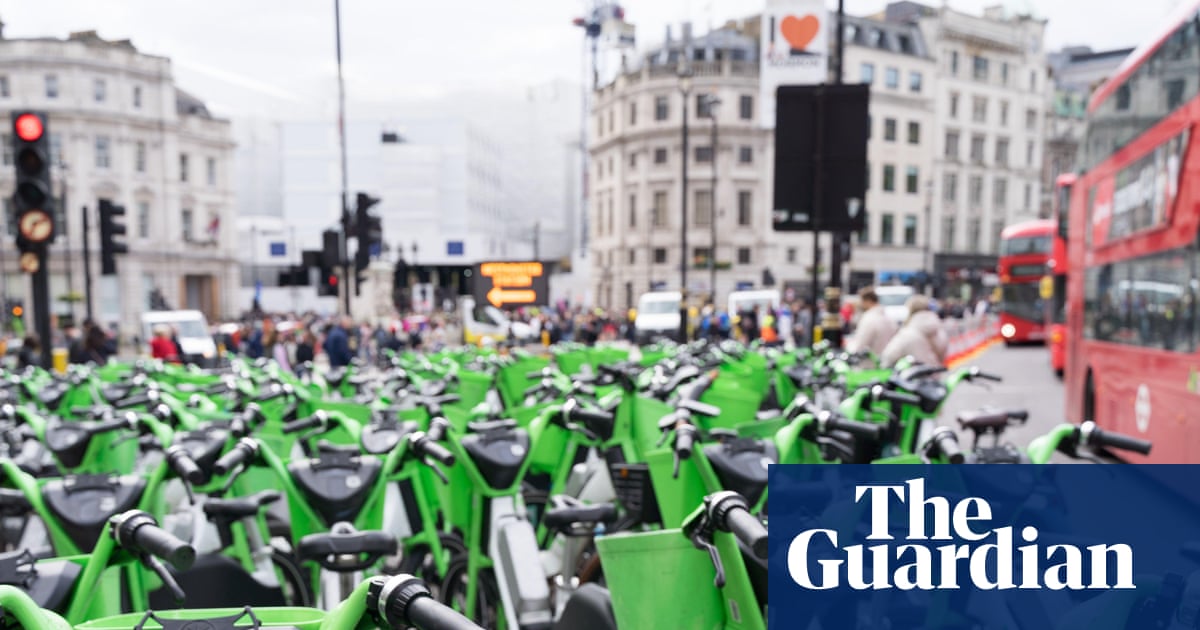
Ministers are seeking to end the “wild west” of parked e-bikes blocking pavements, as they attempt to crack down on antisocial behaviour such as cyclists jumping red lights.The consultation, led by the Department for Transport, will aim to establish national standards on issues including parking, ending the current patchwork of agreements between individual bike companies and councils.While some areas enforce rules that mean shared bikes – such as those operated by Lime, Forest and Voi – can only be left in designated parking bays, elsewhere the rules are looser, prompting complaints about bikes blocking pavements, particularly for wheelchair users, people with pushchairs and those with impaired vision.It will also look at antisocial and illegal riding, for example, people jumping lights or the use of bikes by those who are underage or drunk.The plans will also examine guidelines for fleet sizes to ensure certain areas are not overcrowded and possible requirements for operators to have insurance, so someone hit by a rider on a hired e-bike can claim compensation.Another part of the consultation will look at whether councils and mayors should be given powers over the fees charged to rent bikes, and whether companies should share data to improve enforcement and transport planning.Since arriving in the UK in 2018, shared e-bike systems, of which Lime is by some way the biggest, have expanded rapidly, especially in London. More than 2.6 million Britons used an e-bike share scheme in the year to September 2025, according to one estimate.There is evidence that shared e-bikes are used by a broader demographic range of riders than traditional bikes, in part because of the electric assistance, but also because they do not require somewhere secure to park.The DfT argues that the bikes are growing in importance for urban transport, but that the lack of any central oversight has created difficulties, noting that the companies themselves have called for more regulation.The proposed changes would be “a small but important everyday fix to make our streets safer”, Andy Burnham said. The prime minister added: “E-bikes can make getting around that bit easier, but when they block pavements or are used irresponsibly they can be a real frustration.“I want to sort that by giving communities more control over where they are parked and making sure companies and riders play by the rules.”Heidi Alexander, the transport secretary, said: “Shared e-bike schemes have revolutionised the way people travel around our towns and cities. They are easy to use, get us active and help reduce emissions, but we need to make sure they work with the communities where they operate.“That’s why we are taking decisive action to give local leaders the power to stop nuisance parking, tackle antisocial behaviour and make journeys safer.”There are parallel efforts in London under which the DfT would devolve power to the mayor, Sadiq Khan, and Transport for London to unify e-bike regulations, which are currently the responsibility of individual boroughs and vary significantly.Khan said: “The ‘wild west’ approach to dockless e-bikes cannot continue. While these services are helping thousands more Londoners to cycle, their rapid growth has also brought challenges around safety, inconsiderate parking and the lack of data needed to properly manage them.“I’ve been calling for powers to better manage dockless e-bike schemes since 2017, when the first schemes arrived in London, so I welcome the government’s plans to give cities the powers they need to do this.”
Ministers to target ‘wild west’ of e-bikes blocking pavements
Full Article
Original Source
Read the full article at Theguardian →KhanList aggregates and links to publicly available news content. We do not host full articles from third-party sources. Always verify important information with original sources.