
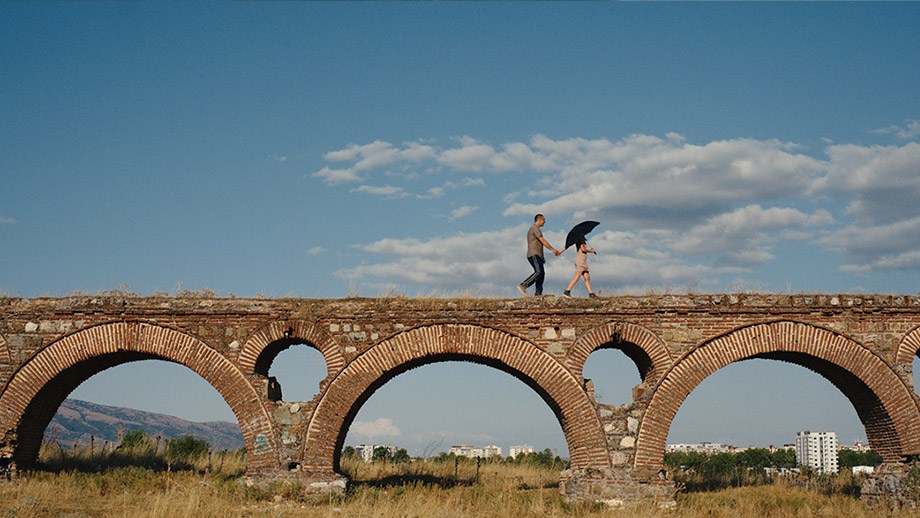
This week, Macedonian filmmaker Milcho Manchevski returns with Sister Brother Manhole Cover, his second feature of the year, which screens in competition at the Tokyo Film Festival. Directed by Manchevski from a screenplay he also wrote, Sister Brother Manhole Cover follows siblings Malina and Viktor, who live on the outskirts of post-Communist Macedonia. They make their living stealing bronze busts and manhole covers, which line their city’s streets. When a routine theft goes wrong and Viktor is badly injured, Malina strikes a desperate deal with a corrupt doctor, forcing them into a dangerous journey through Macedonia’s underworld. Their journey leads to an unexpected refuge: the opulent home of the doctor’s blind mother. Sister Brother Manhole Cover is Manchevski’s ninth feature. The filmmaker debuted his first documentary, Good People, earlier this year at the Sarajevo Film Festival. Watch on Deadline “It’s unusual to have two films come out at the same time, but better two than zero,” Manchevski joked in an interview with Deadline ahead of his trip to Tokyo for Sister Brother, adding that he is enjoying this productive period after spending many years being barred from producing films in his home country. Manchevski, who won the Golden Lion at Venice with his debut feature Before the Rain (1994), was blacklisted and had several projects halted by the Macedonian Film Agency after he reported corruption at the organization. Manchevski’s accusations were later upheld by Macedonia’s Anti-Corruption Commission after an investigation. Below, the veteran filmmaker, who lives between New York and Macedonia, speaks with Deadline about the extensive witch hunt he endured after exposing corruption at the Macedonian Film Agency, finally getting to make Sister Brother Manhole Cover, and why he believes the Tokyo Film Festival is the perfect launchpad for movies. Sister Brother Manhole Cover is a Banana Film production, in co-production with Gala Film (Bulgaria), Sense Production (Serbia), Tirana Film Institute (Albania), Berkeley Media Group (UK), Amarcord Production in association with Augustus Color (Italy) with the support of North Macedonia Film Agency, the Bulgarian National Film Center, Film Center Serbia, the Albanian National Center of Cinematography, and Italy’s Direzione Generale Cinema e Audiovisivo – Ministero della Cultura. The Rome-based Coccinelle Film is handling world sales on the title. DEADLINE: Milcho, where did this idea come from? MILCHO MANCHEVSKI: I wanted to make a film about sisterly and brotherly love—something we rarely see in movies or even in literature. It was also partly inspired by Macedonian folk songs and folk literature, which often include the theme of sisterly love. Sometimes it turns shocking and dark, but it is always fully dedicated. That was the initial embryo. Then I wanted to talk about inequality and wealth inequality. I think that’s the premier issue of today. So many problems in the world go back to this sense of unfairness and inequality. That feeling festers in people. But I didn’t want to turn it into an exclusively dark story. I thought it should be told through defiance and humor, because Victor and Marlena don’t see themselves as victims. They see themselves as people with agency—people who do things. Unfortunately, pretty much the only thing they can do is petty crime. DEADLINE: Yeah, I loved the idea of people stealing the busts. It’s so European. MANCHEVSKI: People actually do it. It’s three euros a kilo for the metal. I did a little research. There was an explosion of new monuments in Macedonia in the early 2010s, because the nationalist government decided to reintroduce us to our past. There was plenty of cash just lying around. And the manhole covers, they cover the underground and the septic part of us that we don’t really want to smell or see. Then our heroes take them off, and you can smell the reek. DEADLINE: I read this film was previously titled Leaving Copacabana? MANCHEVSKI: Yes. The title was Leaving Copacabana. Copacabana was their slum, which we constructed for the film. The little shacks you see are leaning on an ancient aqueduct. We got permission from the government to work there because it’s a national monument. We constructed the shacks for two reasons: first, to have full control; and second, so we wouldn’t go into somebody’s home—somebody’s slum—and disrupt their life. The slum was jokingly called Copacabana, as if they were in Brazil. The tagline was “sister, brother, manhole cover.” But that title somehow took over because it’s more irreverent and catchier, and I think it describes the film better. It’s not so much about leaving one place and going to a richer place; it’s about their relationship and society. DEADLINE: Where did you shoot this film? There are a lot of locations. MANCHEVSKI: Everything was done on location. There was no studio. And even on location, we didn’t want to change too much. The exception was the slum, which we constructed based on actual slums in Skopje. Most are inhabited by Roma, but not exclusively. We built it around the aqueduct because I liked the graphic quality, but also because it incorporated the ancient past into the very prosaic present of the characters and the whole community. Everything else was scouted around Skopje. We looked for actual places that had a certain smell, places where you could feel the underbelly, but also places that could give us a cross-section of society. For example, you have the illegal dump, which we had to sanitize so people could work there. DEADLINE: That was a real dump? MANCHEVSKI: That was a real dump. We took over a corner of it, sanitized the area, and brought in our own paper and cloth—things that didn’t stink too much. We had to ward off dogs. We liked that particular dump because you could see the highway below. Again, there was this contrast: here and there, us and them. That’s necessary when you’re telling a drama. The house was a real house, too. We didn’t do much to it; we brought in the piano and the busts, which we created, of course. I’m taking one of the manhole covers to the red carpet in Tokyo next week. DEADLINE: You’ve become a regular at Tokyo Film Festival. Why do you screen your films here? MANCHEVSKI: It’s an old love story. Before the Rain, my first film, played Tokyo. Going there and spending time there was so nice. I like how people in Japan, and especially at the festival, appreciate films. They take special care with them; they create new posters and trailers. It’s not just a run-of-the-mill place or festival. Then Dust played there, and then Kaymak. Now, I want to go there—it is at the top of my list. DEADLINE: This is your second film of the year. You were in Sarajevo with the doc Good People. I read that this was mostly because for years you were unable to produce anything? MANCHEVSKI: Yes, for a while, I wasn’t able to work because I reported corruption at the film agency in Macedonia. I did it twice, and it was eventually confirmed by the Anti-Corruption Commission and the State Audit Office. As retaliation, they blacklisted me, filed criminal charges against me, launched a smear campaign, and blocked my previous films and films in progress. Eventually I won two court cases against the agency, and the dam broke. This film was initially approved in 2022, and then, at the same time, the tragedy in Kočani happened. I felt I should make a documentary about it. The two films are completely different stylistically. There’s a lot of humor in Sister Brother; there’s no humor in Good People. It’s somber, with a glimmer of hope at the end. The overlap mostly happened in the edit, where you can shuttle between the two. I know it’s unusual to have two films come out at the same time, but better two than zero. DEADLINE: You’ve worked across the United States and Europe and have been able to make many different kinds of things. Many European and American filmmakers now talk about how difficult it is to make work. How do you feel about the industry today? MANCHEVSKI: I’m always an outsider, and I like it that way. I’ve lived in New York since 1985, but recently I’ve mostly been making films in Europe because of the general attitude toward filmmaking and the arts. Financing is always tough. It’s the curse of filmmaking. I’m jealous of painters and poets: you sit down, do your work, and it’s done. Maybe nobody will see it or like it, but at least it’s finished. With film, you first have to sell it and then make it. Filmmaking involves a lot of money, technology, and egos. Working in Europe has advantages, but distribution is not as muscular as in Hollywood. But nobody tells you how to end the film, whom to cast, or whether you need to reshoot a scene. You want feedback and collaboration, but it’s not a situation where the money dictates what the art will look like. That’s why I prefer Europe to Hollywood. I’ve worked in the United States—I worked on The Wire for HBO, made an independent film, developed films with studios, and even started a studio film. But in the last decade or so, there has been pressure to conform ideologically and make films with messages. I think every film has a message by default. The question is whether it offers more: Is there beauty in the film? Is there something profound? Does it talk about a bigger truth rather than just a message? The pressure—from festivals and film funds—to be message-driven and ideological comes at the expense of everything else. Even when I agree with the message, it’s a pity that so much contemporary cinema turns into two-dimensional pamphlets.
Milcho Manchevski Talks ‘Sister Brother Manhole Cover’, His Second Feature Of 2026 & Exposing Corruption At Macedonia’s Film Agency — Tokyo
Full Article
Original Source
Read the full article at Deadline →KhanList aggregates and links to publicly available news content. We do not host full articles from third-party sources. Always verify important information with original sources.