
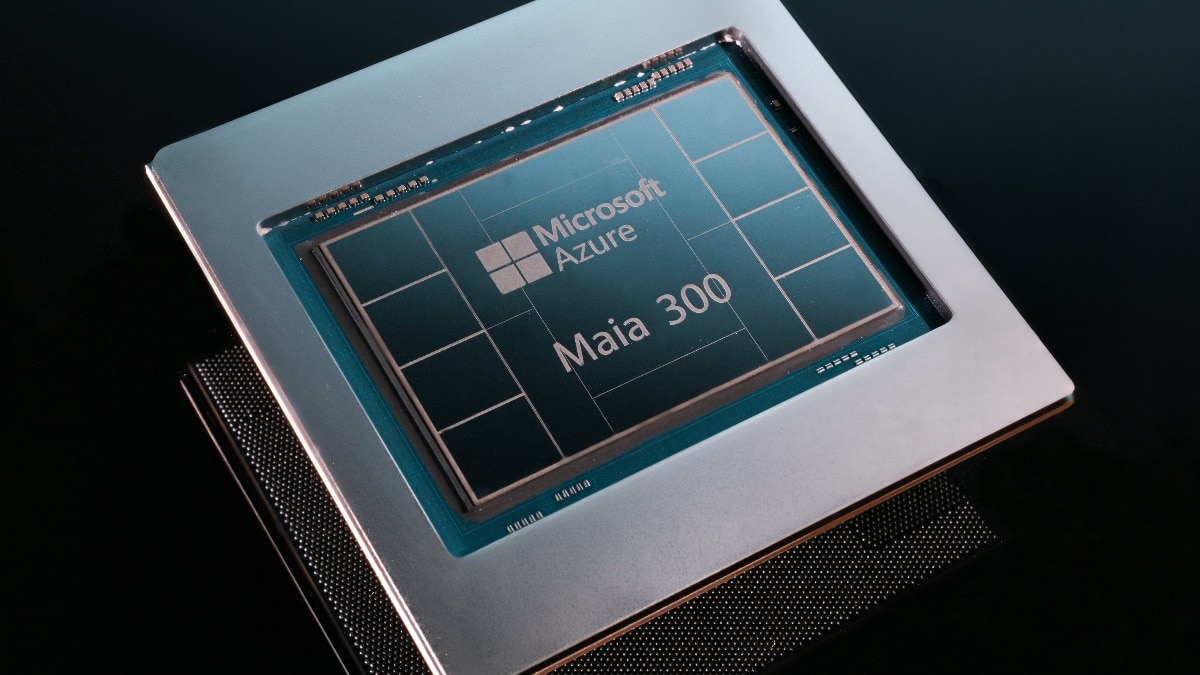
Microsoft has unveiled Maia 300, its third-generation in-house artificial intelligence chip, as it prepares to rely more on its own hardware to run AI services instead of depending heavily on processors from Nvidia and AMD. The company plans to begin deploying the new chip in 2027, with the aim of making its Maia family the primary system for handling AI requests across its products and services.Microsoft CEO Satya Nadella announced the launch on X, calling it the company's "biggest bet yet on our own silicon." He said Microsoft would expand its Maia chip deployments to multi-gigawatt capacity starting next year. The move comes as demand for AI computing continues to grow, pushing technology companies to develop their own chips to improve performance and control the cost of running AI services.Today we are announcing our biggest bet yet on our own silicon. Starting next calendar year, we will scale our Maia family to multi-gigawatt deployments, making it the primary inference system for our own product and services. And we’re introducing Maia 300, which delivers 40% more tokens per watt compared to leading GPU-based systems. We are already deploying Maia 200 across the US, Europe, and Australia, delivering up to 1.7x more tokens per watt across experiences in Teams and Copilot. Our goal is to build on the full-stack efficiency gains we’ve already seen, while continuing to bring the latest innovations from across the ecosystem into our fleet.— Satya Nadella (@satyanadella) October 12, 2026What makes Maia 300 different from earlier chips?Microsoft says Maia 300 is designed to deliver better performance while using less power. According to the company, the chip is expected to deliver 40 per cent more AI tokens per unit of power than leading GPU-based systems.AI tokens are units of text or data processed by an AI model. Higher token output for the same amount of electricity can help companies run AI services more efficiently. Microsoft also says a data centre rack containing 96 Maia 300 accelerators can deliver up to seven times the token throughput of a comparable Maia 200 configuration. The new chip is designed to handle demanding AI workloads, including complex reasoning, longer conversations and tasks that require AI agents to take multiple steps.The company is using a chiplet-based design for Maia 300, separating computing, memory control and input-output functions. This allows different parts of the chip to use technologies suited to their specific requirements.Will Microsoft stop using Nvidia and AMD chips? Not entirely. Microsoft wants its in-house chips to handle a larger share of AI inference, the process through which trained AI models respond to user requests. However, Nvidia and AMD will continue to play a role in its computing infrastructure, particularly for AI model training.Nvidia's graphics processing units (GPUs) remain widely used for AI workloads, and Microsoft has relied on them to power its cloud services and support AI development.Developing its own processors gives Microsoft another option as demand for computing capacity rises. It could also help the company manage operating expenses, as electricity consumption is a major cost for large data centres.Microsoft introduced its first Maia chip in 2023, followed by Maia 200 in January 2026. The company says Maia 200 is already handling production workloads across services such as Microsoft Copilot, GitHub Copilot and Microsoft Foundry.Will Maia 300 make Copilot cheaper or faster?Potentially, but Microsoft has not announced any direct price cuts for customers. Better chip efficiency could reduce the cost of running AI services and allow the company to handle more requests using the same amount of power.Microsoft has also indicated that parts of Microsoft 365 Copilot could become faster with Maia 300. However, the actual improvements users experience will depend on how the chip is deployed and how individual services are optimised.When will Maia 300 be available?Microsoft expects to start deploying Maia 300 in production in 2027, when it also plans to expand its Maia infrastructure to multi-gigawatt scale.- Ends
Microsoft unveils Maia 300 to cut AI chip dependence on Nvidia and AMD
Full Article
Original Source
Read the full article at Indiatoday →KhanList aggregates and links to publicly available news content. We do not host full articles from third-party sources. Always verify important information with original sources.