
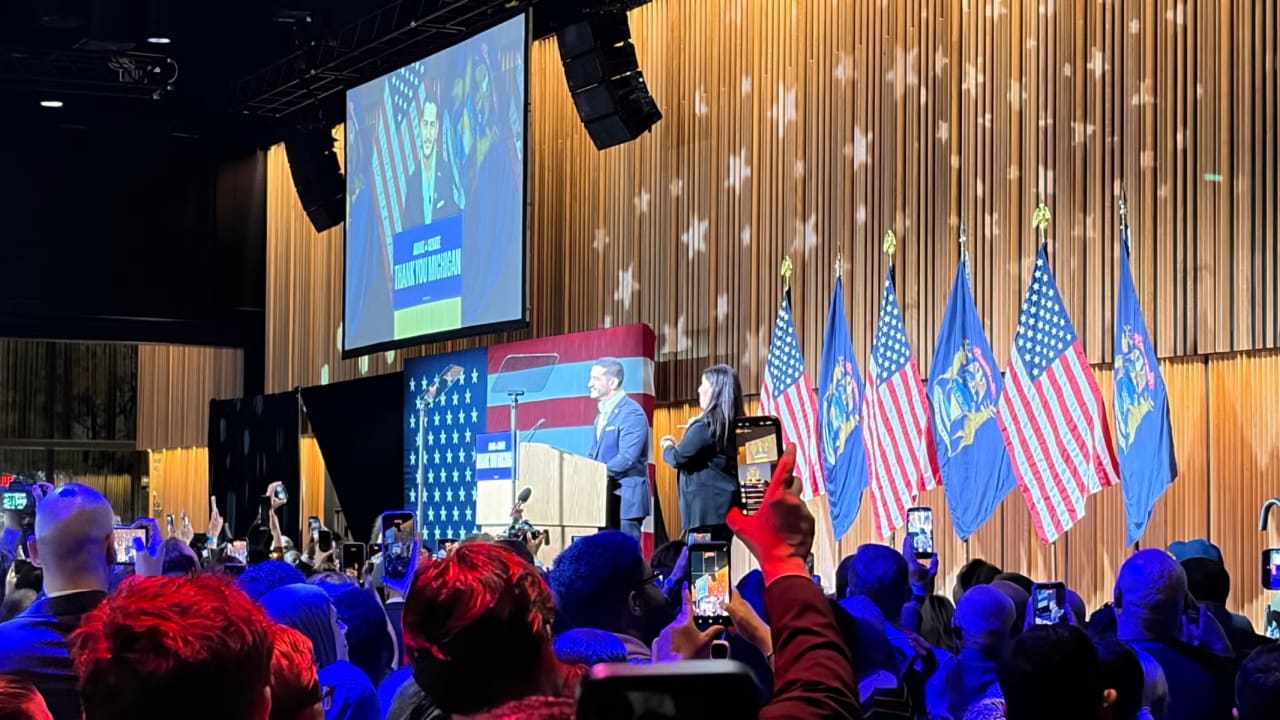
NOVEMBER 5, 2026 21:04The “Jews For Abdul” in the room at the Michigan Democratic Party’s election night watch party were beaming as vote tallies rolled in, pushing Abdul El-Sayed closer to his eventual victory in Michigan’s US Senate race.“It’s actually hard to put into words what this night, and this moment, means to our movement,” Eli Newell, the Midwest field organizer for left-wing Jewish group IfNotNow, told the Jewish Telegraphic Agency shortly before El-Sayed’s victory speech.Newell added, “We see our agenda of shared safety, equality, justice and a brighter future for all represented in Abdul’s candidacy.”IfNotNow had mobilized heavily for El-Sayed, bringing a sizable Jewish cohort in from out of state to canvass in Jewish neighborhoods. Newell himself lives in Chicago. But he and many of the other Jews at the watch party - who almost exclusively tacked left, particularly on Israel - offered a markedly different outlook from the state’s more traditionally pro-Israel Jewish institutions.Rabbi Asher Lopatin (r), who heads the Jewish Community Relations Committee of Ann Arbor, campaigns for Republican US Senate candidate Mike Rogers (l) in Detroit, Michigan, Aug. 20, 2026. (credit: SCREENSHOT VIA YOUTUBE)Many of the leaders from the latter camp had publicly mobilized against El-Sayed to various degrees during the campaign, objecting not just to his hard-line criticism of Israel, but also to his initial reaction to the state’s Temple Israel attack and his associations with Hasan Piker, the far-left streamer. For those Jews, the candidate’s victory was a more challenging story.“Personally, I’m not sure I’m on his most favored list,” Rabbi Asher Lopatin, community relations director at the Jewish Federation of Greater Ann Arbor, told JTA the day after El-Sayed’s win.Lopatin one of first Jewish figures to campaign for RogersShortly after El-Sayed won the Democratic primary, Lopatin took a brief leave of absence from his job to campaign with the Republican nominee, former US Rep. Mike Rogers. He was one of the first Jewish figures in the state to do so publicly. The week before the election, he also appeared at a Republican Jewish Coalition event boosting Rogers, where he and another rabbi in attendance received shout-outs from the stage.Now Lopatin and other Michigan Jewish leaders who similarly backed Rogers face a new question: How can they build relationships with a senator they have gone on record as opposing on deeply personal grounds?“I’m not taking anything back. But I think we have to work with what we have,” Lopatin said. “We have to build relationships with him. We have to build relationships with his supporters.”Broadening the Jewish tent to include El-Sayed supporters was also on the mind of Decky Alexander, who chairs the Michigan Jewish Democratic Caucus. The caucus had refrained from endorsing the senator-elect during the campaign, and several members of its leadership had openly pledged to vote for Rogers.Into that void, progressive Jews in the state organized Michigan Jews for Democracy, a grassroots movement to offer an alternative Jewish voice backing El-Sayed.Now, Alexander said things were shifting. “We need to make sure that we are inclusive in our caucus,” she told JTA, naming Michigan Jews for Democracy and Bend the Arc, a progressive Jewish group that had endorsed El-Sayed, as potential new partners she’d like to work with. “I think we need to have those voices at the table.”The senator-elect’s campaign, on Thursday, pointed to a progressive PAC analysis of voting by ZIP code to argue that El-Sayed had “virtually matched” the 2024 Jewish vote for Michigan’s Jewish senior senator, Democrat Elissa Slotkin. The PAC, Millions of Michiganians, claimed that El-Sayed lost only 1.3% of votes across 72 heavily Jewish precincts that had gone to Slotkin.Yet uniting such disparate Jewish voices could be easier said than done. In one reliably Democratic, heavily Jewish Detroit suburb in the days leading up to the election, homes could be seen repurposing their old “Haley Stevens for US Senate” yard signs after the pro-Israel congresswoman endorsed Rogers in the race’s final days. El-Sayed beat Stevens in the Democratic primary in August.Those yard signs went back up after Stevens’ endorsement and were still up after El-Sayed’s victory on Tuesday. Some had new handwritten additions addressed to Stevens: “Proud of you! Stand tall!!”Hundreds of Michigan Jews pledged to vote for Rogers over El-Sayed’s rhetoricPrior to Election Day, more than 560 Jews in the state had signed a petition, titled “Michigan Jews Against Extremism,” that pledged to vote for Rogers explicitly because of concerns over El-Sayed’s rhetoric.While ultimately numbering slightly more than half of the total Jews to sign the open letter supporting El-Sayed, the signatories were influential. They included the president of Detroit’s Jewish federation; the head of the local flagship Holocaust center; and Mark Davidoff, who heads the Michigan-Israel Business Accelerator.After the election, Davidoff told JTA that his pro-Israel business group “is prepared to work with all newly elected and returning leaders across Michigan.”A representative for the “Against Extremism” letter, Kalamazoo-based Troy Zukowski-Serlin, told JTA after the fact that the letter may have been too strongly worded.“You could just as easily point a finger at the Mike Rogers campaign, with extremism,” Zukowski-Serlin, who had been listed as a Michigan Jewish Democratic Caucus board member until he declared his intent to vote for Rogers, reflected. “That probably got the group off to a bad start.”Even as the Rogers campaign had courted Jews, it also employed messaging many outside observers pegged as Islamophobic. Some of El-Sayed’s campaign surrogates who liaised with the Jewish community, including Michigan state Sen. Mallory McMorrow, also pointed to Rogers’ associations with Christian nationalist donors.Today, Zukowski-Serlin said, “I can understand why somebody would vote for El-Sayed.” His own daughter did, for one - and they were far from the only Jewish household in the state to have split their votes.Echoing a line El-Sayed himself often employed when addressing Jews on the campaign trail, he suggested that, apart from Israel, they were likely aligned on most policy positions.“There’s plenty of other issues that I think we can find common ground on,” he said. “I think we can get along.”Other Jewish groups in the state didn’t mince words, even after the race was called and some early-voting exit polls suggested that a majority of Jews in the state may have voted for El-Sayed despite any reservations.Michigan’s chapter of the Anti-Defamation League was among those to signal what it called “serious concerns” with El-Sayed’s “history of minimizing the fears of the Jewish community and demonizing Israel.”The ADL’s statement included an olive branch of sorts.“As we move forward, Senator-elect El-Sayed has an opportunity and a responsibility to demonstrate that he will hear Jewish Michiganders, reject efforts to blame or marginalize them because of their connection to Israel and confront antisemitism with the moral clarity this moment requires,” the organization noted.Detroit’s chapter of the American Jewish Committee (AJC) raised similar flags. While recognizing what it called the “historic significance” of El-Sayed becoming the first Muslim elected to the Senate, the AJC statement continued, “Unfortunately, this historic moment has been tarnished by the Senator-elect’s continued anti-Israel rhetoric that alienates countless Jewish Michiganders and other supporters of the State of Israel, and endangers American Jews.”Detroit’s Jewish federation, meanwhile, congratulated “all those elected to federal, state, and local office in Michigan” and offered a veiled plea for restraint without naming the senator-elect.“Together, we look to those elected to act with wisdom, lead with compassion, and uphold the civic and social values that ensure the safety and inclusion of our community and of all Americans,” the nonpartisan organization’s communal relations arm said in a statement.Gary Torgow, the Michigan-based chair of the Jewish Federations of North America, told Rogers during the campaign, “We need you to get elected.” On Thursday, Torgow released a post-election statement calling on the local Jewish community to “move forward with optimism, dignity, and pride in who we are.”Now the work of mending fences begins - not just between El-Sayed and Jewish leaders, but between Michigan’s Jews themselves. Across the state, rabbis offered reassuring messages to their communities, and some were eager to put the divisiveness of the campaign season behind them.“I think the election divided the Jewish community,” Lopatin said. “I’m excited to get back to uniting them.”Follow us on Google
Michigan Jews divided after El-Sayed’s Senate election
Full Article
Original Source
Read the full article at Jpost →KhanList aggregates and links to publicly available news content. We do not host full articles from third-party sources. Always verify important information with original sources.