
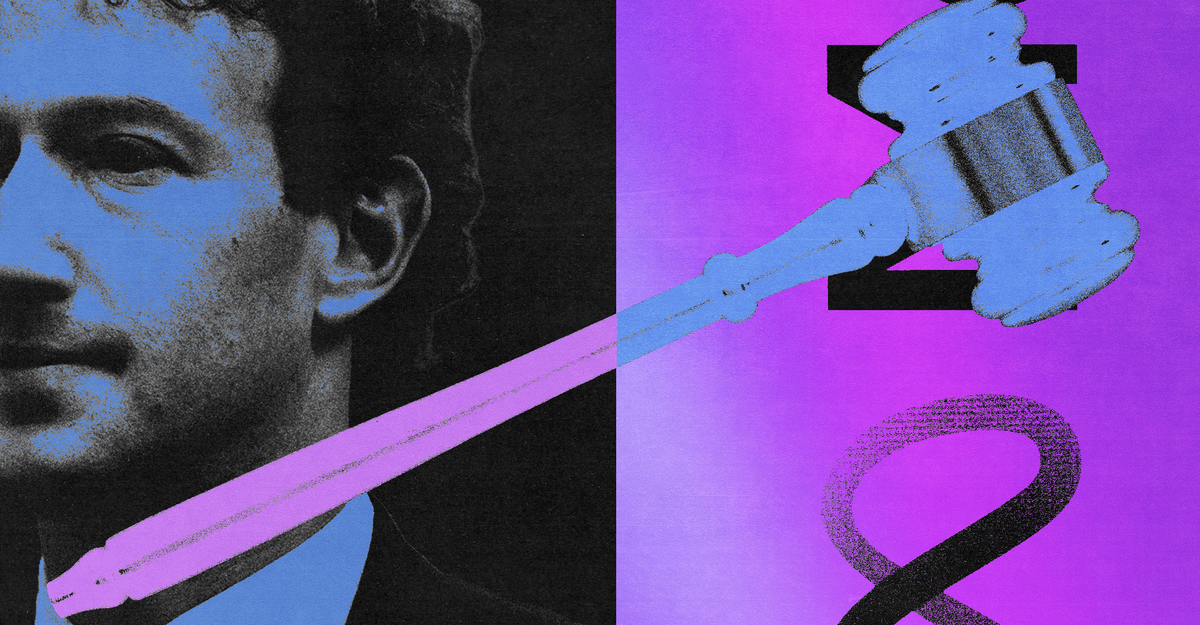
Instagram and Facebook will be radically different following a landmark settlement.Illustration by The Atlantic. Sources: Tom Williams / Getty; Shutterstock.August 26, 2026, 6:18 PM ET Meta avoided the worst today by settling a massive lawsuit over alleged damages “to the mental and physical wellbeing of America’s youth.” The case, brought by the attorneys general of 47 states, plus U.S. territories and Washington, D.C., had been mid-trial in a federal court in California and was by far the most significant legal challenge the company has ever faced. To resolve the lawsuit, Meta will have to make a slew of design changes to its social-media platforms, and it will pay more than $12 billion—down from the approximately $200 billion that was initially sought, and a fraction of the $60 billion that the company made in profit last year.The settlement can be used by the states and other parties to pay for their litigation costs and for a variety of school and community programs. Judge Yvonne Gonzalez Rogers agreed to the proposal this morning, saying “I’m quite happy” and congratulating both parties. There seems to be good cheer all around; Meta, which avoided any admission of guilt, put out a sunny announcement framing the agreement as part of its “longstanding efforts to empower parents and support teens.” Brian Schwalb, the attorney general of the District of Columbia, told The New York Times that the settlement represents a “monumental public health victory” that will “fundamentally and immediately change how young people use Instagram and Facebook.”The former claim will have to be proved over time, but the latter is clearly true. As part of the agreement, Meta has agreed to submit to regular auditing of both its age-verification systems and its efforts to prevent minors from making multiple accounts to get around its restrictions. And the company will make other tweaks that are intended to target the big recent villains of social media: short-form video and the never-ending feed.Read: A legal decision that could change social mediaTeen users, by default, will not have access to most features of Instagram and Facebook at night (though they can still access messages and settings) and will not receive notifications from the platforms during school hours (defined as 8 a.m. to 3 p.m. on weekdays from August 15 to June 15). They’ll also be limited to a maximum of one hour a day per platform, though this doesn’t include time spent sending messages or consuming long-form content (which the agreement defines as audio or video at least 22 minutes long). Meta is also required to interrupt scrolling every 15 minutes with pop-ups that encourage “productive pauses,” and the company will have to study how well the interruptions work and submit its findings to an auditor. Parents can still manually change any of these settings for their kids.The settlement also requires limits on features that some experts believe are detrimental to teenagers’ self-esteem and self-image. By default, teen users won’t see the number of likes or reactions on posts; they also won’t be able to use “cosmetic procedure filters,” which have been a sore spot for Meta for some time. When the plaintiffs filed their complaint, they cited evidence that Mark Zuckerberg had personally vetoed a proposed in-house policy against these filters despite concerns expressed by employees that they were causing young people to develop body dysmorphia. Meta will also be legally required to maintain and enforce the “age-appropriate” content guidelines it debuted at the end of last year.This may seem like quite a lot of changes—especially considering that the case is not even the end of Meta’s legal problems. The company is still facing numerous lawsuits filed by individuals and school districts. “If Meta is going to resolve all its pending liabilities, this is only the first of several large checks it is going to have to write,” Eric Goldman, a professor at Santa Clara University School of Law, told me. But today’s settlement shows that the tech company was able to “buy out one of the most serious legal threats” it faced, and it managed to do so without acquiescing to demands that might have been truly destructive to its business. Meta will have to give teen users the ability to opt in to a chronological, non-personalized feed, but the company does not have to pivot away from the default algorithmic recommendations that many critics characterize as addictive. It seems unlikely that many people will select a straightforward chronological feed; Meta has tested this change before and found that users did not like it.Read: What if it’s not the phones?As for the one-hour limit, in an email, a Meta spokesperson told me that the average American teenager spends about 66 minutes a day on Instagram anyway, and that teen activity across platforms accounts for less than 1 percent of the company’s revenue. So perhaps these were battles that the company could afford to lose.The attorneys general “made a bunch of guesses” as to what kinds of changes might help kids, Goldman said, and have pulled off a major success in getting Meta to accept them. Many of these interventions might have suffered First Amendment challenges if they’d been pursued by other methods. (For instance, if the plaintiffs had actually won at trial.) Mark Bartholomew, a professor at the University at Buffalo School of Law, agreed, writing to me that “the state AGs got Meta to consent to dramatic limits on its own speech that Congress was unlikely to go for and the courts were unlikely to bless.”The company is now promoting the changes widely and calling on other social-media platforms to follow suit. It has also agreed to pay an additional $5.3 billion if TikTok and YouTube, which are also defendants in the ongoing litigation, implement restrictions and pay into the settlement. Although this is not the end of Meta’s legal battles—personal-injury lawsuits similar to the one it lost in March will likely keep coming—the company has won the opportunity to select its own restrictions, define its own limits, and discard its own deal-breakers, effectively setting a standard that the rest of the industry will be expected to abide by without having had any say in its creation.“Obviously, Meta doesn’t want to unilaterally disarm in the war for user attention while its rivals are allowed to continue,” Bartholomew noted. At the start of the year, when the first of Meta’s big cases came to trial, I wrote that social media had come to a fork in the road: The lawsuits were asking existential questions about whether social-media platforms are responsible for a mental-health crisis and whether it is possible to hold them accountable for it. This agreement answers only the second question—yes, it is possible, but for now, it may be possible on only one company’s terms.
Meta’s Day of Reckoning
Full Article
Original Source
Read the full article at Theatlantic →KhanList aggregates and links to publicly available news content. We do not host full articles from third-party sources. Always verify important information with original sources.