
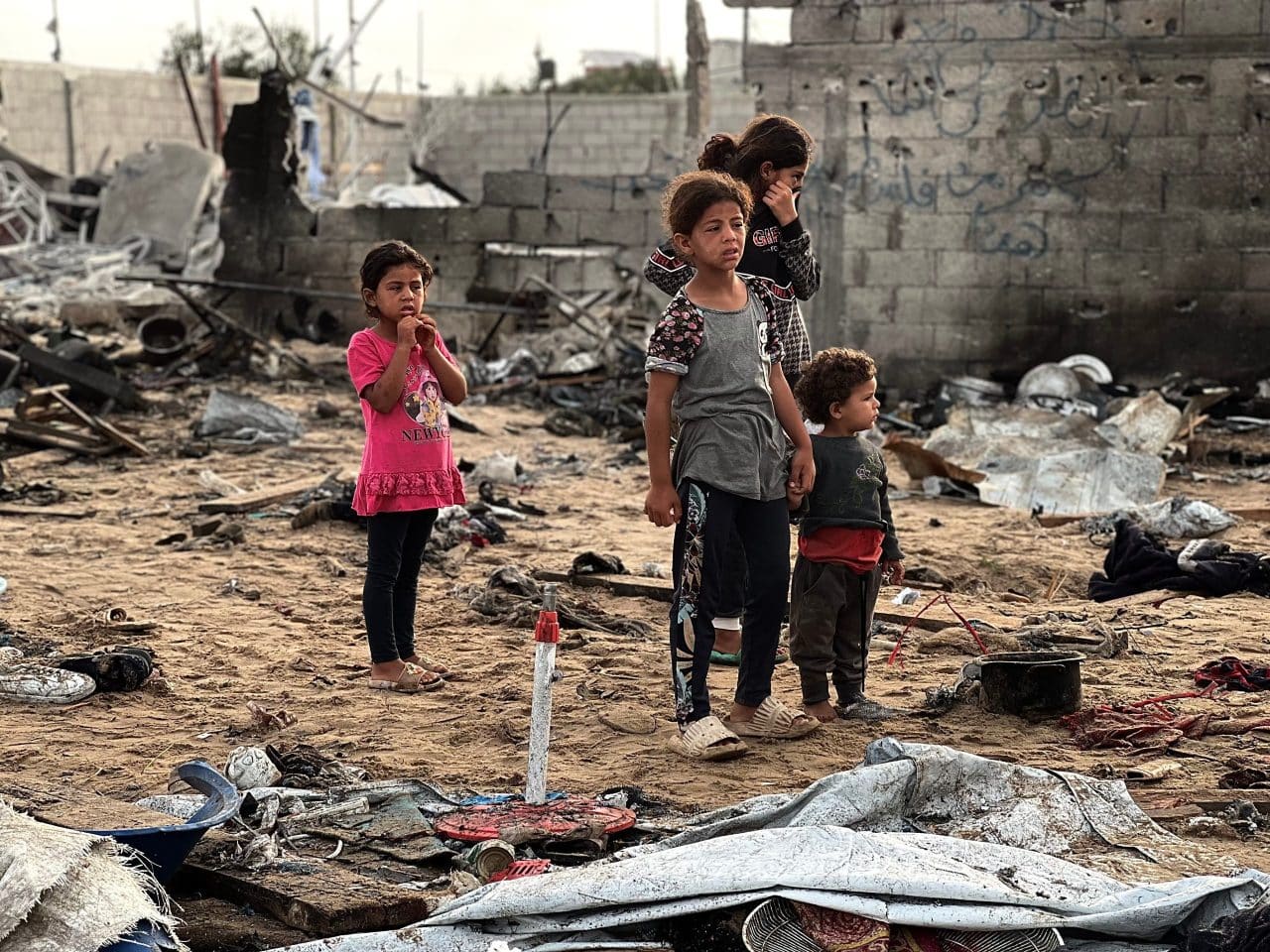
Islam al-Ajili, 34, has spent the past eleven days at Nasser Medical Complex in Khan Younis, staying beside her five-month-old baby, who is receiving treatment for meningitis. After giving birth last July, al-Ajili returned from the hospital to her tent in al-Mawasi, west of Khan Younis. But the conditions she and her baby faced there were far from those needed to protect a newborn from disease. Poor hygiene, insects, rodents, and other hazards had become part of everyday life inside the displacement camps. She says she used to place a white cloth around her baby so she could spot the reptiles and insects that might enter the tent. “We lack basic hygiene in general, and the environment we live in inside the tents is suitable for the spread of all kinds of diseases, including the most dangerous ones. We live alongside insects, mice, and rodents. Even stray dogs enter our tents at any time,” she said. Al-Ajili’s experience comes as the Ministry of Health in Gaza warns of an escalating meningitis outbreak, with infections increasing more than eightfold in October compared with the usual monthly rate. 15 deaths among children have been recorded so far, according to the ministry. On November 24, Dr. Nidal Ghannam, Deputy Director General of Primary Healthcare for Public Health Affairs in Gaza, announced in a press conference at Nasser Hospital an epidemic alert across the Strip, warning that the outbreak threatens the lives of hundreds of thousands of civilians, particularly children. “From the heart of the Gaza Strip, we alert the entire world to the fact that the Gaza Strip is facing an epidemiological risk that threatens the lives of hundreds of thousands of civilians, foremost among them children,” Ghannam said. He explained that preventive medicine teams had been monitoring meningitis cases across all governorates over the preceding two days, leading to the declaration of an epidemic alert throughout Gaza. According to the ministry’s epidemiological surveillance data for 2026, reported cases of both viral and bacterial meningitis have risen significantly. The outbreak reached its peak in October, when 272 cases were recorded in a single month, compared with the usual monthly rate of 30-50 cases. Bacterial meningitis cases have also risen sharply, increasing from 10-20 cases per month to 108 cases in October. Another 100 new cases were recorded between the beginning of November and the day of the ministry’s press conference. Ghannam says that the Ministry of Health laboratories had recently identified and confirmed the pathogen responsible for viral meningitis. “It belongs to the enterovirus group and is closely associated with environmental deterioration.” He noted that this form of meningitis is less dangerous and that patients generally recover fully. The ministry, nevertheless, has recorded 15 deaths resulting from meningitis infections since the beginning of the year, five of them during the past three months. The ministry attributes the rise in infections not to an isolated natural phenomenon but to the “direct consequences of the systematic Israeli destruction of Gaza’s infrastructure and the harsh environmental and living conditions imposed on its population. “Severe overcrowding in displacement shelters, damaged water and sewage networks, and the mixing of domestic water with wastewater have all contributed to the deterioration. The situation has worsened with the arrival of winter, as rainfall and flooding have caused sewage water to spread through displacement shelters and densely populated residential areas, creating conditions conducive to the transmission of infectious diseases,” the Ministry of Health explained. The ministry also points to the lack of sufficient clean drinking water, deteriorating public hygiene, and acute shortages of laboratory and diagnostic supplies and essential medicines banned by Israel from entering Gaza. These shortages are placing further pressure on hospitals and pediatric departments, according to its statement. Inside the pediatric department at Nasser Medical Complex, Dr. Darwish Abu al-Khair, a pediatric specialist, says the hospital has been dealing with a severe wave of meningitis for more than a month. “We have enormous numbers of patients coming to the emergency department, reaching between 500 and 600 children every day,” he said. “The infection and its spread are now at their most severe, and we are at the peak of the outbreak. Our departments are overcrowded with hospitalized children, and we no longer have the capacity to admit or accommodate additional children. As a result, we are transferring children to other hospitals that can accommodate them.” Abu al-Khair identifies overcrowding in displacement camps as one of the main factors contributing to the spread of the disease and the increase in infections. The outbreak has coincided with the beginning of winter, when rainfall and flooding have further exposed the consequences of Gaza’s destroyed infrastructure. According to the doctor, the mixing of rainwater with sewage and drinking water has caused environmental contamination, creating conditions that facilitate the spread of infection. After the ceasefire agreement in October 2023, the Israeli army has split the Gaza Strip by the so-called ‘Yellow Line’ into two halves. The Israeli military occupies almost 70% of the Strip, resulting in 1.4 million displaced people crowded in displacement camps in separated parts of the Strip. For al-Ajili, who is displaced in al-Mawasi in Khan Younis, the illness began with a fever in her baby. She initially took her baby to the hospital, where the infant received medication before returning with her to the tent. But the fever continued to rise, forcing the family to take the baby back to the hospital. Doctors then examined a sample of spinal fluid, taken from the baby’s back, as the mother describes it. The examination confirmed the diagnosis of meningitis. The experiences of families dealing with meningitis inside Gaza’s displacement camps vary according to their awareness of the disease and their ability to provide care for their children. For some, recognizing the symptoms and seeking medical attention early has made a difference. Inside Nasser Medical Complex, 36-year-old Naima al-Qudra holds her four-month-old son, who is also being treated for meningitis. She says she first noticed that her baby had become unusually and persistently lethargic and was experiencing difficulty breathing. She immediately took him to Nasser Medical Complex, where several examinations confirmed that he had meningitis. Al-Qudra believes that her family’s awareness of the seriousness of the illness from the beginning, together with the assistance of the hospital’s medical teams, helped them confront the disease. “From the first day we discovered the illness, I was given intravenous treatment because I am a breastfeeding mother of an infected child. The medical teams at Nasser also gave my husband and children a type of medication to protect them,” she said. “We received appropriate medical care, even if it was limited, but we managed to overcome this disease.” Al-Qudra has remained at the hospital for eleven days since her son was diagnosed. She says she believes they have managed to overcome the illness and that her son will not become one of its victims. She also stresses that without the medical care she received at Nasser Medical Complex, she would not have been able to say that they had overcome the disease. Meningitis, she explains, requires medical supervision around the clock, with medications and intravenous fluids administered every six hours according to a specific schedule, alongside antibiotics and intravenous solutions. Such continuous medical care, she says, is simply impossible to obtain inside a displacement tent.
Meningitis cases surge in Gaza as deteriorating living conditions put children at risk
Full Article
Original Source
Read the full article at Mondoweiss →KhanList aggregates and links to publicly available news content. We do not host full articles from third-party sources. Always verify important information with original sources.