
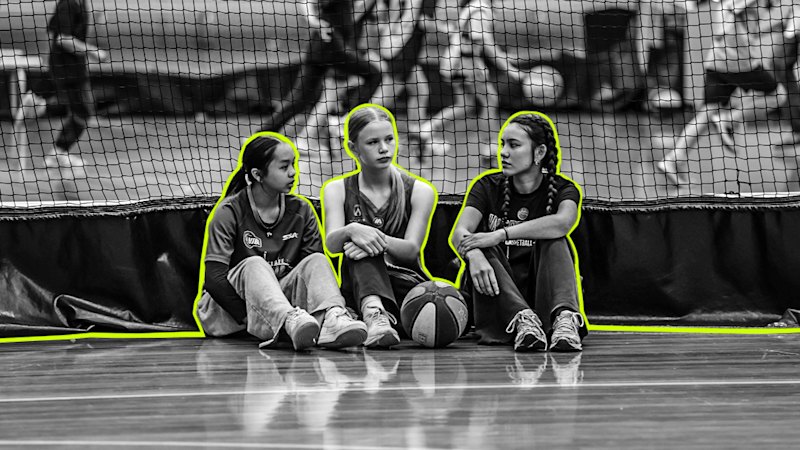
October 16, 2026 — 5:00amSarah Simpson is steeling herself to make a difficult announcement. She is about to inform at least 15 teenage girls that they cannot play basketball for Westgate in the junior state league this season.“We have enough quality talented girls to field another representative team … but we can’t actually enter it because we don’t have enough courts,” the Westgate Basketball Association general manager said. “I got a bit emotional looking at some of the girls who might miss out an opportunity last night … It’s causing a lot of anxiety and stress.”Zara Garcia, Freya Morris and Skye Coonerty from the Westgate Imperials at RecWest community sports facility.Joe ArmaoSimpson said it was particularly frustrating to have to turn away girls aged 14 and 15 – the demographic most at risk of dropping out of sport altogether – due to a lack of access to training facilities.About 150 more children in Melbourne’s western suburbs are on the waitlist to join Westgate’s domestic teams, most of which are running sessions late into the night to extend capacity, while some are even considering adding sessions before school.“It impacts the kids and their schooling because they’re absolutely exhausted,” Simpson said. “But that’s literally the only time we can get them on the court.”Though Westgate has arrangements with some schools in the area, Simpson said they had reached an impasse with others, including one government school that had declined to open its courts to community clubs outside of school hours.The Age has been taking an in-depth look at big ideas for the future of Melbourne, including what it means to be the sports capital of Australia, and what the city must do to retain and strengthen this status – a key theme being explored at next week’s Melbourne Assembly.One of the top priorities for Vicsport, the state’s independent peak body for sports and recreation, is getting the government to compel public schools to share their facilities with community sports clubs out-of-hours.Vicsport chief executive Elyse Jenkins said the government should introduce a mandate, and invest in a centralised portal to make it easy to co-ordinate. She said private schools should also be encouraged to take part, given they also receive government funding.“There are informal agreements happening between schools and sporting clubs at the moment, but it’s ad hoc,” she said. “There’s a big opportunity to use tech here … to maximise the use of space.”In July 2025, the Victorian government announced a $1.4 million pilot program to open sports facilities at 41 public schools for out-of-hours community use.The government told The Age that to date, its pilot program had resulted in assisting with the administration and establishment of 55 community-use agreements that could be one-off, occasional or up to five years in duration.Then premier Jacinta Allan with her successor Ben Carroll in Pascoe Vale last year to announce a pilot program to open school sports facilities to community clubs out-of-hours.Justin McManus“We know quality community facilities are in high demand, which is why we’re making better use of existing school facilities and ensuring every new public school is designed with spaces that can be shared with the local community,” Deputy Premier and Minister for Education Gabrielle Williams said.However, some schools on the government’s list that The Age spoke to were not aware they were taking part in the pilot. One said extenuating circumstances had not allowed it to participate, while another school said its facilities were already owned by the YMCA in a public-private partnership, so it was not up to the school what access was provided. Another explained it had been renting out its facilities to community groups before the pilot program, and that demand was so high it was regularly turning clubs away.The lack of clarity around the program, including who is responsible for co-ordinating with sports clubs, appears to have hampered efforts, and is emblematic of the issue as a whole across Victoria.At a national level, the federal government has also listed increasing community access to school sports facilities as a short-term priority in its grassroots sports strategy. Since June, a national team has been leading a monthly working group with representatives from every state and territory exploring how to achieve this.Jenkins said South Australia was so far taking the lead, committing to introducing legislation requiring all public schools open their doors to local clubs outside teaching hours, organised via a central booking platform.Sports facilities not aligned with populationIn 2024, residents of Melbourne’s growth corridors recorded the lowest sports participation rates of anywhere in the state.Cricket Victoria chief executive Nick Cummins said many outer suburbs had minimal access to grounds and facilities, despite significant opportunities to build green space. As the city’s population continues to grow, Cummins said this needed to be a fundamental consideration in designing new communities.The general manager of Westgate basketball, Sarah Simpson. Joe ArmaoMeanwhile, in the inner city, he said the focus must be on maximising the use of existing facilities. On top of leveraging school facilities, he said installing lights at community sports grounds was a simple way to extend access.Cummins is among a number of local sports leaders calling on the state government to do more to address the gap in grassroots facilities and establish a clear strategy to keep pace with population growth and participation trends moving forward.“Our fastest-growing cricket association is winter cricket, which has grown to something like 400 teams … So they’ve got to find grounds that are not used for winter football codes,” Cummins said. “Then you’ve got footy clubs wanting to access cricket grounds in the summer [for pre-season training] and pushing their seasons back later because they’re having byes in the middle of the year.”Lalor Football Netball Club, whose home ground was the site of footballer Nathan Fitzgerald’s fatal on-field accident earlier this year, told The Age at the time that there had been issues with people pulling the cover off in the winter to play cricket – which can cause covers to lose some of their cushioning and risk exposing the concrete underneath. The cause of Fitzgerald’s death is yet to be determined, but many observers expressed concerns about him having hit his head on this part of the field.Football Victoria said its recent audit of more than 1000 pitches across Victoria found 48 per cent did not meet the 100-lux lighting standard, while 50 per cent were in moderate, poor, or very poor condition.Another sport that has grown in popularity over the past decade is badminton, which the national governing body said had been influenced in part by a growing Asian migrant population.There are around 350 dedicated badminton courts in Victoria across 26 venues, which are primarily commercially operated. With about 70,000 Victorian adults participating in organised badminton, that equates to about 200 participants per court.Badminton Australia said there were also a number of council-owned multipurpose facilities, but that lighting and ceiling heights were not always fit-for-purpose, and there was significant competition with other indoor sports.Badminton Australia chief executive Tjitte Weistra has called on local and state government to factor a more diverse range of sports into facilities planning.Badminton Australia“We would like to see greater recognition of badminton’s participation footprint within government and local council sporting infrastructure planning,” said Badmington Australia chief executive Tjitte Weistra, a former professional badminton player and coach from the Netherlands.“Access in Europe to multi-use facilities are far more equitable and fair compared to Australia, where basketball and netball have a stronghold on council facilities and it’s very challenging for other sports like badminton to get access more than once per week at not very desirable times of the week.”Other sports such as pickleball and padel have also seen significant surges in popularity, collectively doubling their participant numbers in Victoria between 2024 and 2025.One solution being explored by Basketball Victoria is partnering with private businesses. Earlier this year, a three-court competition-grade basketball facility opened in Melbourne’s outer-east that was fully paid for by the owner of the shopping centre beneath it, Forest Hill Chase.Basketball Victoria general manager Jake Keogh said he had since met with two other shopping centres interested in doing the same thing.According to Keogh, Victoria remains about 200 basketball courts short of meeting demand, with an additional 20 courts per year required based on the current growth rate.He has secured election commitments to fund new courts at six priority sites from both the Labor and Liberal parties, but not all areas have been so lucky.The City of Maribyrnong, where the Westgate Basketball Association is based, is among those still waiting for investment. Simpson said a 2018 council review identified an urgent need for between four and six more courts in the area.Six years and 3000 more participants later, those courts are yet to materialise. While council has approved a site at McIvor Reserve in Yarraville, and asked state ministers for support financing it, neither party has come to the table.Melbourne Assembly will be held from October 19 to October 21. More information is available on the Melbourne Assembly website.From our partners
Melbourne’s sports crisis: Why children most at risk of dropping out are being turned away
Full Article
Original Source
Read the full article at Smh →KhanList aggregates and links to publicly available news content. We do not host full articles from third-party sources. Always verify important information with original sources.