
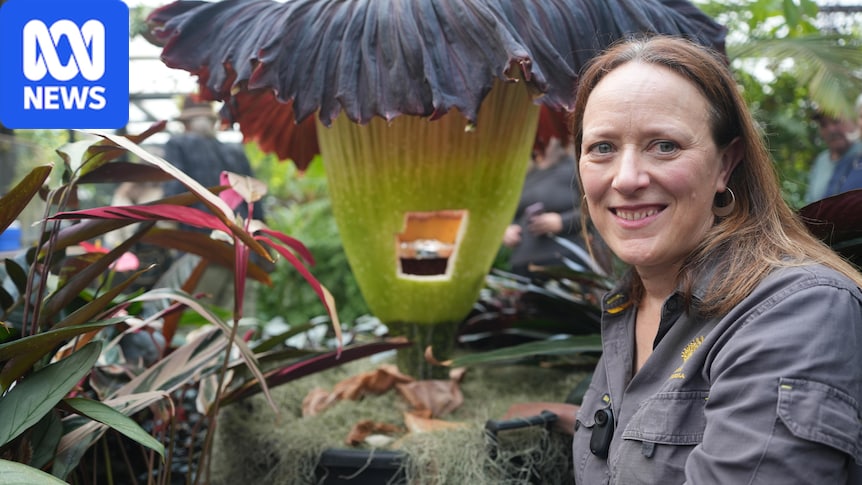
Rotting fish. Dirty socks. Mouldy carpet. Dead Rat. None of these things smell very nice, but they are some of the words used to describe the stench of a corpse flower in bloom in the Geelong Botanic Gardens this week.Thousands of Victorians lined up to get into a humid 27-degrees-Celsius green house, putting up with persistent mosquitos and intermittent mist from the overhead watering system."People say it's like rotten flesh, but I would say it's a little bit more like just general funk stench, like the bottom of a teenage boy's school bag," said John Tucker from Geelong.The excitement among the crowds was palpable.The plant, named Pete by his keepers, did not disappoint.John Tucker says the corpse flower smells like a "teenage boy's school bag". (ABC News: Jonathon Kendall)"It's quite impressive," Mr Tucker said."I didn't think it was going to be as impressive as it is."And the stench when you come in is a little bit overpowering."An imposing presence, Pete was the star of the show and refused to be overawed by the moment.When he had finished flowering he even took a bow, collapsing on Friday morning.The titan arum only blooms for up to two days every seven to 10 years. (ABC News: Jonathon Kendall)Saving the flowerCorpse flowers, also known as titan arums or Amorphophallus titanum, do not just have a rare odour: scientists estimate there are fewer than 1,000 left in their native jungles of Indonesia.They have become endangered because of poaching, climate change and deforestation for palm oil, timber or agriculture.Their stubbornly infrequent reproductive cycle has also played a role, with the flower only blooming for up to two days every seven to 10 years.Behind the scenes, Royal Botanic Gardens Victoria research scientist Dr Rebecca Miller has been working on a conservation mission to make sure others can experience the rare corpse flower bloom.Rebecca Miller cut a window into the plant and monitored its temperature. (ABC News: Jonathon Kendall)She monitored the plant's condition and temperature before performing some stinky surgery, using a scalpel to harvest Pete's pollen so it could be kept safe as an insurance policy against extinction.It is the first time pollen from the corpse flower will be stored at the Victorian Conservation Seedbank at the Royal Botanic Gardens of Victoria in Melbourne.Dr Miller said she planned to experiment with how to store it best.Yellow male flowers on the inside of the titan arum releasing pollen with the darker female flowers below. (Supplied: Dr Rebecca Miller)"We'll be storing it at different temperatures, minus 20, minus 80, changing the relative humidity or moisture content of the pollen," she said."Hopefully we're able to store it for a few years and it can be used to pollinate flowers that might flower in other botanic gardens around the world."But Dr Miller said corpse flowers in captivity often had the equivalent of "a low sperm count"."I think the viability will be low, which is what seems to be typical of the species and what's been found elsewhere with these titan arums," she said."But I'm hopeful that we'll be able to retain some that we can use going forward."Lucy Griffiths predicted in May the plant would flower this year. (ABC News/Jonathon Kendall)The Geelong Botanic Gardens staff said they were proud of the role they were playing in saving the corpse flower from extinction."I think the fact that this plant is endangered in the wild creates a bit more interest and people want to learn about why that is and it makes us feel special that we can house it and be a part of the conservation effort of this plant," said Geelong Botanic Gardens horticulturalist Lucy Griffiths.Dr Miller is hoping having Pete in the spotlight will also bring attention to Australia's natives that use similar reproductive techniques, such as Lazarum wilbertii, which is endemic to northern Australia.It mimics the smell of herbivore dung to trick flies into providing pollination services."They're rare and they're beautiful," Dr Miller said."The Arum family, the Araceae family, is distributed globally and we have a really special contribution to that family within Australia that I think are underappreciated."
Meet the scientists working to save the corpse flower from extinction
Full Article
Original Source
Read the full article at Abc →KhanList aggregates and links to publicly available news content. We do not host full articles from third-party sources. Always verify important information with original sources.