
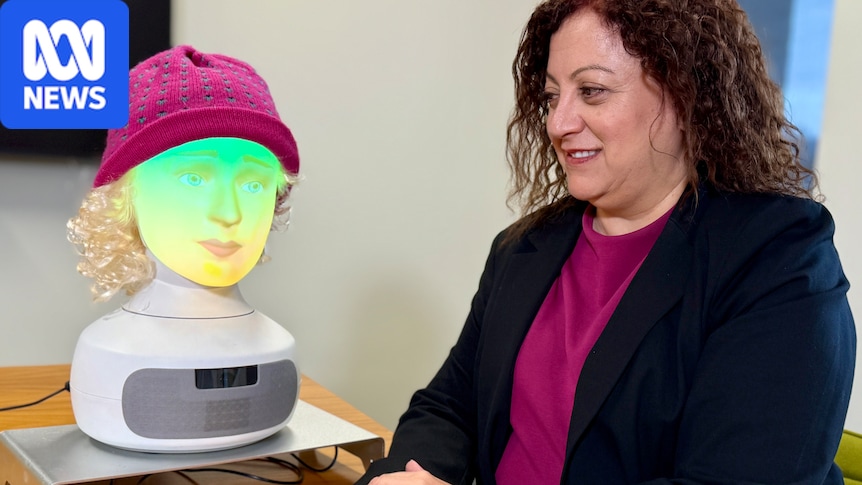
With conflicts at school gates across Australia happening on "a day-to-day basis", digital education expert Therese Keane hopes a new robot powered by artificial intelligence will help prepare teachers and stop them from leaving the profession."We have verbal aggression and physical assault," Professor Keane, from La Trobe University, said."It is quite a large problem. A lot of the time it's under-reported and so we don't really have a true picture of what's going on."A longitudinal survey of principals has found violence against teachers increased by 80 per cent over the past 15 years.While emphasising that most parents interacted with schools respectfully, Professor Keane said conflict with those who did not could be so distressing that teachers quit."After a couple of hits of these sorts of interactions they lose their self-confidence, their self-esteem and that then starts to make them concerned, stressed, burned out," Professor Keane said.Professor Keane's solution was to draw on hour-long interviews with 20 senior educators, identify common gripes from parents, and group them into scenarios.She and her team then used AI to write scripts to allow Fletch the robot to act as a disgruntled parent in a difficult conversation with trainee and early career teachers.Therese Keane with Fletch the robot, who is helping teachers practise difficult conversations with disgruntled parents. (ABC News: Billy Draper)"They come in very nervous, they're not entirely sure what to expect, they sit there, and do this for about four or five minutes," Professor Keane said."They feel exhausted [afterwards]. They feel it's relentless at times."Cherry Demir is a PhD student and teacher helping train the new teachers.She said Fletch's manner could change to mimic a parent becoming increasingly unreasonable.Cherry Demir says practise conversations with the robot will help prepare teachers for real scenarios. (ABC News: Billy Draper)"Its voice changes, it becomes more aggressive as time goes forward and it does get a little bit difficult and scary, especially for pre-service teachers," Ms Demir said."When you're not well-prepared, it's extremely intimidating, because you're caught off guard most of the time."Ms Demir has been working with Fletch for three years and said new teachers left the training well-prepared for real-world scenarios.Fletch the robot has been trained to become increasingly unreasonable as conversations progress. (ABC News: Billy Draper)"I think this will be invaluable for pre-service teacher preparation. It will be an excellent way to gain confidence," Ms Demir said.Teachers, parents under a lot more pressureLong-serving principal Henry Grossek, who retired last year, had almost six decades' experience to draw on when training Fletch.During a 57-year teaching career, 38 of them as a principal, he saw it all.Unfortunately, his view is that conflict at schools has risen.Henry Grossek retired in 2025 after a long teaching career and says parents and teachers are under a lot of pressure. (ABC News: Patrick Stone)"The world has changed a lot," Mr Grossek said."Post-COVID, we see a different scenario in schools. Parents are under a lot more pressure for a variety of reasons."They don't always articulate their concern or their problem in a way that leads to a productive conversation. Teachers are in the exact same boat."Mr Grossek said Fletch the robot was an exciting initiative that would equip teachers to de-escalate challenging conversations."We've got this perfect storm, where if we've not got productive conversations and relationships between parents and the school, at the end of the day the children will suffer," Mr Grossek said.At La Trobe University, Professor Keane said other uses for Fletch were already being explored, such as difficult conversations between teachers, as well as between teachers and students.Further along, Fletch could also have a role as a classroom assistant, helping identify students not paying attention, she said.According to the team at La Trobe University, it is an example of the benefits that can come from AI, even as society wrestles with potential downsides."These simulations are very positive. This is not something to be feared," Professor Keane said.
Meet the AI-trained robot 'parent' helping prepare new teachers for conflict
Full Article
Original Source
Read the full article at Abc →KhanList aggregates and links to publicly available news content. We do not host full articles from third-party sources. Always verify important information with original sources.