
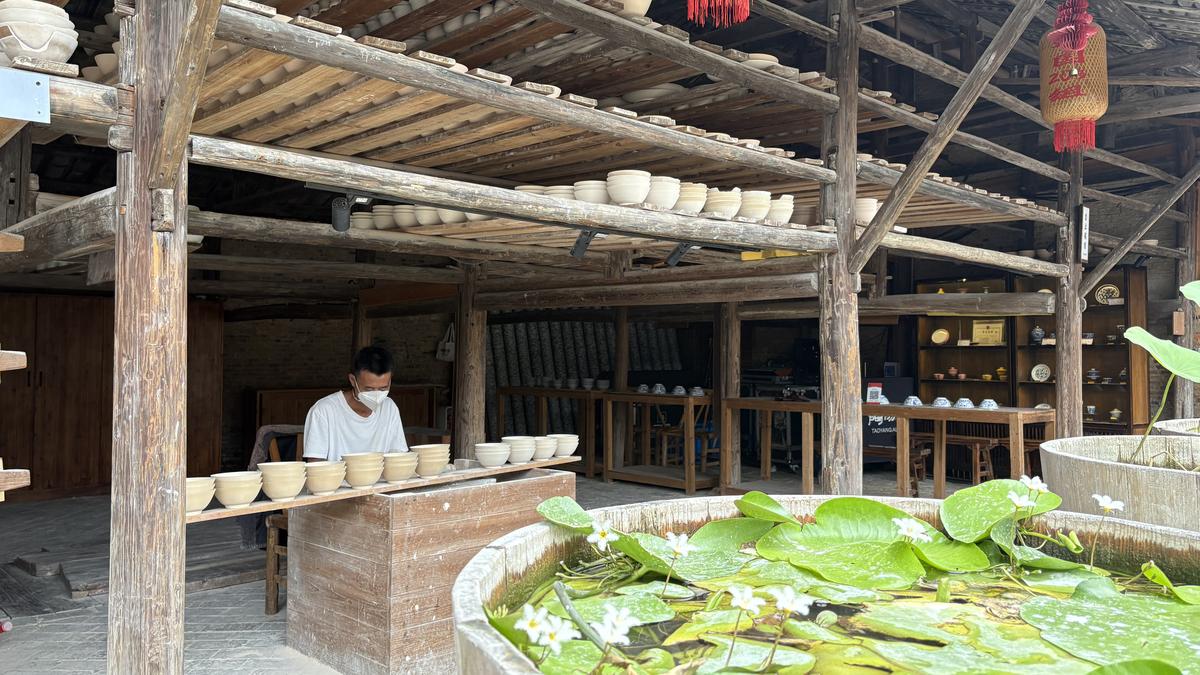
Porcelain runs through the blood of artist Sun Lixin. For several generations, the Sun family has worked in the kilns of Jingdezhen, the ancient town that made china synonymous with China. The porcelain works from this eastern city’s famed Imperial kilns have, for centuries, adorned the residences of China’s emperors, and travelled around the world through the Silk Road and maritime trade, becoming a potent symbol of Chinese soft power. Artist Sun Lixin Jingdezhen — whose 45 handicraft porcelain industrial sites were added to UNESCO’s world heritage site this July — is a thriving hub for artists today. The city, in a sense, is a microcosm of a broader transformation underway in China. “I don’t think there is any other city in the world which has had such continuity spanning more than 1,000 years,” says Sun, who is a senior craft artist at Jingdezhen’s Ceramic Culture Inheritance and Innovation Center.Choosing between reinvention and opting outIt was this history that brought Shao Haichuan, a 34-year-old artist and entrepreneur from the town of Yancheng in Jiangsu province, some 700 km away, to Jingdezhen. In the past few years, Jingdezhen has become a magnet for tens of thousands of young Chinese who’ve dubbed themselves “the Jingdezhen drifters”, or “jing piao” in Mandarin. They are mostly Gen Z, who have left their jobs in the cities and quit the rat race that has become emblematic of life in China’s big cities. Shao Haichuan left a “safe” career in engineering and construction to become a designer-entrepreneur in Jingdezhen You can’t go very far in China today without hearing about the phenomenon of “neijuan”, meaning “involution” — referring to competition so debilitating it ends up becoming self-defeating. For many, the answer is to opt out. Some decide, to use another popular Chinese Gen Z phrase, on “tang ping”, or “lying flat” (opting out of high-pressure competition and prioritising mental health and meeting basic survival needs). Others choose to reinvent themselves.Shao says he epitomises the Jingdezhen drifter. He left behind a “safe” career in engineering and construction, and decided to become a designer-entrepreneur in Jingdezhen. He has a small space in the Taoxichuan market, which is popular with young artists, where he sells the wares (mostly jewellery) of his brand Zheng Wu, which, he explains, refers to a Chinese idiom meaning “not attending to serious business”. “It captures a sense of relaxed creativity, without being completely apathetic or burnt out,” he says. “That describes my ideal creative mindset.” Jingdezhen’s old town has a unique artistic community For Shao, the attraction in moving to this old town was its unique artistic community, coupled with what he sees as its “high efficiency for cultural and creative creators” and enabling of “low-risk entrepreneurship.” Taoxichuan, for instance, charges a 10% commission of sales instead of fixed rent. “I couldn’t afford doing what I do in Shanghai or Beijing,” he says. “Also, we get tourists from China and around the world who specially come here for local ceramics and creative goods. More than that, it has a special overall environment where you are part of a community of fellow entrepreneurs.”Right next to Shao’s studio, Du Ningxin runs a small shop that makes modern porcelain teaware. She tells me she is a fifth-generation porcelain maker, but proudly considers herself a “Jingdezhen drifter” too, despite her local roots. “I grew up surrounded by traditional porcelain, but over time I developed an aesthetic fatigue towards that style. So I decided to start my own studio, and reinterpret this ancient skill with a modern aesthetic.” Du Ningxin runs a small shop that makes modern porcelain teaware A history of talent and techniquePart of the reason for Jingdezhen’s appeal for those seeking to reinvent themselves is its extraordinary history. In China, Jingdezhen’s porcelain is seen as the ultimate representation of the country’s civilisational history. This is chronicled at the city’s stunning Imperial Kiln Museum, a cavernous architectural marvel designed by architect Zhu Pei that is made from 2.8 million bricks, and holds an extraordinary collection, including a prized 15th-century Ming Dynasty porcelain “chicken cup”. A similar cup, small enough to fit in the palm of one’s hand, sold for a record $36 million in an auction in Hong Kong in 2014. It also houses a rare peacock-green Ming vase from the early 15th century that was excavated from a kiln site in 2003. The rare peacock-green Ming vase Jingdezhen’s wares went global, when starting in the 16th century, during the reign of the Ming emperor Zhengde, custom-made porcelain took off. The city’s Export Porcelain Museum houses works including those made for the Portuguese, who had sailed up to Malacca and ordered through Fujianese merchants porcelain customised with royal emblems. There are works with Buddhist motifs that were made for monasteries in Tibet and beyond, and vases with verses from the Quran made for Arab traders.Another collection has wares made exclusively for the British East India Company, whose representatives would carry designs to Canton, from where traders would travel up to Jingdezhen and bring the pieces back — a remarkable porcelain-driven supply chain, some five centuries before “supply chain resilience” became a buzzword to talk about China’s global trade dominance. “What Jingdezhen embodies is not only 3,000 years of Chinese porcelain making, but a history that draws on talent, taste and technique from around the world,” says Wang Guangyao, director of the Chinese Archaeological Society. The Imperial Kiln Museum is made from 2.8 million bricks A 14th century Yuan Dynasty plum vase at the Imperial Kiln Museum This is a history that Jingdezhen’s artists want to keep alive. Sun, the fourth-generation artist, tells me he was “depressed” when his older son went into bioengineering instead of keeping the family tradition going. He now pins his hopes on his daughter. “She made her first porcelain work when she was three,” he says. “That day, she told me she would teach me. That was probably the happiest moment of my life.”As Sun explains, it’s not just about the porcelain. “It’s a way for the next generation to engage with China’s history,” he says. Today, many of the next generation are doing precisely that, drifting into one of China’s oldest towns as they seek to build something new.
Meet Jingdezhen’s Gen Z drifters
Full Article
Original Source
Read the full article at Thehindu →KhanList aggregates and links to publicly available news content. We do not host full articles from third-party sources. Always verify important information with original sources.