
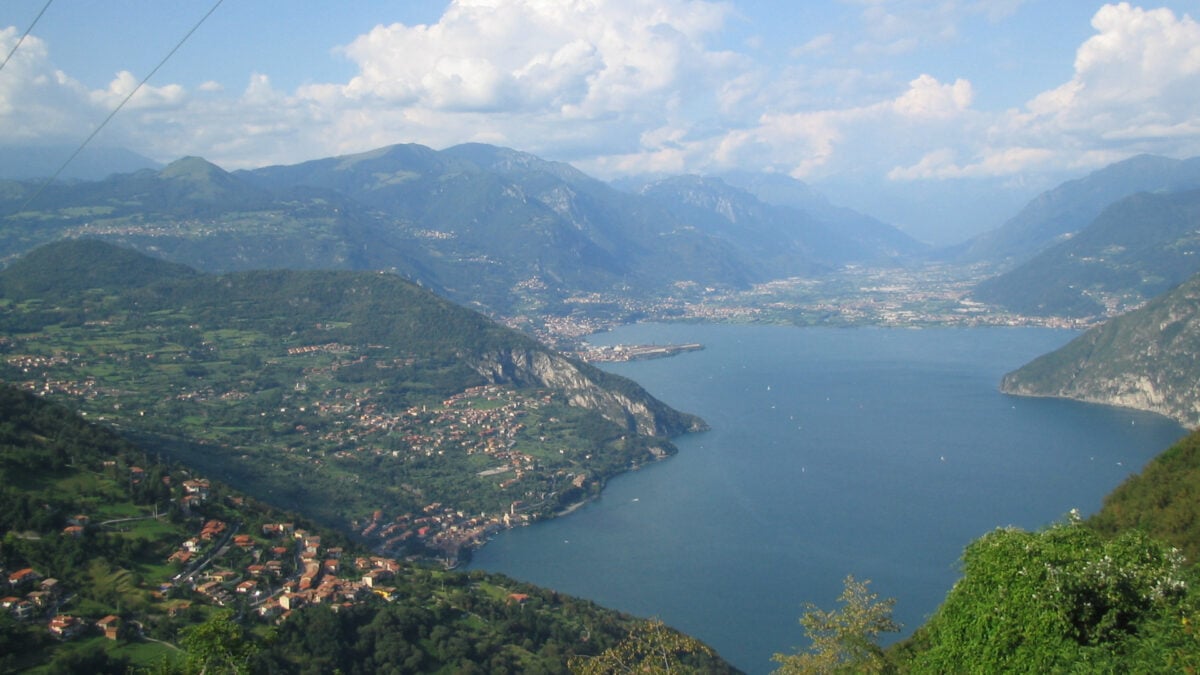
Tsunamis are typically associated with oceans, but they’ve also historically appeared in giant lakes near human farms. When scientists took a deeper dive into the specifics of these rare events, they reached a chilling conclusion—these “lake tsunamis” may strike densely populated lakeshores in the near future. For a recently published study in Nature Communications, researchers studied how human land use near Lake Iseo in northwestern Italy increased the risk of massive tsunamis in the 12th and 13th centuries. The analysis examined known historical events, as there are records of powerful earthquakes and tsunamis striking the region in 1117 and again in 1222. While both natural and anthropogenic processes have since altered the landscape at Lake Iseo, the team warned there’s reason to believe these lake tsunamis may return—not just to Italy, but elsewhere in the world. “Lake Iseo offers a unique natural archive,” Flavio Anselmetti, a study co-author and a geologist at the University of Bern in Switzerland, said in a translated statement (via Google). “Here we can combine geological traces with historical accounts and thus understand how these catastrophic events unfolded.” Well, we’ve got to farm somewhere According to the study, Lake Iseo has been a longtime hotspot for human agriculture and pastoralism. Since the Roman period, the area has experienced a “threefold rise” in sediments fed into the lake as a result of human-driven erosion, the paper added. This caused abrupt changes in the lake’s border with the Oglio River delta—and this had consequences. A map depicting the location and geographical features of the region surrounding Lake Iseo in Italy. © Zafar et al., 2026 Namely, the delta “grew quickly, and its underwater front became steep and overloaded,” as Denys Dutykh, a study co-author, wrote in a column for Phys.org. “It had collapsed once already, in the sixth century, and six centuries of this erosion loaded it again.” When the quakes hit, it shook these overloaded areas, sending massive amounts of sediment into the lake’s deep basin and pushing the water above it into tsunami waves. Historical and archaeological records show that two powerful earthquakes struck the Lake Iseo region in 1117 and 1222. Later estimates by modern scientists put the quakes at magnitudes of 6.5 and 6.0, respectively, according to the paper. Dutykh, an applied mathematician at Khalifa University of Science and Technology in the United Arab Emirates, explained that one manuscript reported how, on January 3, 1117, the “lakes also rose so much that very few of those living in the villages nearby escaped this danger.” Recreating a disaster Using sediment cores and seismic surveys, the team measured how much material each collapse moved. Then they simulated how the mud slid along the lake floor and how the resulting waves surged across the lake and onto land. Dutykh, whose role was to describe the mathematics of the waves, explained that the simulated 1117 waves were about 3.4 miles (5.5 kilometers) long—roughly 22 times the lake’s greatest depth of about 820 feet (250 meters). Using these measurements, the team determined that the wave in 1117 would have reached the shores near the delta within a minute and flooded the low plain of the Oglio up to 1.7 miles (2.7 kilometers) inland. “[A]t the town of Iseo, the water rose by about 5.5 meters (18 feet), 6 to 7 minutes after the collapse,” Dutykh added. “The smaller collapse in 1222 raised waves of about 13 meters (43 feet).” The…end? In his column, Dutykh explained that the pressure on the land briefly eased after 1222—thanks to the Black Death—but spiked again from 1661. The erosion has simultaneously rebuilt the delta, but the team suspects that its underwater slopes are still shaky and vulnerable to landslides caused by earthquakes. “Our results indicate that human interventions not only cause short-term environmental changes,” Anselmetti said. “They could also create a geological legacy that persists for centuries and amplifies natural hazards.” And they’re not just talking about Lake Iseo, although a tsunami at the Italian lake—a tourist hotspot as well as home to several towns—would no doubt be catastrophic. But there have been records of similar events at lakes in Switzerland, Alaska, and New Zealand, suggesting that this mechanism exists worldwide, Anselmetti said. The Sarnico dam over the Oglio River. © Pampuco via Wikimedia Commons Then again, the researchers aren’t necessarily saying we should immediately vacate these scenic lakeshores. Rather, as the team advised in the paper, authorities will need to carefully consider the “hidden legacy” of human land use when assessing natural hazards. “To judge the danger of a lake, we must read its history as well as its faults: how much sediment its delta has gathered, and since when,” Dutykh concluded.
Medieval Farming Set the Stage for Deadly Lake Tsunamis in Italy. It Could Happen Again
Full Article
Original Source
Read the full article at Gizmodo →KhanList aggregates and links to publicly available news content. We do not host full articles from third-party sources. Always verify important information with original sources.