
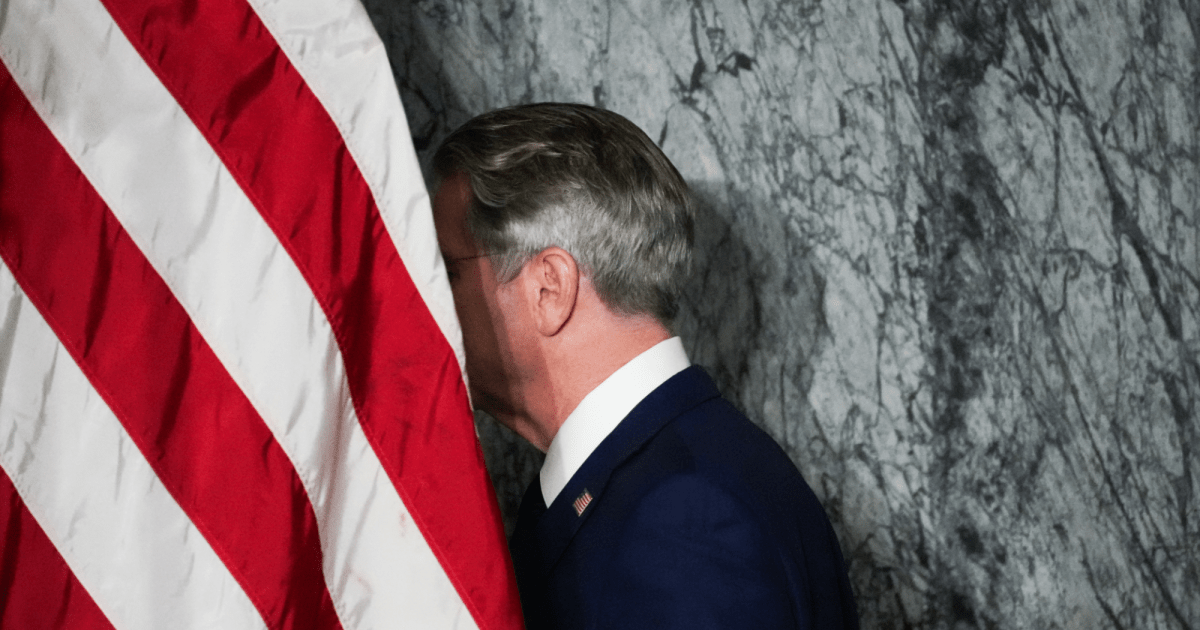
Treasury Secretary Scott Bessent leaves a press conference after announcing unspecified secondary sanctions on countries conducting business with Iran, August 24, 2026.Julia Demaree Nikhinson/AP Get your news from a source that’s not owned and controlled by oligarchs. Sign up for the free Mother Jones Daily. On Monday afternoon, President Trump’s Treasury Secretary Scott Bessent announced that the US would impose all-encompassing sanctions on countries and institutions that conduct business with Iran, in an apparent attempt to end the war after most viable military options have failed. Bessent described the plan, dubbed Operation Economic Outcast, as an “economic D-Day,” in reference to the Allied invasion of Normandy during World War II, with the Iranian regime replacing Nazi Germany. Bessent vowed to “sever every economic lifeline” that sustains Iran—including digital assets, technology, gold, aviation, and shipping—by enforcing a “zero-leakage approach” that will shut down “every facilitator and every network” that Iran has used to smuggle oil past existing sanctions. But Bessent did not disclose how that process would work, or on what timeline. When we don’t know what to do, we sanction Iran. In fact, the treasury secretary offered almost nothing in the way of details—perhaps because, over roughly 47 years of US sanctions on Iran, there is little that the United States hasn’t tried and even less indication that Iran has become more compliant. When we don’t know what to do, we sanction Iran. The Trump administration has already nominally imposed secondary sanctions on many countries that trade with Iran for oil, but has not significantly enforced them on Iran’s major trading partners like China, Russia, India, Pakistan, Turkey, and Qatar. Some of those countries are key US allies; others are major trading partners; that leaves Russia, which is already under extensive American sanctions and has unmatched experience in evading them with regard to its global oil trade. Trump, Bessent said, is holding an ongoing series of calls with world leaders—under threat of sanctions—about what he wants from them. After his announcement, reporters asked Bessent which leaders, and when secondary sanctions would be enforced over noncompliance. Bessent declined to say. Last week, the United Arab Emirates, Iran’s largest trading partner in the Middle East and a US ally, said it would at least temporarily end all trade with Iran. Bessent reiterated on Monday that the move was due to US pressure—supposedly evidence that sanctions would work this time. As Trump has claimed repeatedly during his second term, and as Bessent repeated on Monday, Iran has been “at war against America” and “much of the world” for 47 years, which is also when the US first imposed sanctions on the country. Over that time span, American economic sanctions on Iran, which have increased by roughly nine times over the past 20 years, have not led to a more democratic—or even simply US-friendly—Iranian government. Instead, it has largely strengthened Iranian regime leaders’ hold on the country at the price of civilian lives. Meanwhile, according to 2025 data from the World Bank, about 35 percent of Iran’s 92 million residents live on less than $8.30 per day—the poverty line for its economic peers.
Maybe Iran Sanctions Will Work This Time
Full Article
Original Source
Read the full article at Motherjones →KhanList aggregates and links to publicly available news content. We do not host full articles from third-party sources. Always verify important information with original sources.