
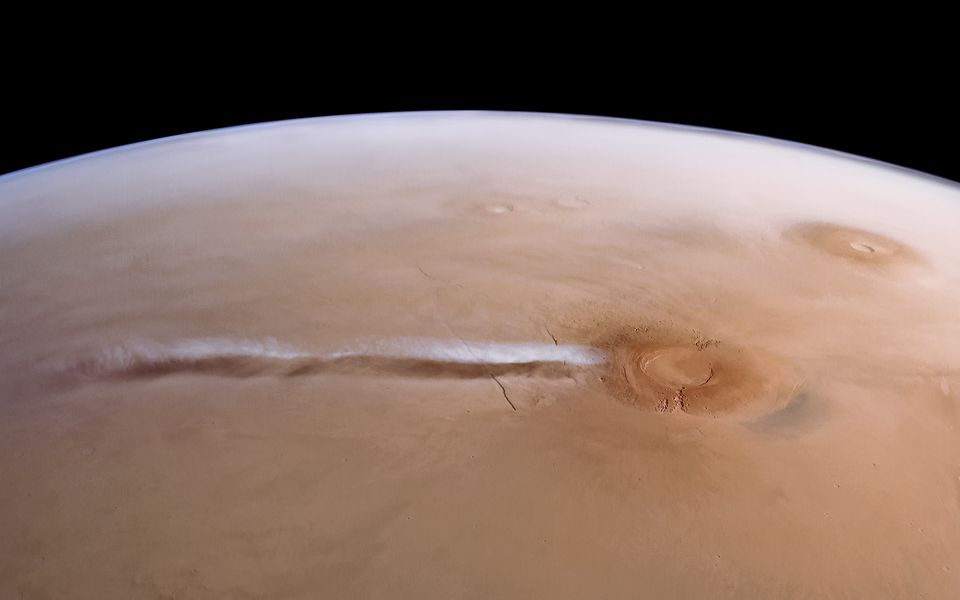
It may not be as obvious, but just like Earth, Mars has seasons. And every day of every summer, an 1,800 kilometer long thin white cloud appears to the west of Arsia Mons, a 20 kilometer high extinct shield volcano. At least for a few hours, before it dissipates until it reappears the next morning. Scientists have known about this feature, which they call the Arsia Mons Elongated Cloud (AMEC), for decades, but planetary scientists have been unable to explain it using traditional atmospheric models. But a new paper, published in Nature Geoscience by a research team led by Dr. Jorge Hernández-Bernal of the Sorbonne, suggests that the cloud could be the first documented real-world example of a cloud flash-freezing out of thin air. That phenomena, known as homogeneous nucleation, has been theorized in text books for years. However, scientists have long thought of it as only a laboratory curiosity rather than something that naturally happens in nature. To understand why, it's first best to review the high school physics explanation of how clouds form. On planets like Earth, when humid air rises, it expands and cools, simultaneously driving up its relative humidity. However, water vapor molecules are notoriously reluctant to clump together themselves. They have gigantic surface tensions that cause them to evaporate almost as soon as they form. Unless they have something to grab on to. Video describing a NASA citizen science project to track Martian clouds. Credit - SciStarter YouTube Channel That “something” usually takes the form of a particle in the atmosphere. Through a process called heterogeneous nucleation, the water vapor condenses onto microscopic airborne seeds known as condensation nuclei, which serve as the building blocks of clouds. On Earth, these take the form of anything from sea salt crystals to industrial pollution. Mars is notoriously dusty and routinely swept by global dust storms, so scientists naturally assumed that those dust grains supplied the condensation nuclei needed to grow the AMEC. However, when scientists have run atmospheric simulations trying to reproduce AMEC using traditional cloud formation theories, they have come up short. They would either produce wide patches of haze, or no trailing tale reaching thousands of kilometers at all. Researchers could not explain how such a thin, intensely bright streak of water could remain stable across thousands of miles of open Martian desert. If you read the textbooks closely enough, though, the scientists have long understood that homogeneous nucleation, i.e. cloud formation without a particle, is theoretically possible. In this scenario, water molecules collide with enough brute force to create liquid droplets or ice seeds without needing any preexisting molecule to coalesce around. But, it requires absurd levels of humidity, making it an interesting laboratory-only result to scientists who believed that there was always so much dust available in atmospheres that the heterogeneous nucleation we’re familiar with on Earth undercut the formation of any droplets formed by simply spontaneously forming. Anton Petrov describes the AMEC in detail. Credit - Anton Petrov YouTube Channel The new study shows that the atmospheric environment surrounding Arsia Mons in the summer is actually strong enough to break that rule. The researchers used a combination of weather models and specialized microphysics packages from a software known as the Mars Planetary Climate Model, to show what specifically happens surrounding Arsia Mons in the summer. First, there are notable westward winds that hit the shield volcano straight on, deflecting upward violently enough to generate a phenomenon called gravity waves - standing ripples in the atmosphere that represent gigantic pressure shifts. As air moves through these waves, it experiences extreme adiabatic expansion, and cools by about 30℃ in less than fifteen minutes, superchilling to below -143℃. In the summer, the Martian atmosphere is relatively dust-free, with only 0.1 dust grains per cubic centimeter. That means there’s relatively little dust to soak up the vapor quickly, which then means the humidity in the area skyrockets to around ten million percent. That is exactly the type of environment where homogenous nucleation can happen. At this point, water vapor molecules hit a physical breaking point and spontaneously freeze into hundreds of ice crystals per cubic centimeter. In other words, they create an ice cloud. That’s where the wind takes over, blowing these newly formed ice particles to travel outside of the freezing pocket and into more than a thousand mile long pencil thin tail of cloud without dissipating. Showing that this process can, in fact, happen in a planetary atmosphere opens up other possibilities for understanding where else it might occur. From the icy plumes of Enceladus to our own polar mesosphere, there are other places in the solar system that, at least in theory, could have the same absurdly high relative humidity levels with relatively low dust particle counts. But for now, this brilliant white streak on Mars is the only known natural example of an extremely rare cloud-forming phenomena. It just might not remain that way for long. Learn More: ESA - Mars’s oddest cloud may be even odder than we thought J. Hernandez-Bernal et al. - Homogeneous Nucleation of Water Vapor Evidenced by Elongated Clouds on Mars UT - There's One Cloud on Mars That's Over 1800 km Long UT - There's a Funny Cloud on Mars, Perched Right at the Arsia Mons Volcano. Don't Get Too Excited, Though, it's not an Eruption
Mars’s Most Mysterious Cloud Might Be Defying Textbook Cloud Physics
Full Article
Original Source
Read the full article at Universetoday →KhanList aggregates and links to publicly available news content. We do not host full articles from third-party sources. Always verify important information with original sources.