
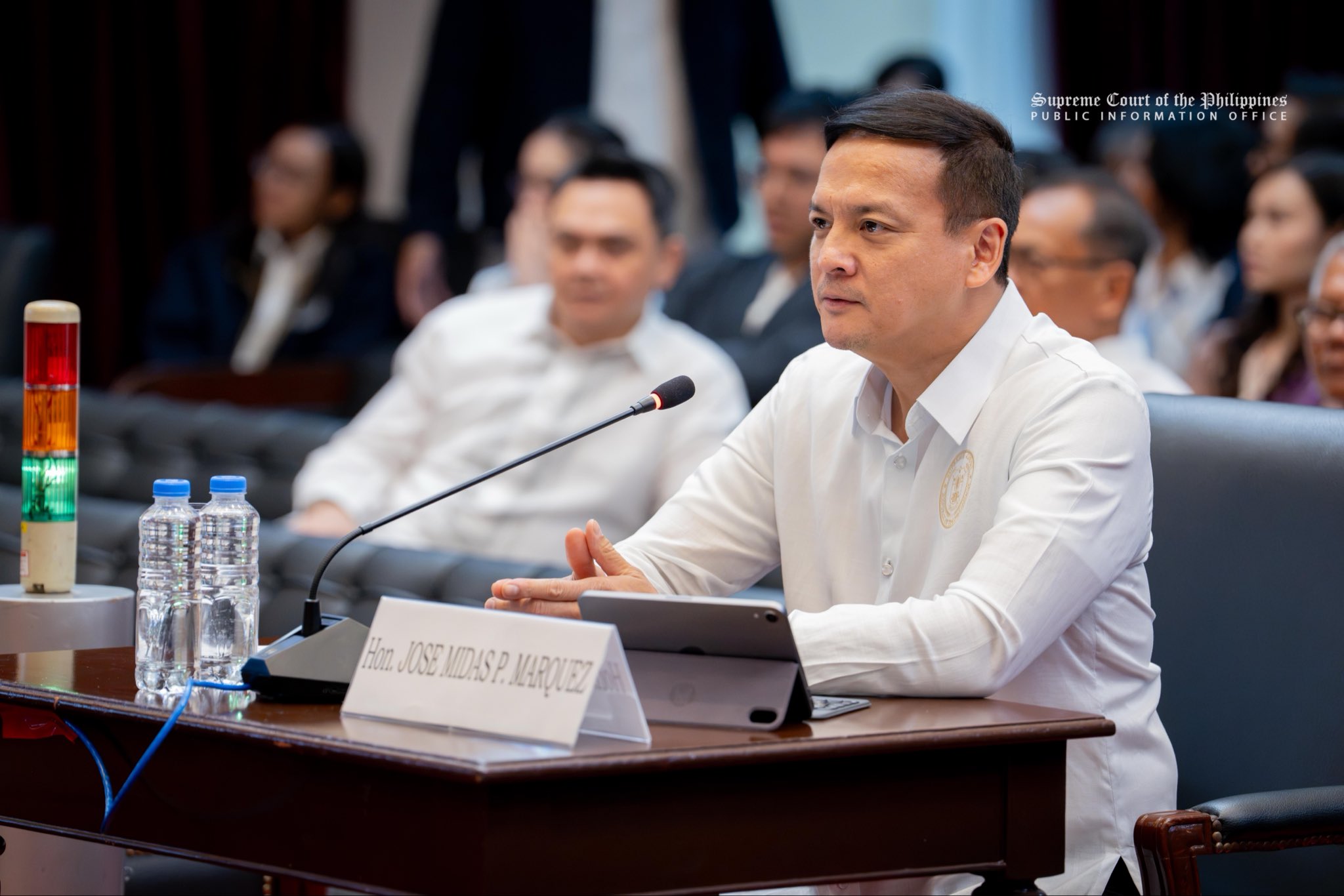
Associate Justice Jose Midas Marquez promises to eliminate overburdened courts by 2032 if appointed as Chief Justice, emphasizing the importance of quality justice over physical court structures. Marquez identifies key issues in the judiciary, including court congestion and delays, and plans to implement a Strategic Plan for Judicial Innovations 2.0 focusing on technology, court management, and judicial independence. He advocates for legislative support to create more courts, clarify budget roles, and strengthen judicial accountability, while also addressing judges' independence and allowances. This is AI-generated. Read the article for full context. Report any errors. MANILA, Philippines – Associate Justice Jose Midas Marquez made a big promise when he faced the Judicial and Bar Council (JBC) for his interview as a chief justice candidate. Marquez, who once served as head of the Supreme Court’s (SC) Office of the Court Administrator, said there will be no more overburdened courts six years from now if he is selected as Chief Justice Alexander Gesmundo’s successor. “By 2032, we should no longer have [an] overburdened court,” said the aspiring chief justice during his public interview on Monday, October 26. “While a courtroom or a courthouse is a physical representation of justice, the true measure of a court is not its buildings or facilities, but the quality of justice it provides. Citizens do not come to court because of the structure that houses it; they come because they seek protection of their rights, resolution of disputes, and assurance that the rule of law will prevail,” Marquez added. Marquez is one of the five SC associate justices in the running to become Gesmundo’s successor. The JBC concluded the interviews on Monday and will proceed to deliberations. Afterwards, the council will submit to President Ferdinand Marcos Jr. a short list of nominees. Marcos will then appoint the country’s 28th chief justice. Marquez is currently the most junior among the candidates and is holding seat no. 12 at the High Court. If chosen, he will serve as chief justice for 10 years, or until 2036. Plans for the judiciary During the interview, Marquez said the judiciary faces three perennial problems: congestion of court dockets, delay in resolution of cases, and the perception of alleged corruption. “So to enhance our court processes, court management, pagandahin pa natin ‘yong internet connectivity not only here in NCR (National Capital Region), but especially in far-flung areas para mas papabilis ang takbo ng resolution ng mga desisyon,” the magistrate said. “Dapat po meron tayong continuous monitoring of the dockets of all courts nationwide, ‘di lang ang congested courts,” he added. (So to enhance our court processes, court management, let’s improve our internet connectivity not only here in NCR, but especially in far-flung areas to improve the resolution of cases. We should have a continuous monitoring of dockets of all courts nationwide, not only those which are congested.) Marquez said that if selected, he will launch his Strategic Plan for Judicial Innovations 2.0 (SPJI) that will run from 2028 to 2032. SPJI is the brainchild of outgoing Chief Justice Gesmundo which contains the innovations for the judiciary, including digitalization. It has been running since 2022 and will conclude in 2027. The aspiring chief justice said his SPJI 2.0 will focus on the following: Sustain and institutionalize SPJI reforms Invest in people development and people encounter Reinforce the Court as both a place and a service Strengthen the Judiciary’s independence and fiscal autonomy Harness technology and digital transformation to address judicial inefficiencies Continuous monitoring of the Rules of Court Initiatives for the Philippine Judicial Academy, which is the “training school for justices, judges, court personnel, lawyers, and aspirants to judicial posts.” Initiatives for the JBC More power to the Judicial Integrity Office (JIO). This is the SC office that handles administrative disciplinary cases and ensures accountability within the judiciary. More power to Office of the Judiciary Marshals. This office was established under Gesmundo to deal with threats and violence against members of the bench and court personnel that affect not only their lives and safety, but also undermine judicial independence. When asked to give at least three laws that the Congress may pass to help the judiciary, Marquez said he wants legislation that will will focus on the creation of more courts – both regular and Shari’ah (Islam) courts. He said that he also wants a law that clearly defines the role of the Department of Budget and Management in the preparation of the budget of government branches and agencies. Marquez added he also wants a law that will strengthen the mandate, powers, and authority of the SC’s JIO. As to additional courthouses, Marquez said the construction of halls of justice is not only a concern of the judiciary, but also of local government units (LGU). “Para sa akin po, ‘yong construction ng hall of justice po, kasi kasama po sa trabaho ng LGU, pasensya na po (For me, the construction of hall of justice is part of the LGU’s job, I’m sorry). Because if you want your LGU to be the best LGU, you have to provide all these services,” he explained. Marquez also said he wants to standardized the allowances of judges. He explained that it’s an independence issue that some of the judges are receiving allowances from LGUs where their courts are located. “For me, para po talaga mawala na ‘yong usapin ng independence [of our judges] being encroached upon by the LGUs, may siguro dapat pong pag-usapan or pag-isipang mabuti how we can increase the allowances of our judges and give that allowance,” he said. (For me, to eradicate the issue on our judges’ independence being encroached upon by the LGUs, maybe we can talk or think carefully how we can increase the allowances of our judges and give that allowance.) From intern to chief justice? During the interview, Marquez was also asked about the SC’s power of judicial review – or the mandate to revisit whether another branch of government erred in following rules and in case it violated the Constitution. He explained that his years as associate justice were honed by his past experiences inside the High Court. He explained that when resolving cases involving other branches, he always looks at the mandate of that specific branch. “That’s the jurisdiction of the Supreme Court, the judiciary. Maingat na maingat po ako doon (I am really careful about that). I don’t want to overstep the mandate or overreach the mandates of either the executive or the legislative,” the magistrate said. If he becomes chief justice, Marquez said he will lead, like Gesmundo, with collegiality. “Kung paano ang naging pamalakad ni Chief Justice Gesmundo, palagay ko po kaya ko rin pong gawin, tularan, o kung kaya pong higitan pa, gagawin po natin (I can emulate the leadership style of Chief Justice Gesmundo, and if I can go beyond it, we will),” he added. Marquez also revealed during the interview that his age and experience in the bench – being the most junior candidate – were part of the things he considered when he accepted the nomination. The justice said he rose from the ranks – he started out as an intern, court lawyer, spokesperson, and court administrator. Marquez said he will lead by example if chosen as the next head of the judiciary. “Para sa akin, I’ve always led by example. So pinapakita ko lang po na inire-respeto natin silang lahat, nagtatrabaho po tayo nang maayos, at nakikinig po tayo sa lahat ng dapat pong pakinggan (For me, I’ve always led by example. So I just show that I respect everyone, I work professionally, and we listen to those who need to be listened to),” Marquez said. “You just have to do your work…. Do not look for promotion. Just do your work and do it well. There’s no substitute for hard work,” he added. – Rappler.com
Marquez’s plan as chief justice bet: No more overburdened courts by 2032
Full Article
Original Source
Read the full article at Rappler →KhanList aggregates and links to publicly available news content. We do not host full articles from third-party sources. Always verify important information with original sources.