
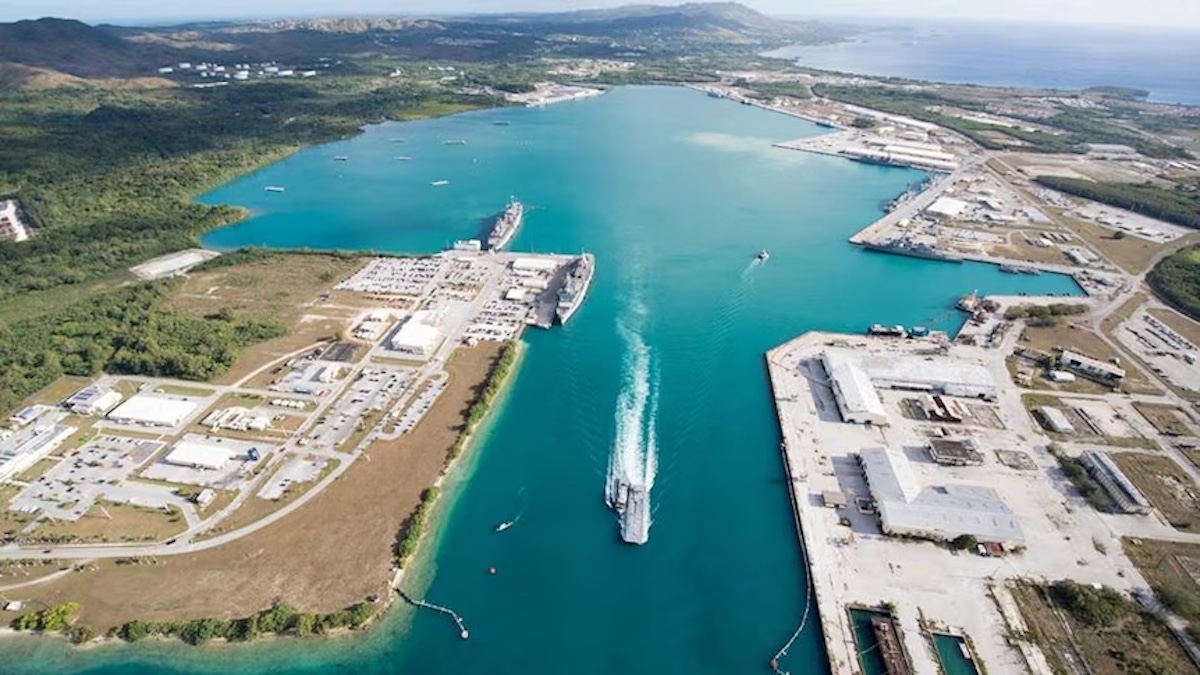
While some watch election outcomes in Michigan, Texas and other high-profile campaigns, defense planners should closely watch election results in another part of the United States. The US territory of the Commonwealth of the Northern Mariana Islands (CNMI) is also going to the polls and will elect a new Governor, Attorney General, and more, as well as decide a tight race for the CNMI Delegate to the US Congress. Although CNMI’s population is around 50,000, its location makes it disproportionately important to the rest of the United States. CNMI’s main island, Saipan, is an eight-hour flight west of Honolulu and only four hours from Taiwan. Just south of CNMI is the fellow US territory of Guam, and to its north it shares a maritime boundary with Japan. CNMI is America’s Asian border – right in the center of the so-called Second Island Chain of islands that runs from Japan, through CNMI, Guam, Yap (Federated States of Micronesia), Palau, Taiwan, the Philippines, and further south. US Pacific Command (PACOM) has been increasingly focused on this area, including under concepts such as the US Air Force’s Agile Combat Employment (ACE) and the US Navy’s Distributed Maritime Operations (DMO) concept. The US Marines, Army, Coast Guard and Space Force each have their own plans. In CNMI, the US military is refurbishing and expanding World War II-era airfields on the island of Tinian, while also making more use of nearby Saipan and the broader Mariana Islands chain as logistics and training areas for US forces and allies. Meanwhile, China has studied World War II and acknowledged the region’s importance for decades. Using a range of political warfare methods, including strategic investments, they’ve quietly expanded their influence throughout the Pacific – to include the CNMI. Build influence, and China makes it harder for the US military to operate. In the CNMI, that influence first came via proxies who invested in the garment industry in the 1980s, then through casinos on Tinian. But the real push came via the Chinese-linked Imperial Pacific International (IPI) casino on Saipan in the early 2010’s that promised wealth and economic salvation to CNMI. IPI’s Chinese owners spread millions around CNMI – which only has a population of 50,000. This included things like over-market-price land deals to the family of CNMI Governor Ralph Torres, according to Bloomberg reporting. Torres, while a legislator, opposed issuing a gaming license to IPI, but he changed his mind after being taken on a “fact-finding” trip to China. While its main casino was under construction, IPI operated a casino on a handful of tables in a shopping mall and was soon moving US$2 billion a month, an impossible figure according to industry experts. And that sort of money moves out of China only with Chinese government approval. Allowing that money to move was a good investment for Beijing – with money comes influence. And one properly looks at these commercial entities as an arm of the Chinese state, especially given things like China’s National Intelligence Law that compels all Chinese citizens and organizations to support Chinese intelligence efforts if asked. What you see in Saipan is beyond the garden-variety corruption that you’ll find in Boston or Chicago. Rather, it’s a symptom of Chinese influence – that aims to build influence by corrupting local elites and societies, using a commercial “hook.” The ultimate aim is to weaken CNMI’s ties to the US, make it dependent on Chinese largesse and create a vassal state. A letter written by then-Governor David Panuelo of nearby Federated States of Micronesia in 2023 clearly describes how Chinese political warfare works in practice. The IPI casino shuttered around 2020 and filed for bankruptcy in 2024. But a new Chinese company, apparently pretending to be Japanese, has acquired IPI’s assets (working with one of IPI’s former executives) and is making another push. The US FBI got involved in 2019 after reports of labor law and other violations at IPI became too much to ignore, raiding IPI and Governor Torres’ offices in an anti-corruption probe. And beyond casino-related alleged corruption, over the last years of the Torres administration, well over a billion in Covid recovery funds provided by Washington could not be accounted for. There are hints of where it may have gone, including in around $4,000 an hour for janitorial services to a company linked to the Torres administration. Limited audits by Ernst & Young cited $349 million in doubtful spending. But no comprehensive accounting was ever done. For that much money, the entire island of Saipan should be plated in gold. Keep in mind there are maybe 50,000 people in CNMI. Instead, the territory is in serious financial distress, and the current leadership is asking the federal government for more money before it has fully explained where the last tranches went. Now the same clique that “greenlit” the IPI Chinese casino in CNMI, and that made a bundle from those associated with it, is aiming for a return to power. Ralph Torres is once again running for Governor of CNMI, with his brother running for Attorney General. The group around them continues to insist – with an unnatural fervency – that there is no alternative to Chinese investment and tourism, even though for around a decade, there have been more tourists coming to CNMI from South Korea than from China. And that in spite of the fact that, until recently, CNMI was the only place in the US where Chinese could arrive for tourism without a visa. As for the money that disappeared, those CNMI “leaders” now insist there’s no point digging up the past, and are demanding more money to keep the lights on and themselves employed. As for how to bring prosperity? Ask Senate President Karl King-Nabors. He says it’s to allow online gambling and set up a CNMI cryptocurrency scheme. There is an alternative future for CNMI – one fought for by the governor of CNMI who came after Torres. Governor Arnold Palacios took office in 2023, aiming to roll back Chinese dependency and conduct a thorough investigation into what happened to CNMI’s finances. He testified before the US Senate and also begged the Biden administration and the subsequent Trump administration to send auditors, accountants and investigators to review everything. He specifically asked CNMI’s legislator in the US Congress to request FBI Director Kash Patel’s help, noting he had plenty of evidence to provide (the fact he didn’t want to give it to local FBI representatives is telling). He was also working to break the idea of “China” as savior, and bring in others. Instead, the FBI and Patel inexplicably closed the investigation into Torres in 2025. A few months later Palacios died suddenly, under unclear circumstances. Torres himself later got a sweetheart immunity deal from the CNMI Assistant Attorney General (covering everything he had ever done while in office) in apparent exchange for a token payment. The deal was issued without the CNMI Attorney General’s approval. The Assistant Attorney General who let Torres off the hook was fired and shortly afterward hired as Legislative Counsel to the CNMI Senate. And who is the president of the Senate? Remember crypto fan Karl King-Nabors? How could the Trump administration drop the ball? It doesn’t help with perceptions that the Department of Interior’s Deputy Assistant Secretary for Insular and International Affairs, Angel Demapan, with responsibility for CNMI and other Pacific territories, was Governor Torres’ Chief of Staff, and was found by the Federal Election Commission to have taken Chinese money for his unsuccessful Congressional election campaign. Demapan presumably knows where at least some of “the money is buried.” And he doesn’t seem to be keen to challenge the “China as savior” narrative. He’s a political appointee; he’ll be wanting a job – maybe from his old friends in CNMI – after his term runs out in DC. He was also CNMI’s representative in Congress, Kimberlyn King-Hinds’, legislative director before he got the job at Interior. And, as it turns, she is also the sister of Senate President Karl King-Nabors. Talk about a closed loop. CNMI is now rattling the tin cup, demanding hundreds of millions more to keep CNMI afloat. First, it will be good to explain where the previous vast amounts went. It’s not as if leprechauns spirited it away. Few in CNMI – except Torres insiders – saw any of that money. If Torres returns to office, they likely never will. And Beijing will undoubtedly celebrate. The financial collapse and corruption will continue, adding fuel to the narratives that China is the savior and the US doesn’t care, while in fact Washington is making CNMI a military target. So, eventually, the logic will be: it’s best to leave the US – and don’t worry, China will bail you out. Governor Palacios wanted a clean government and knew it was possible, as most people on CNMI hope. And he understood Chinese influence leads to becoming vassals – and corrupt ones at that. Run a clean operation, and it will attract clean investment from the Japanese, South Koreans and others, and Washington will be more willing to help too. So it’s a real choice on November 3rd. Ultimately. It’s between candidates who want what’s best for CNMI and those who want what’s best for themselves (and Beijing). And the midterm outcomes will reverberate far beyond the shores of CNMI. Grant Newsham is a retired US Marine officer and former US diplomat. He is the author of the book, “When China Attacks: A Warning To America.” Buy it here on Amazon.
Marianas midterm vote a referendum on China’s murky influence
Full Article
Original Source
Read the full article at Asiatimes →KhanList aggregates and links to publicly available news content. We do not host full articles from third-party sources. Always verify important information with original sources.