
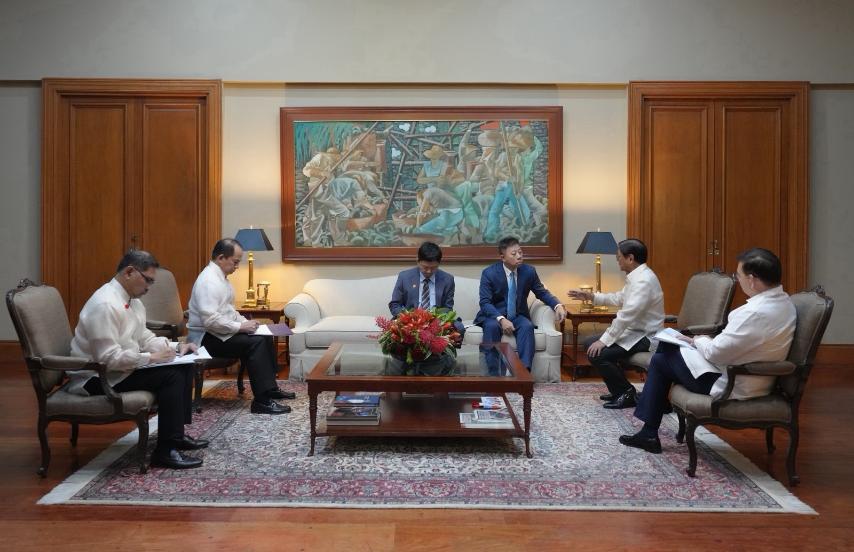
PH-CHINA TIES. President Marcos summons Chinese ambassador Jing Quan 'over maritime incident at Ayungin Shoal' in July 2026. File photo by Malacañang The Philippine leader says Chinese Ambassador Jing Quan's remark 'deserves a discussion between the ambassador and myself; President Ferdinand Marcos Jr. plans to summon Chinese Ambassador Jing Quan due to remarks perceived as a threat regarding the use of force in tensions between the Philippines and China. The Department of Foreign Affairs criticized Jing's comments as a poor choice of words that implied a threat, while the Chinese embassy accused the DFA of misinterpretation and undermining diplomatic relations. Tensions between the Philippines and China have escalated recently, with ongoing maritime confrontations and political pressures, including sanctions from Beijing against Philippine officials. This is AI-generated. Read the article for full context. Report any errors. MANILA, Philippines – President Ferdinand Marcos Jr. will summon Chinese Ambassador Jing Quan over a “threat” the envoy had made on the use of force in dealing with tensions between Manila and Beijing. Asked in a chance interview if he would summon Jing over his remark, Marcos said in a chance interview on the sidelines of the Philippine Coast Guard (PCG) anniversary celebration, “I think that deserves a discussion between the ambassador and myself.” A summon, especially one made by the head of state, is among the highest means of communication a government can use to express concern, disapproval, or anger to an ambassador’s home office. Should the summon push through, it would be the second time for Marcos to summon Jing to the Palace in just over 10 months of being posted in Manila. The last time was in July, after a Filipino soldier was injured in a violent confrontation with China Coast Guard (CCG) personnel in Ayungin (Second Thomas) Shoal in the West Philippine Sea. Echoing the view of the Department of Foreign Affairs, Marcos said of Jing’s remark on Friday: “Well it sounds very much to me like a threat, and it is not a very diplomatic statement to be made. So we perhaps would like to understand what exactly it is that he means.” In an interview with reporters on October 15, Jing insisted that China was no troublemaker in the region and blamed some Philippine officials for causing tensions between Manila and Beijing. The veteran diplomat, who was assigned to the United States before being sent to the Philippines in December 2025, added: “We should feel fortunate enough that you have a neighbor like China in this region. If we want to use force, we may easily win. But no, we’ll not use force. We love peace.” The DFA, in a statement late October 15, criticized Jing for his “poor choice of words that would seem to convey a thinly veiled threat of the use of force.” The Chinese embassy has since hit back through an October 16 statement, accusing the DFA of “selective quotation and overinterpretation” and said “diplomacy must be honest and straightforward in order to reduce misunderstandings and prevent misjudgments.” It also claimed that “certain individuals are actively seeking to undermine normal exchanges and cooperation between the two countries” and that the DFA should “play a more responsible role in preventing such actions.” The embassy has made similar statements in the past. Tense public exchanges between the Chinese embassy and Philippine government agencies — the DFA included, albeit rarely — have been a recurring feature in bilateral ties of the two countries, despite Marcos saying that he wants a “reset” in bilateral relations. The rhetoric is matched by maritime tensions and confrontations across different parts of the Philippines — from northern areas close to Batanes and westward in the West Philippine Sea. Political pressure has also escalated between the two countries. Beijing sanctioned Teodoro and his family over his remarks against Beijing, including calling it unreliable in the context of South China Sea code negotiations with the Association of Southeast Asian Nations, which Manila chairs. Most recently, tensions have been spurred by statements by impeached Vice President Sara Duterte who is accused to have recieved millions from China state-owned firms through businesses linked to her and her husband. In retaliation, Duterte said the Philippines is seen as a “troublemaker” in the region over tensions with China — over the West Philippine Sea, and even over scrutiny when it comes to business ties with the Asian superpower. “Troublemaker” is how Beijing has characterized Manila in the past whenever maritime tensions rise in the West Philippine Sea, an area that includes the Philippines’ exclusive economic zone in the South China Sea. China claims almost all of the South China Sea, despite a 2016 Arbitral Award finding the suppose historical claim baseless. – Rappler.com How does this make you feel? Loading
Marcos to summon China envoy over use of force ‘threat’
Full Article
Original Source
Read the full article at Rappler →KhanList aggregates and links to publicly available news content. We do not host full articles from third-party sources. Always verify important information with original sources.