
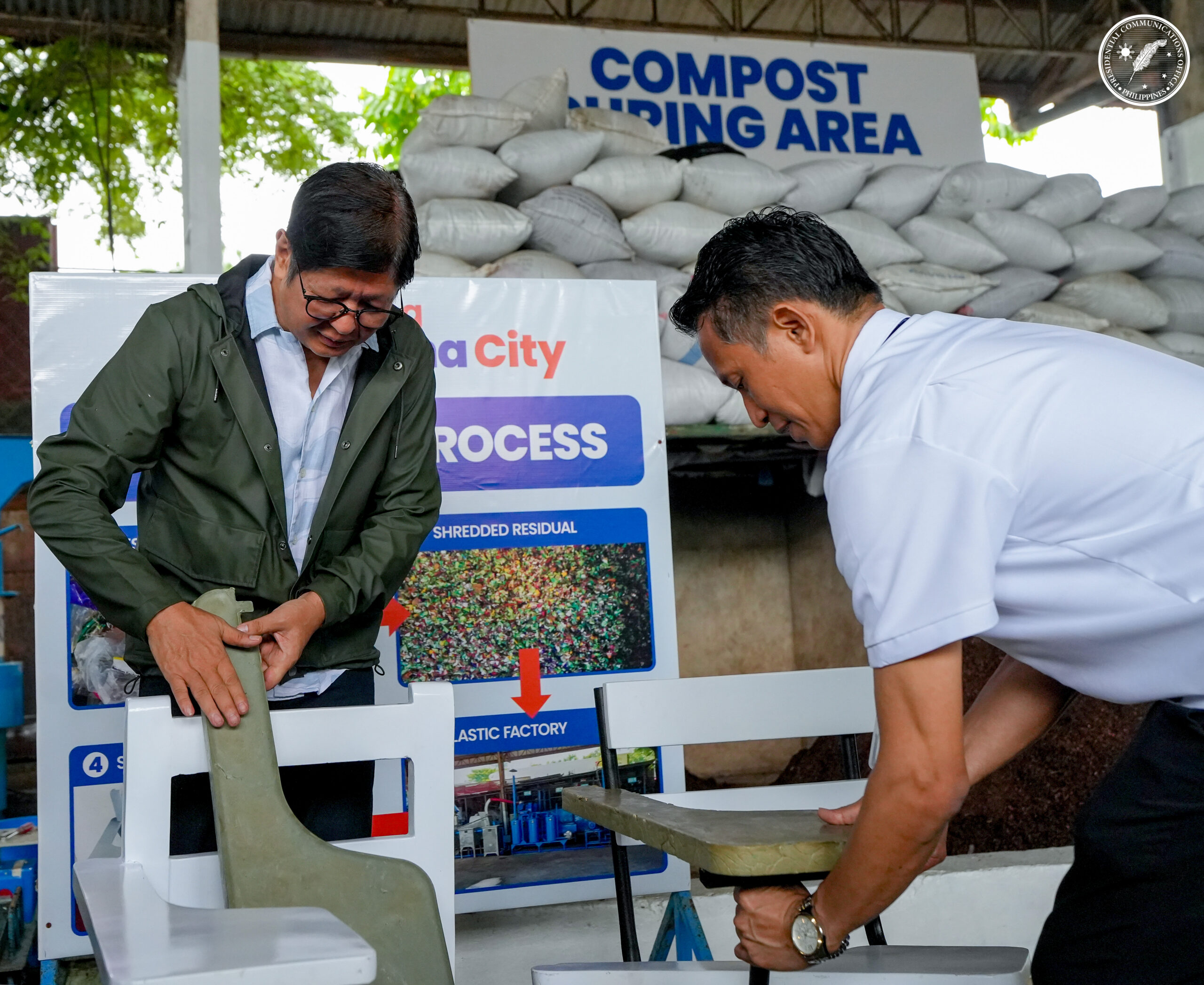
President Ferdinand R. Marcos Jr. inspects the Marikina Centralized Materials Recovery Facility in Barangay Sto. Niño, Marikina City, on Sept. 7, 2026. He said the city’s waste recovery and recycling system is a model of circular economy for other local government units. (PHOTO FROM PCO) MANILA, Philippines — President Ferdinand R. Marcos Jr. has cited Marikina City’s flood and waste management system as a model that other local government units (LGUs) across the country — especially in Metro Manila — should adopt to address flooding and garbage problems. Marcos made the statement on Monday after inspecting the Marikina River Linear Park and the city’s centralized materials recovery facility (MRF) in Barangay Sto. Niño. He said Marikina City had significantly improved its flood management over the past decade by clearing no-build zones along the Marikina River, relocating structures and residents from danger areas, and installing trash catchers to prevent garbage from accumulating in the waterway. Article continues after this advertisement “Over the last more or less 10 years, 11 years, Marikina was able to put up a good system,” Marcos said, recalling that Marikina River used to overflow and caused flooding in the city even after relatively light rains. “This should be the template… for all the different cities in the Philippines, especially here in the National Capital Region. But this also applies to all the cities that have problems with garbage and do not know what to do with it,” he added. According to Marcos, Marikina’s approach now goes beyond simply collecting garbage and clearing waterways. READ: Marcos pushes stricter enforcement of ‘no-build zones’ amid floods Waste collected from the river is brought to the materials recovery facility, where biodegradable waste is turned into compost, while plastics are processed into various products, including bags, bricks and materials for school desks. Article continues after this advertisement Marcos described the system as the best example of a circular economy, where materials are recovered and reused instead of being discarded. He noted that effective flood control requires an integrated system rather than isolated efforts such as desilting rivers or collecting trash. Article continues after this advertisement The Department of Environment and Natural Resources (DENR) has supported the system through floating trash traps installed at critical tributaries to intercept waste before it reaches the river. READ: Strict segregation, proper landfill design to fix waste problem – DENR As of July 2026, the DENR and the city government had deployed 47 estero rangers in 12 barangays to maintain trash traps and conduct waterway cleanup operations. The Barangay Sto. Niño MRF has sorting bins, composting bioreactors, upcycling facilities and biohazard storage and can process as much as 200 tons of dry waste daily. Marcos urged other LGUs to establish reliable garbage collection systems, particularly for facilities such as waste-to-energy plants that require a minimum volume of waste to operate. Marcos said proper waste recovery would benefit not only flood management but also the environment, particularly amid the effects of climate change. Marcos said the national government would continue promoting such technologies and systems among cities and LGUs, especially those facing persistent garbage problems. Your subscription could not be saved. Please try again. Your subscription has been successful.
Marcos lauds, endorses Marikina’s waste recycling, flood control systems
Full Article
Original Source
Read the full article at Newsinfo →KhanList aggregates and links to publicly available news content. We do not host full articles from third-party sources. Always verify important information with original sources.