
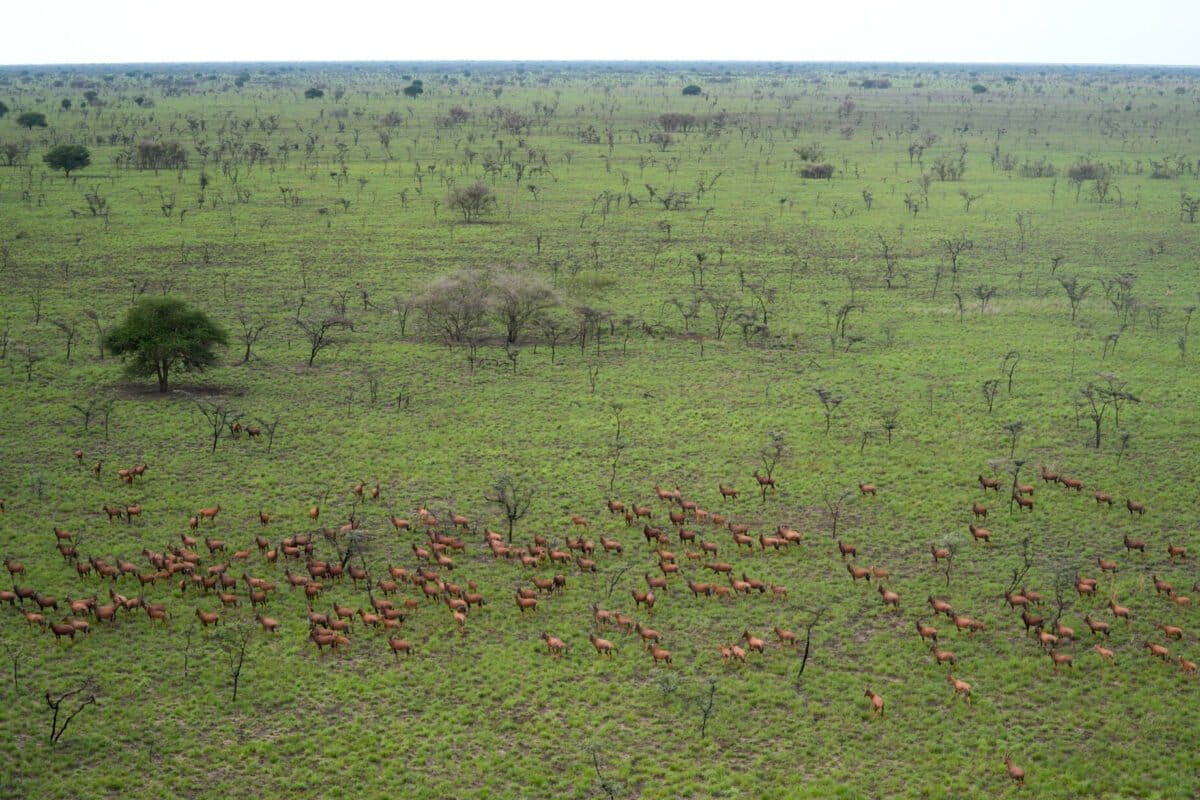
South Sudan is home to the world’s biggest migration of mammals — some 6 million antelopes that move across a vast area of seasonal swamps, woodlands, and grassland.Part of this region has recently been declared a UNESCO World Heritage Site, including two national parks — Boma and Badingilo — that are at the center of this landscape.But the antelope spend at least 70% of their time outside their boundaries, making the work of wildlife protection a challenging one. The lines on the map resemble the gossamer threads of dense spiders’ webs. Conservationists in South Sudan call them the “lines of life.” The map was made by joining up millions of points of data recorded by GPS collars attached to 262 migratory antelopes since 2023. The different colors denote four different migratory species: white-eared kob (Kobus kob leucotis), tiang (Damaliscus lunatus tiang), Mongalla gazelle (Eudorcas albonotata), and bohor reedbuck (Redunca redunca). Their seasonal movements across South Sudan’s Great Nile Migration Landscape collectively represent the largest mammal migration on the planet, totaling around 6 million animals. The “lines of life” map denotes years of GPS data collected for four different species of migratory antelope living across the Great Nile Migration Landscape: yellow for the tiang; red for the bohor reedbuck; blue for the white-eared kob and white for the Mongalla gazelle. Image courtesy of Inge van den Meiracker. Most of these movements occur outside the boundaries of Boma and Badingilo national parks, a landscape shared with an estimated 1 million people, their cattle, and growing numbers of new towns, roads, and mines. The “lines of life” are helping conservationists to figure out where to concentrate their efforts to ensure the wildlife can keep on moving. “There are some [wildlife] corridors that come out of this, like the high-use areas, which we do now have a better handle on,” says Megan Claase, conservation manager for African Parks, the South Africa-based NGO that co-manages Boma and Badingilo with the South Sudanese government. The patterns on the GPS tracking map also show the places where animals gather in leks, or traditional mating grounds, and where they deliver their calves. “If we’re able to at least protect those critical areas, I think that would make the most impact,” says Inge van den Meiracker, AP’s manager for geographic information systems, who compiled the “lines of life” map. But, as she notes, this migration is unlike the famous Serengeti migration of wildebeest, gazelles, and zebras, which move in a circular direction from Tanzania into Kenya and back again. “It’s just more chaotic, there’s different herds and they move in different directions,” van den Meiracker says. A total of 148 white-eared kob (Kobus kob leucotis) have been collared since 2023, allowing conservationists to trace their migratory routes over multiple years across vast swathes of the Great Nile Migration Landscape. Image courtesy of Inge van den Meiracker.. The white-eared kob, of which one collared individual has been recorded traveling nearly 3,000 kilometers (1,864 miles) in a single year, spend the dry season in an area bounded by three great permanent rivers: the White Nile in the west; the Akobo, along part of South Sudan’s eastern border with Ethiopia; and the Sobat, a tributary of the White Nile, in the north. But in the wet season, when the elephant grass grows tall and thick, making any movement difficult, the antelopes move south toward South Sudan’s border with Kenya, possibly in search of shorter grass that could also be more palatable. “That’s the theory,” says Claase, though she adds the short-versus-long-grass variable is difficult to measure in a landscape where ground surveys are challenging to conduct. Following poor rains this year, many of the antelope have stayed much farther north, nearer to the permanent rivers. This time last year, the GPS data showed white-eared kob gathered in the Tingili Desert, in between the two national parks, where the animals took advantage of the seasonal grass and water that occurs there during years of good rainfall. Unlike the white-eared kob, the migratory pattern of the tiang shows they don’t use the whole of the landscape, but rather remain in the west, closer to the White Nile. Image © seanbrogan via iNaturalist (CC BY-NC 4.0). The tiang appear to cover the longest distances out of all four monitored species. One individual travelled 11,573 km (7,191 mi) in just over three years, according to the collar data. While their seasonal movement sticks closer to the White Nile, some tiang journey between the towns of Bor, on the White Nile, and Pibor, a town to the west of Boma National Park, around 186 km (116 mi) away. This route sits entirely outside the confines of the two national parks and crosses a major road linking the two towns. During wet years, the road often becomes impassable. If it were to become an all-weather road, it could encourage human settlements alongside it, creating a possible barrier to the movements of the tiang. It’s “big picture” conservation because the animals “move everywhere,” Claase says. “It’s all connected, so if you don’t look at it as a whole big picture, it’s not really going to work.” Historically, some community members hunted antelope using spears, limiting the number of animals they could kill. But firearms now proliferate in South Sudan, and new roads make it easier for hunters to gain all-season access to some areas with larger vehicles, and to transport more animal carcasses for commercial large-scale hunting. “We definitely do see an alarming level of offtake in some areas,” Claase says.There is likely to be a substantial local market in Bor, she says, with probable movement of meat to the capital Juba, and even across the border to Dima, southwestern Ethiopia. African Parks carries out an aerial survey of animal numbers every two years. It recently published figures from the 2025 survey, based on aerial counts along transects across approximately 110,000 square kilometers (about 42,500 square miles) of the migratory landscape. The survey estimates populations of 5.17 million white-eared kob, 440,500 tiang, 191,200 Mongalla gazelle, and 131,700 bohor reedbuck. However, these aren’t exact counts, and the actual numbers could be substantially higher or lower. There’s been no detectable growth or decline, though, between the 2023 and 2025 estimates, AP said in a statement. Bohor reedbuck (Redunca redunca) in Boma National Park. Image © Majak Mangar via iNaturalist (CC BY-NC 4.0). Malik Doka Morjan, a South Sudanese wildlife biologist based at the University of Juba, conducted continuous research on the Boma-Badingilo antelope migrations from 1999-2014. He did his Ph.D. on the migration of the white-eared kob and knows full well the complexities of wildlife management and conservation across this landscape. Morjan confirms to Mongabay that while some hunting took place in the past, it was small-scale: hunters could only hunt animals opportunistically to complement their agricultural or pastoral livelihoods. The animals might only appear briefly, before migrating elsewhere for nine months. The rise of commercial hunting is a recent phenomenon that violates official hunting bans that go back as far as 2005, Morjan says, adding that putting a stop to it is complicated while South Sudan has “political hurdles” to overcome. The country experiences recurring violence between rival communities competing over scarce resources or carrying out retaliatory attacks following cattle raids, as well as clashes between government troops and armed opposition groups. “Once all these political problems are solved, then the situation will become normal, and this hunting will die off,” Morjan says. White-eared kob (Kobus kob ssp. leucotis) in Pochalla, South Sudan. Image © Inge van den Meiracker via iNaturalist (CC BY-NC 4.0). The recent recognition of 112,000 km2 (about 43,200 mi2) of the Boma-Badingilo migratory landscape as a UNESCO World Heritage Site is significant, Morjan adds, but community engagement and inclusion will be vital to ensure landscape-scale conservation works. “Typically in South Sudan, if you exclude some key players and then say, ‘We are doing conservation, we want to involve communities,’ it’s not enough,” he says. “It depends on what you find on the ground, and you develop programs according to it — it has to be inclusive.” Claase agrees that conservation of the migration landscape is almost impossible without support from the communities that live within it. “Conservation must be community-led,” she says, adding that this could take various forms, from wildlife conservancies, to game management areas and sanctuaries. “Working with communities, you can look and see what the current land use is, what the wildlife use is, and kind of figure out what’s the best strategy for that area,” she says. Informing this work will be the “lines of life.” “I’ve been lucky enough to see the big herds myself from the air, and you can barely describe the scale of it,” says van den Meiracker, the GIS expert. “When I look at those lines [on the map], I see those antelope moving — like what I’ve seen from the air,” she says. “I think it’s an incredible and valuable data set, and there’s so much to discover from it.” Banner image: Tiang Damaliscus lunatus ssp. tiang) in Badingilo National Park, South Sudan. Image © Inge van den Meiracker via iNaturalist (CC BY-NC 4.0). World Heritage status for South Sudan parks will be a boon for the birds Migratory bird species increasingly at risk, report finds, but there is still hope How Southern African farmers & elephants can both adapt to coexist Feedback: Use this form to send a message to the author of this post. If you want to post a public comment, you can do that at the bottom of the page. Credits Topics
Mapping the ‘lines of life’ of South Sudan’s vast antelope migration
Full Article
Original Source
Read the full article at News →KhanList aggregates and links to publicly available news content. We do not host full articles from third-party sources. Always verify important information with original sources.