
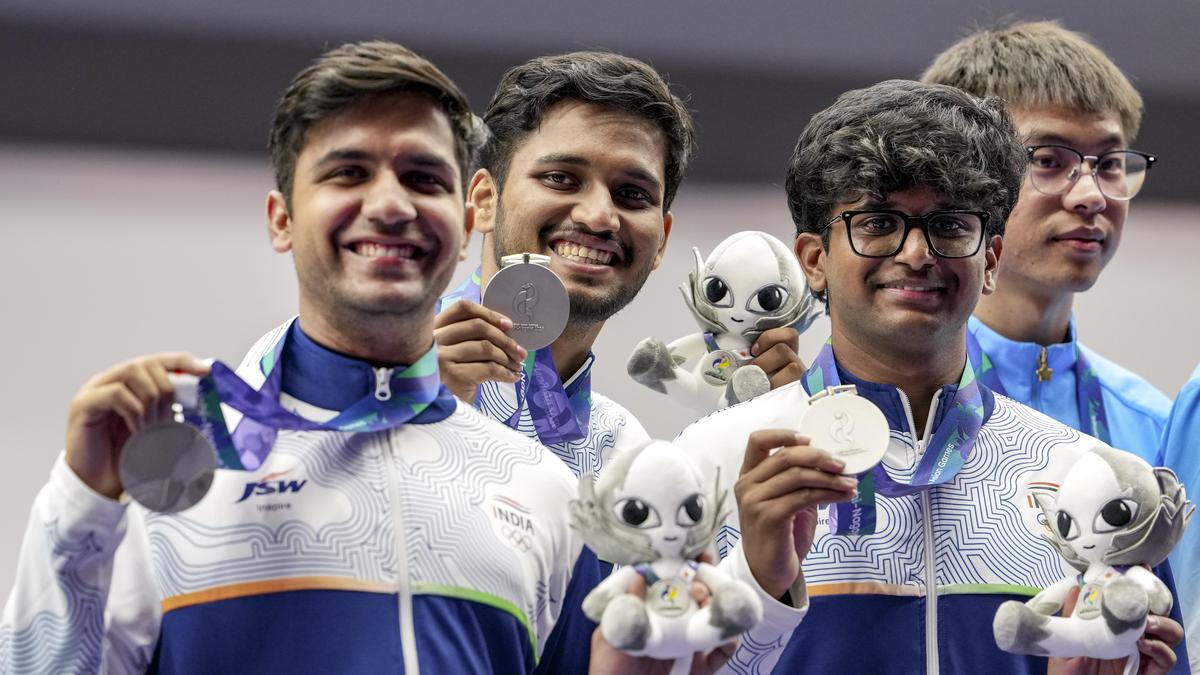
When Manu Bhaker first walked into the Asian Games arena as a teenager in Jakarta back in 2018, she arrived as one of the bright young faces of an Indian shooting generation being moulded for the future.Saurabh Chaudhary was another teenager on that stage. Seven years later, Parth Mane is beginning to write the next chapter.Keep track: Asian Games 2026 LIVE | Himanshu Dhillon, Rudrankksh Patil lead India’s shooting medal haul with three more medalsThe bespectacled 18-year-old announced himself on the senior continental stage with a silver medal in the men’s 10m air rifle team event on Monday (September 21, 2026), adding another piece to India’s growing collection of shooting medals and, more significantly, offering another glimpse of the depth coming through the country’s shooting ranks.For Mane, the medal was not merely a reward for a good day at the range. It was the culmination of a difficult transition from junior shooting, where he had already become a world champion, to a senior circuit in which the scores, pressure and competition demanded an entirely different level of consistency.And behind that transition was a family decision that required more than just sporting ambition.His parents moved from Solapur to Mumbai after his father, a police officer, was transferred there in 2021, allowing Mane to train under former Olympian Suma Shirur at her shooting club.“It is a special moment for me and a special medal, of course, as it is my first senior medal in an international competition,” Mane said after winning silver on his Asian Games debut.“It is a special medal and a good experience and good learning also.” The most valuable lesson, however, came not from the podium but from the pressure of the qualification round. Mane narrowly missed out on the individual final after finishing outside the top eight, even as his teammates Himanshu Dhillon and Rudrankksh Patil made the cut.There was no frustration in his response, though. Instead, he spoke of the experience as preparation for bigger stages.“In the last series or in the last few shots, I got that confidence about my process and everything,” he said. “I just learnt how to continue doing my natural process in that situation, in high-pressure situations.” That composure became particularly important in the team event, where Mane combined with Dhillon and Rudrankksh to secure team silver for India.The result completed a significant day for Indian shooting and added to the country’s medal haul, but for Mane it also served as confirmation that he is beginning to find his footing among the seniors.The journey has not been straightforward. After winning individual and team gold at the junior World Championships, Mane found the jump to the senior level daunting.The scores required were higher, the margins thinner and the field far less forgiving.“Initially it was not easy for me to participate in the senior events because of the competition and the scores were too high,” he said.He when back to the basics. Mane and his coach worked extensively on his process, fine-tuning his stance and technique and gradually building the consistency required at the senior level.“We worked really hard, we worked on my process, we fine-tuned everything, my position and my process,” he said.“After a few competitions, I could achieve the score that is needed for competing in the senior events.” That process now appears to be bearing fruit. Mane was introduced to shooting almost by accident when he was 13. His father took him to a shooting summer camp at his school, expecting little more than an introduction to a new sport. But Mane found something else. “I just loved the environment of the range. I just loved the peace that shooting gives me,” he said.“I saw that opportunity that I can represent my country at an international stage.” That dream has now taken him to an Asian Games podium before he has even completed the transition into senior shooting.His family has been central to that journey. With no sporting background at home, his parents nevertheless made a significant commitment to his ambitions. His father moved to Mumbai, and the family settled there so Mane could train in better surroundings.“My family has been so nice, so supportive from the beginning of my career,” he said. “My father transferred his job to Bombay, where I train right now. So, it’s been great support from my family.” Mane now lives at Shirur’s residential facility, just about 20 minutes from the range, giving him an environment entirely geared towards training and competition. He has also managed to balance shooting with academics and has completed his Class 12 education. But there is little doubt about where his ambitions lie.“This is something that I would do for the rest of my professional career,” he said. “Because I have the opportunity to represent my country, it is what I wanted from the beginning.” The next target is the World Championships in Qatar, where a quota place will be at stake, is his immediate focus. Beyond that lies the bigger dream of Los Angeles 2028. “Definitely,” he said when asked if an Olympic gold in LA was the target.For now, though, there is another match waiting for him on Tuesday (September 22) and little time to savour his first major senior medal. From a 13-year-old discovering shooting at a summer camp in Solapur to a junior world champion and now an Asian Games medallist, Mane’s journey has moved quickly. Yet he insists he is not there yet.“Definitely, I have come into the big league…but I am still working on my process, still working on my mindset. I will get there for sure.”
Manu, Saurabh, Now Parth: India’s new shooting generation takes centre-stage
Full Article
Original Source
Read the full article at Thehindu →KhanList aggregates and links to publicly available news content. We do not host full articles from third-party sources. Always verify important information with original sources.