
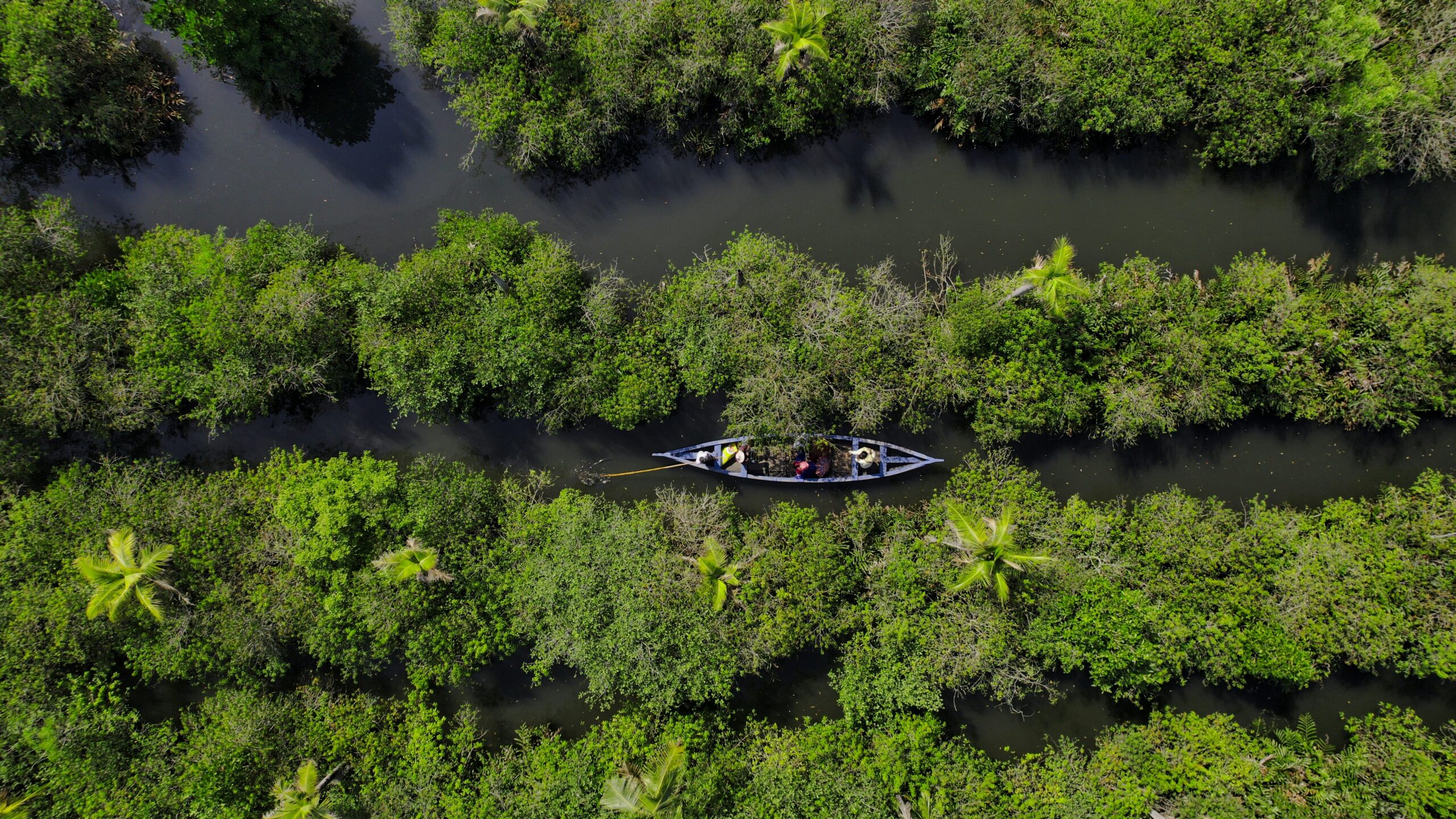
Globally, mangrove cover has grown by 477 square kilometers (184 square miles) between 1985 and 2025, marking a turnaround from the losses that have predominated for years, but gains are uneven.India recorded significant net increases, followed by Pakistan, Australia, the Philippines and Senegal.Indonesia, Myanmar, Malaysia, Nigeria and Cuba led in net losses as land-use changes — agriculture, aquaculture and development — together with pollution drove mangrove destruction.Experts say community-led mangrove restoration works, along with greater corporate accountability and better enforcement of existing laws protecting the coastal forests. After decades of losses, new data show the world’s mangrove forests are beginning to rebound. It marks a modest but significant turnaround for the salt-tolerant coastal trees and shrubs, which provide vital ecosystem services, including carbon storage, habitat for thousands of species and protection from storms and erosion. Global mangrove cover increased by 477 square kilometers (184 square miles) between 1985 and 2025, according to the latest Global Mangrove Watch (GMW) data released in July. Restoration and stronger protections drove the modest net gains, which represent a 0.3% increase over four decades. The new assessment follows a separate study, published in June, that reached a similar conclusion about overall growth in mangrove cover. GMW, a mapping initiative of the NGO consortium known as the Global Mangrove Alliance, has tracked mangrove gains and losses since 2011. In this third update, researchers used 10-meter (33-foot) resolution satellite imagery and machine learning to map changes in mangrove cover across 108 countries. It’s the first of the updates to span a 39-year period, from 1985 to 2024, according to Lammert Hilarides, the GMW program lead at the Netherlands-based NGO Wetlands International. The previous version only tracked changes in the data since 1996, covering about 24 years. “The importance of tracking changes in mangroves lies in the need to have accurate information if you want to successfully halt loss, protect and restore mangroves,” Hilarides told Mongabay by email. He added that the new data show significant differences between regions, countries and the timing of gains and losses. Aerial view of mangrove forests that have been cleared for farming and aquaculture in Kalimantan, Borneo, Indonesia. Image by Rhett A. Butler for Mongabay. India led the growth, adding 1,180 km² (456 mi²) of mangroves. Other countries with significant mangrove expansion over the four decades included Australia, Pakistan, Senegal and the Philippines. But recovery hasn’t been universal. In Indonesia, Myanmar, Malaysia, Nigeria and Cuba, for example, mangroves registered net losses over the study period. The data show Indonesia, with a fifth of the world’s mangroves, led with 2,043 km² (789 mi²) in losses since 1985. Myanmar came next with 1,458 km² (563 mi²); then Malaysia with 390 km² (151 mi²); Nigeria with 312 km² (120 mi²); and Cuba with 272 km² (105 mi²). Yet despite overall losses in some countries since 1985, the GMW data highlight recent turnarounds. Since 2010, the net decline in Indonesia, for example, has slowed significantly, and since 2015, it has been among the three countries with the most growth in mangrove cover, Hilarides said. The opposite trend occurred in the Caribbean and in Central and North America. Those regions saw significant gains between 1985 and 1995. “But in the last 5 years we are seeing a declining trend,” Hilarides said, adding the regional drivers are still unknown. Volunteers replant mangroves outside Saloum Delta, Diamniadio Island in Senegal, in October 2015. Image by Jane Hahn/AP Photo. Mangroves as climate armor The dense roots of mangroves support healthy coral reefs and provide sheltering habitat for fish and other marine species. Their roots trap mud and filter pollution from the land, so the water reaching the reefs is clearer and cleaner, fostering the growth of corals and other species. Mangrove forests also provide vital coastal defenses, protecting against erosion and reducing the power of wind and waves that cause flooding and infrastructure damage. In countries like Indonesia and Myanmar, decades of clearing mangroves has left coastal villages more vulnerable to cyclones and storm surges. In Nigeria, the coastline along the Gulf of Guinea holds an estimated 5-7% of the world’s total mangrove cover. But the country has lost significant areas of mangrove, exposing some communities to worsening flooding and coastal erosion. “When mangroves disappear, communities lose a natural barrier against erosion, flooding and rising seas,” Ogunlade Olamide Martins, associate director at the Nigeria-based NGO Corporate Accountability and Public Participation Africa, told Mongabay. “This is especially serious as climate change brings stronger coastal flooding.” Climate impacts also hurt the mangroves themselves. A 2025 report found mangrove forests globally could face severe risk from climate change-intensified tropical cyclones and rising seas. Mangroves line a river in Nigeria. Image by Temitayo Agbaje via Unsplash. Deer in mangroves of Sundarbans, a mangrove forest area in the Ganges Delta formed by the confluence of the Ganges, Brahmaputra and Meghna Rivers. Image by Ashique Anan Abir via Unsplash. Deforestation, development and pollution drive losses According to a 2024 Global Mangrove Alliance report, the main global drivers of mangrove loss are land conversion for aquaculture, rice and oil palm cultivation and urban expansion; pollution; and over-harvesting of timber and charcoal. Oil pollution and coastal erosion are major drivers of mangrove declines in Nigeria’s Niger Delta, which has the biggest mangrove forest in Africa. About 260,000 barrels of crude oil has spilled into the delta annually for nearly seven decades, Nnimmo Bassey, director of the Nigeria-based Health of Mother Earth Foundation, told Mongabay. Wetland conversion through sand filling and canalization by oil companies also harms mangroves. “A restored mangrove forest would restore fisheries, economy and livelihoods. It would be a marker of a return of human security in the region,” Bassey said. Ogunlade said weak governance and a lack of corporate accountability in Nigeria, like elsewhere, complicates efforts to address the problem. Google Earth satellite imagery of Muthupet, Tamil Nadu, India on April 20, 2024, showing the fishbone-like canal network that supports mangrove restoration. Image by Google Earth; Airbus, Maxar Technologies. What’s working In India, mangrove cover has expanded after decades of loss. Ramasubramanian R., a mangrove restoration scientist and senior fellow at the M.S. Swaminathan Research Foundation, told Mongabay the turnaround came through policy, engineering and community action. “The government stopped felling and declared most wetlands as protected areas because mangroves are vital for coastal protection and fisheries,” Ramasubramanian said. Starting in the late 1980s, the Indian states of Tamil Nadu and Andhra Pradesh dug “fish-bone” canals — small channels that spread out like the bones of a fish. These canals let ocean water come in with the high tide and go out with the low tide, creating optimal soil conditions for mangroves to grow. Livelihood programs helped, too, Ramasubramanian said, including alternatives to mangrove-derived firewood and paying communities to plant mangroves. The Indian government has scaled community-led restoration projects and sought to integrate women in mangrove protection, which “reduces pressure on forests” because “women manage both fuelwood and restoration,” he said. Two people planting mangroves in Bangladesh as part of a United Nations Development Program project. Image by UNDP Bangladesh via Flickr (CC BY-NC 2.0). Ramasubramanian suggested countries with declining mangrove cover assess how much communities depend on mangroves for basic necessities like firewood and food, as well as coastal protection, and provide alternatives to destructive activities like logging and charcoal production. Stopping further mangrove damage, he added, also depends on involving communities in restoration, securing sufficient conservation funding and beefing up enforcement of existing laws. The GMW data show some mangrove gains from afforestation and restoration. Yet many mass planting projects have failed to create healthy mangrove forests. Global Mangrove Alliance calls “community-based ecological mangrove restoration” the best practice. The approach emphasizes community ownership and mangrove ecology rather than achieving a quota for tree planting. “Restoring a forest to a healthy state requires doing more than simply putting an x number of seedlings into the ground, ” Hilarides said. “It requires community ownership to ensure long term sustainability as well as restoring the ecological conditions for mangroves to grow.” Banner image: Drone photograph of the mangrove forests surrounding Munroe Island, Kerala, India. Image by Cymatics.in via Unsplash. ‘It has been worth it’: The local women saving Yucatán’s mangroves Citations: Sagala, P. M., Bhomia, R. K., … Murdiyarso, D. (2024). Assessment of coastal vulnerability to support mangrove restoration in the northern coast of Java, Indonesia. Regional Studies in Marine Science, 70, 103383. doi:10.1016/j.rsma.2024.103383 Wang, D., Dai, Z., Long, C., Liang, X., Xiong, Y., … Cheng, J. (2025). The serious loss of mangrove forest over the largest delta of Africa, Niger delta: Causes and reasons. Marine Environmental Research, 210, 107350. doi:10.1016/j.marenvres.2025.107350 Lovelock, C. E., Barbier, E., … Duarte, C. M. (2022). Tackling the mangrove restoration challenge. PLOS Biology, 20(10), e3001836. doi:10.1371/journal.pbio.3001836 Feedback: Use this form to send a message to the editor of this post. If you want to post a public comment, you can do that at the bottom of the page. Cite this articleSamuel Ogunsona (2026). Mangroves gain ground globally, marking turnaround after decades of loss. Mongabay Conservation news. DOI: https://doi.org/10.66709/news-332579 Credits Topics
Mangroves gain ground globally, marking turnaround after decades of loss
Full Article
Original Source
Read the full article at News →KhanList aggregates and links to publicly available news content. We do not host full articles from third-party sources. Always verify important information with original sources.