
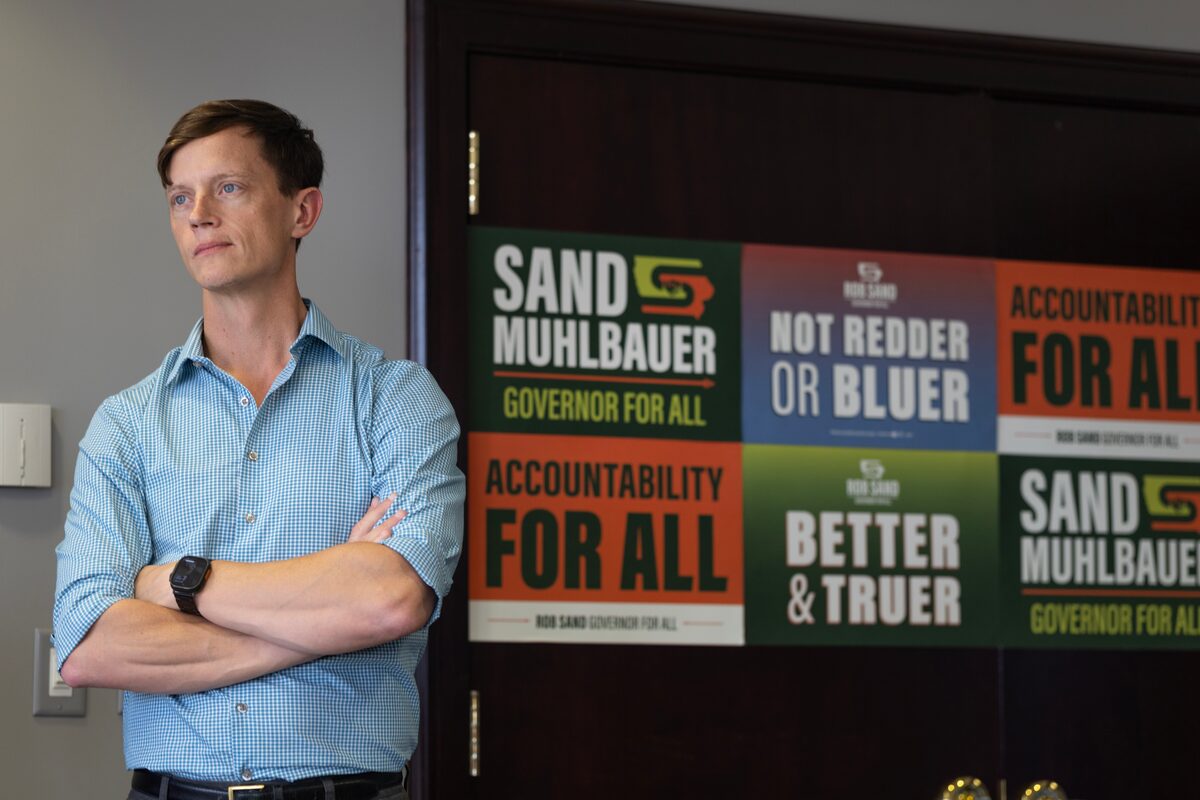
Open this photo in gallery:Iowa Democratic gubernatorial candidate, state auditor Rob Sand attends a campaign stop at the state Education Association on Oct. 8, in Des Moines, Iowa.Scott Olson/Getty ImagesRob Sand wants you to know that he wishes he weren’t a Democrat.Pacing the hardwood floor of the Starlight Ballroom at the Davenport, Iowa, fairgrounds on a recent weeknight, the gubernatorial candidate opens his pitch to 800 or so assembled voters by explaining that he only registered with a political party because it was necessary to vote in nomination races.“Our political system is broken, basically, because it’s run by two private clubs,” he says to applause. “A lot of the people in leadership of both of those parties are more interested in beating up on each other than they are in solving our problems.”A lanky 44-year-old who resembles the actor Cillian Murphy, Mr. Sand presents himself as a centrist technocrat. Currently the state auditor and previously a public corruption prosecutor, he outlines a personal history of cracking down on waste, fraud and abuse within the government.Explore our U.S. midterms series, The Restless RiverHe rails against Iowa’s incumbent Republican administration for frittering away a budget surplus. He vows to deal with the state’s rising cancer rates and falling educational achievement. And he calls for imposing term and age limits on public officials − and making them take cognitive tests.When he gets to U.S. President Donald Trump’s tariffs, he frames them as fiscally damaging. “Canada is responsible for 30 per cent of Iowa’s exports. So this trade war is going to hurt our economy. When our economy gets hurt, our tax receipts will go down and our deficit will go up.”His speech is peppered with dad jokes and references to his small-town childhood.“Four important parts of my upbringing: going to church, hunting, fishing and my first job, which taught me a lot, catching chickens. Three of those four things are still important parts of my life today,” he says.Amid the Trump era’s political polarization, Mr. Sand is banking that a big-tent approach can deliver in these midterm elections. The polls give him reason to hope: He is leading the Republican nominee, private school owner and conservative activist Zach Lahn. A Sand victory would be the first for a Democrat in an Iowa gubernatorial race since 2006.Once solidly Republican, Iowa is becoming a swing state again 47Conversations with voters of all political stripes around the Davenport area reveal a consistent set of preoccupations, usually with bread-and-butter issues, that could play to his advantage.Some match the national frustration over high fuel and grocery prices, blamed on Mr. Trump’s tariffs and war on Iran. Others are more specific to Iowa: the cancer rates, which are some of the highest in the country, and lingering resentment over a contentious school voucher program that subsidizes children, often from wealthy families, to attend private school at the expense of funding for the public system.Katherine Carstens recounts a trip to the hospital emergency room that crystallized how overburdened the state’s health care system is. While waiting to be seen for chest pains, she met an 85-year-old woman with trouble breathing who hadn’t been seen by a doctor after nearly 12 hours in the ER.“I ended up leaving because I had to be at school the next day. I never did get to see a doctor,” says Ms. Carstens, a 50-year-old primary school teacher.At Ron and Sherri Dietz’s corn, soybean and cattle farm, the couple has to shell out nearly double for diesel this year, a major cost of shipping what they produce to market. “Trump doesn’t understand what a tariff does, how it affects the person that’s buying the goods instead of the country he’s trying to penalize,” says Mr. Dietz, 69.Grant Allison, a 68-year-old retired veterinarian and registered Republican, is deeply worried about the cancer rates. Two of his neighbours have leukemia, two of his clients have pancreatic cancer, and his former business partner of 40 years died of the disease in January.Military conflicts and Trump’s failed Russia-Ukraine truce roil oil marketsWhile experts are still not sure what is causing the higher rates in Iowa, Mr. Allison, like many here, blames it on runoff from agrochemicals. He says the state isn’t doing enough to protect water quality. “It’s killing my neighbours. People get cancer and die − and nothing is being done about it.”And like many here, Mr. Allison has watched his children decamp to other states and countries. One of his daughters and her husband live in Shanghai and teach at an international school. There’s no incentive for them to return, he says. For one thing, she earns more in China than Mr. Allison did as a veterinarian, something that would not be the case if she worked as a teacher here.For another, his son-in-law is a Pakistani national, and Mr. Allison worries that, despite having a U.S. green card, he could be swept up in Mr. Trump’s immigration dragnet and deported.“They should be here in Iowa. But they don’t want to be here because it’s not safe,” Mr. Allison says as he sits outside Mr. Sand’s townhall on this mild autumn evening, gazing across at the darkened county fairgrounds.In the U.S. midterms’ murky math, economic distress is the only clear variableIt is this malaise about the state of the state that Mr. Sand seems eager to tap, in large part by appealing to middle-of-the-road voters such as Mr. Allison. His slogan is “Not redder or bluer but better and truer,” and his green-and-orange campaign signs make no mention of his party.While Democrats are also polling competitively in races for an Iowa Senate seat and three of its four House districts, none is performing as well as Mr. Sand.In Mr. Sand’s most reformist proposal, he is calling for a wholesale change to the electoral system in a bid to break the power of political parties. Under his plan, instead of each party nominating people for office, every candidate, regardless of political stripe, would run in a blanket primary, with the top four vote-getters advancing to the general election.In the general, he proposes, voters would use a system called “approval voting” in which they vote for as many candidates as they approve of. The one with the most votes wins. The idea is to incentivize politicians to appeal to their opponents’ supporters – and earn their approval – by eschewing negative campaigning. “The people in both those private clubs, they want you to hate your neighbours that vote differently than you,” he tells the hall in Davenport. “I want us to love our neighbours instead.”
Man in the middle: Iowa gubernatorial candidate Rob Sand is no fan of parties
Full Article
Original Source
Read the full article at Theglobeandmail →KhanList aggregates and links to publicly available news content. We do not host full articles from third-party sources. Always verify important information with original sources.