
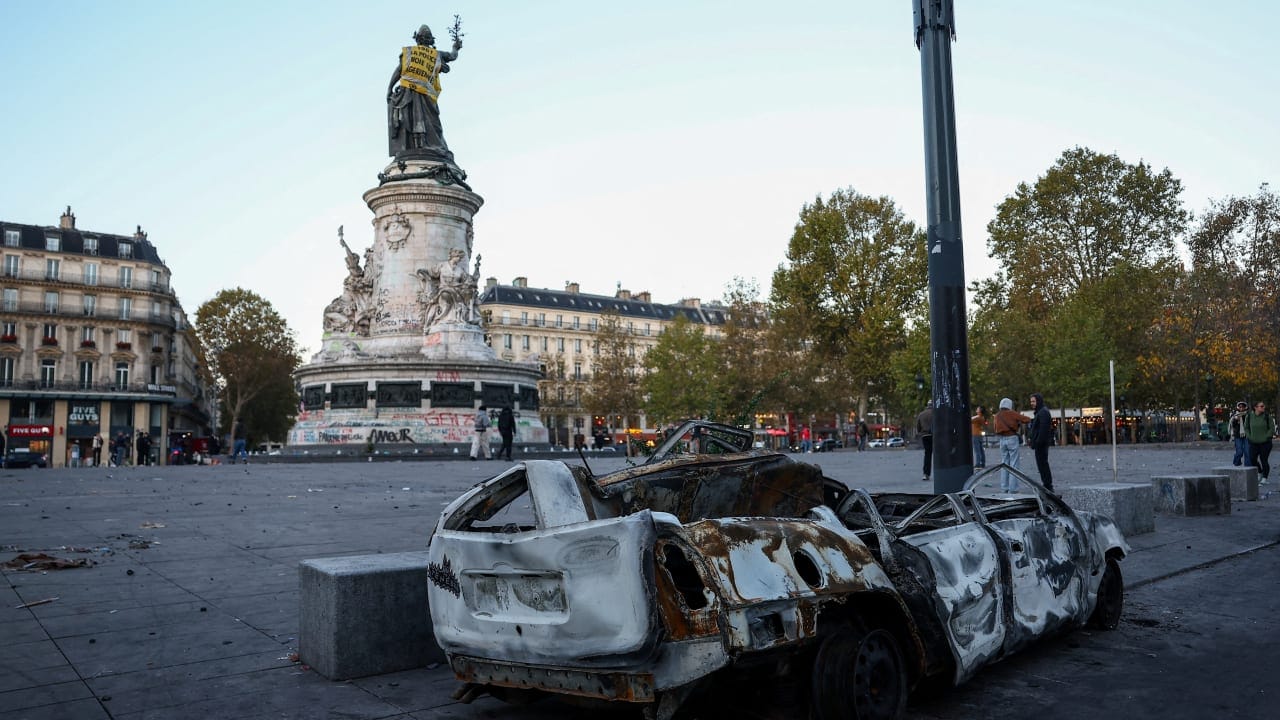
OCTOBER 18, 2026 15:55Updated: OCTOBER 18, 2026 16:06Some of the protesters in Paris on Saturday didn't stay on the ground. They climbed the Monument to the Republic, the bronze Marianne at the center of Place de la République, and stood above a crowd of tens of thousands. Reuters photographer Jack Taylor caught them up there. In his picture, two flags fly side by side over the square: the French tricolor and the Palestinian flag.The people below had come to protest the cost of living, worsening public services, and the state of French schools. Those are French problems, and serious ones. So what was the Palestinian flag doing up there next to the tricolor?Saturday's demonstrations turned into some of the worst violence France has seen in years. Rioters burned cars, looted shops, and attacked police officers. By Sunday, nearly 1,800 people had been arrested across the country, according to Reuters. More than half a million people took part in the demonstrations, the overwhelming majority of them peacefully, over real problems: French classrooms are short of teachers, and families are struggling with living costs.I want to be careful with the answer. The flag proves less than some people were already claiming. It shows that protesters brought the Palestinian cause to a demonstration about French problems. It doesn't tell us whether anyone carrying it had a hand in the arson or the attacks, and we don't know that yet.On Sunday, the Combat Antisemitism Movement shared a video it said showed a Paris synagogue vandalized during the unrest. It opens on what looks like a small prayer room. The Torah scroll is still standing in its wooden ark. Around it, the furniture has been shoved out of place, and things are lying all over the floor.A firework explodes near police officers as people take part in a demonstration as part of nationwide protests called by the ''Yellow Vests'' movement against the cost of living and rising fuel prices, in Nantes, France, October 17, 2026. (credit: REUTERS/Stephane Mahe TPX IMAGES OF THE DAY)The synagogue was reported to be in the 19th arrondissement, a district in northeastern Paris. Nobody has independently confirmed what happened there, when the video was filmed, or whether it had anything to do with Saturday's riots. I've watched too many frightening clips get treated as fact before anyone bothered to ask what happened, and I don't want to add another one.Still, it bothered me. On Saturday, the Jewish Sabbath, a synagogue is a pretty ordinary place. People pray, complain that the rabbi's sermon ran long, and ask about each other's kids. Nobody there should have to wonder what happened at a political demonstration earlier that day.This is how the conflict travels. When it reaches Paris or New York, it rarely finds an Israeli official to shout at. It finds Jews, and it works on them in two steps. First they're made to stand in for Israel. Then they're made to answer for it. I learned how the first step works on a Paris street in 2015.Ten hours in Paris after 2015 terrorist attacksIn February 2015, I spent 10 hours walking through Paris and its suburbs in a kippah (skullcap) and tzitzit, the ritual fringes worn by observant Jewish men. It was a few weeks after the terrorist attacks at the satirical magazine Charlie Hebdo and at the Hypercacher kosher supermarket, where four Jews were murdered. A photographer followed me with a hidden camera. A security guard came along and stayed out of sight.I was covering the Jewish world for the Israeli news website NRG and the newspaper Makor Rishon at the time, and we wanted to see what ordinary Jewish life felt like on the streets of Paris.We started in the center of Paris, where the worst I got was the occasional stare. Then we headed into other neighborhoods and out to the suburbs, and the mood changed. People cursed at me and threatened me, and some spat. Someone shouted "Vive Palestine" as I walked past. In one neighborhood, our security guard, who had been keeping out of sight, decided it was getting dangerous, and we got out.I hadn't said a word about Israel or carried a flag, and nobody asked what I thought of the Israeli government. Apparently my kippah had already answered for me. That's the first step: to the people shouting at me, a Jew walking down a Paris street had become Israel.What still gets me is how young some of them were, teenagers barely older than children, who seemed to know almost nothing about Jews except what they'd picked up on the street.The video went viral. Millions of people watched it, and for a while I was the guy explaining on television around the world what it felt like to walk through Paris in a kippah.Attacking a synagogue to send a message to IsraelOne Saturday morning in August 2024, two cars went up in flames outside the Beth Yaacov synagogue in La Grande-Motte, a seaside town near Montpellier in southern France. One of them had a propane tank inside. Firefighters found more fires at two of the synagogue's entrances. Five people were inside, including the rabbi, and none of them was hurt. A police officer who walked up to the scene was injured when the tank exploded.French prosecutors later said the suspect had admitted carrying out the attack to support the Palestinian cause and to provoke a reaction from the Israeli authorities. He denied wanting to kill anyone, though he acknowledged he had wanted to frighten people.I still find the logic hard to follow. A man angry at Israel set fire to a synagogue in southern France and expected it to influence decisions made in Jerusalem. The people who prayed there had no say over Israeli policy and no special line to the prime minister's office. They were Jews, and as far as he was concerned, that was enough. It was the same first step I met on the street in 2015, this time carried out with fire.After the attack, Yonathan Arfi, president of CRIF, the body that represents French Jewish institutions, spoke to my colleague Michael Starr. He said French Jews lived with the knowledge that some people saw them as legitimate targets in a battle being fought thousands of kilometers away.French Jews have lived with this since the Second Intifada, which began in 2000, long before October 7, 2023. In those years, attacks on Jewish schools, synagogues, and individuals became common for Europe's largest Jewish community.Ilan Halimi was kidnapped, tortured, and murdered in 2006 because he was Jewish. In 2012, a terrorist murdered Rabbi Jonathan Sandler, his two sons, and 8-year-old Myriam Monsonego at a Jewish school in Toulouse. In 2025, France recorded 1,320 antisemitic incidents, according to the Interior Ministry. That was down from the year before and still historically high.The second step does its damage more quietly. A CRIF study published in July looked at the experiences of 30 Jewish schoolchildren interviewed in 2024. Many said they felt pressured to answer for Israeli policies, sometimes by classmates who barely understood the conflict. Some hid that they were Jewish or avoided talking about Israel at all.These are teenagers worried about grades and friends, and they're being asked to defend decisions made by the Israeli cabinet. I'm not sure most of the ministers could explain all of those decisions. A Jewish kid in a Paris classroom is expected to.What a rabbi told New York Mayor Zohran MamdaniEarly in his campaign, New York Mayor Zohran Mamdani resisted calls to condemn the slogan "globalize the intifada." Intifada, he argued, means uprising, and some activists use the word to describe resistance to oppression.In September 2025, he told MSNBC's Al Sharpton that his views had changed. A rabbi, he said, had told him the slogan reminded her of bus bombings in Haifa, and that she feared extremists could terrorize Jews in New York. She was describing exactly how the intifada travels. He said he now saw a gap between what some people meant by the phrase and its impact on Jewish New Yorkers, and that he would discourage its use.I'll give him credit for that. It means he can't say nobody explained it to him. The rabbi could have added the Park Hotel in Netanya, where a Palestinian suicide bomber walked into a Passover Seder in March 2002 and murdered 30 people.For Israelis who lived through the Second Intifada, the word means buses blown up in Jerusalem and Haifa and restaurants turned into murder scenes. So when someone calls for that to be globalized, I'd like to know what exactly they're planning to export.Mamdani's supporters may mean demonstrations, civil disobedience, or solidarity with Palestinians. Fine, that's politics. But we hear the bombings, and calling it an "uprising" doesn't change what we hear.Last month, his administration announced a strategy to combat antisemitism, including $6.4 million in grants for hate-crime prevention and support for victims, along with more money for security at synagogues and other houses of worship. I hope it helps.Earlier this month, I wrote that his security grants and cultural programs would leave a central part of the problem untouched: the hostility Jews face over their attachment to Israel. That part depends on Mamdani himself, and on whether he tells people on his own side when their language or behavior has crossed a line.On a Wednesday evening in November 2025, two weeks after Mamdani won the election, Nefesh B'Nefesh, which helps Jews move to Israel, was holding an event at Park East Synagogue on Manhattan's Upper East Side. Outside, police put up barricades between protesters and a group of counterprotesters. Some of the protesters chanted "globalize the intifada" and "make them scared." Inside, the event went on.The next day, his press secretary said he had discouraged the language and would continue to do so. The same statement said sacred spaces "should not be used to promote activities in violation of international law." When the news site Jewish Insider pressed his team on what that meant, it said it was referring to the organization's promotion of settlement activity beyond the Green Line, the pre-1967 armistice line.So the Jews inside heard a crowd chanting about making them scared, and the next day the mayor-elect's office suggested they'd misused their own synagogue by promoting settlements. The protesters had made them stand in for Israel. The incoming mayor's office then asked them to answer for it. Which part of that evening, exactly, was their fault?Even the Union for Reform Judaism, whose leaders are hardly automatic supporters of every Israeli government, condemned the intimidation and criticized his response.Anyone can protest Israel's policies. Jews going into a synagogue should be able to get there without being threatened, and a mayor should be able to say so without adding a "but." It isn't a hard sentence to write.Young child in Paris understood the presence of antisemitism The Israeli-Palestinian conflict is part of ordinary life in France now. It comes up in classrooms and neighborhood conversations, and in arguments between people who have never been to Israel.I have plenty of disagreements with my own government, as regular readers of this column know. A Jew in France or New York should be able to hold any opinion about Israel, or none, without being tested on it before walking into a synagogue.One moment from those 10 hours in Paris is stuck in my head, much more than the insults.A young boy saw me walking by in my kippah and asked his mother what I was doing there. Didn't I know I might be killed?He seemed genuinely worried about me. The boy knew nothing about the hidden camera or the security guard. All he saw was a Jew walking through his neighborhood. Young as he was, he already understood what that could mean there, and he was afraid of what might happen to me.He'd be a young man now, and I wonder whether he remembers that afternoon as well as I do.As for the teenagers who spat at me, I'd like to know whether any of them ever got to know a Jewish person, learned something about Jewish history, or rethought what they had been taught.Eleven years later, there's violence in France's streets again, and French Jews are looking at videos like the one from the 19th arrondissement.Mamdani has said he wants Jewish New Yorkers to feel safe. I hope he means it. He can show it the next time someone chants "globalize the intifada" outside a synagogue, by condemning it plainly, with no second sentence about the people inside.People can support Palestinians without reaching for the worst years of the Second Intifada. And kids in Paris and New York deserve to meet Jews as neighbors before anyone teaches them that every Jew is a stand-in for Israel.I still wonder what that boy's mother told him. I hope it was something kind.Follow us on Google
Mamdani, Paris already knows where 'globalize the intifada' ends up - comment
Full Article
Original Source
Read the full article at Jpost →KhanList aggregates and links to publicly available news content. We do not host full articles from third-party sources. Always verify important information with original sources.