
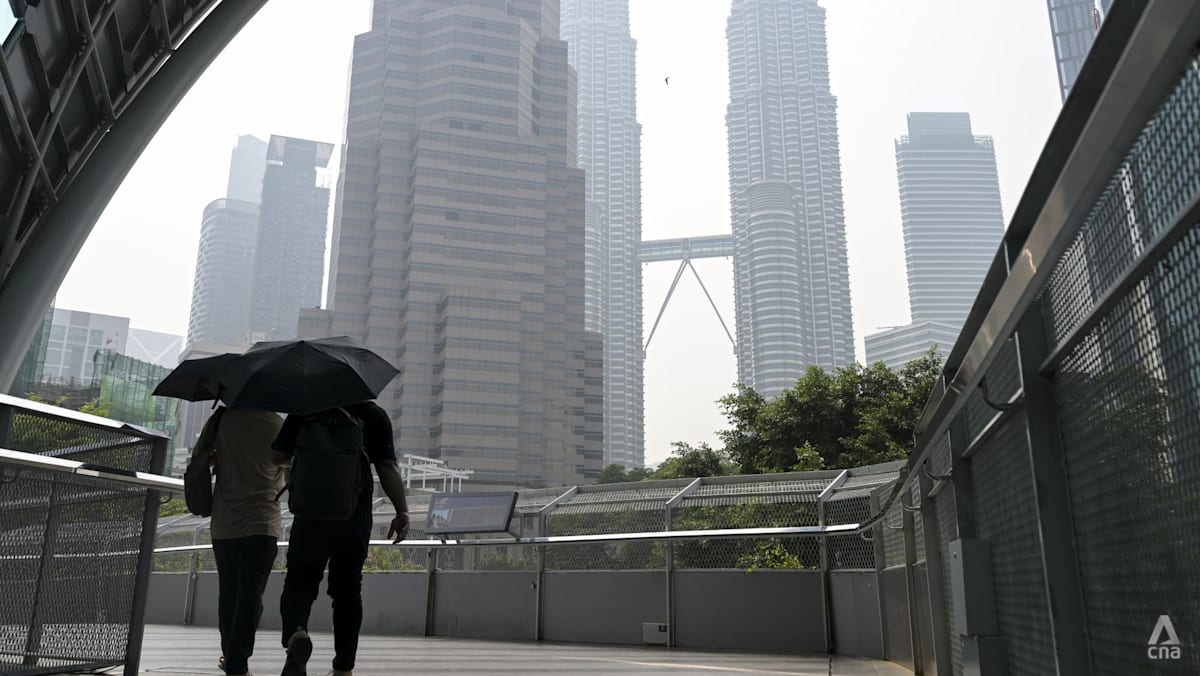
Asia Middle-income households are expected to get greater attention, even as economists warn that electoral pressures could slow politically difficult fiscal reforms. Pedestrians walk along the Saloma Link bridge as the Petronas Twin Towers stand shrouded in haze in Kuala Lumpur on Oct 7, 2026. (Photo: CNA/Fadza Ishak) New: You can now listen to articles. This audio is generated by an AI tool. KUALA LUMPUR: With the 2027 budget potentially being Malaysia’s final fiscal blueprint before the 16th general elections (GE16), Prime Minister Anwar Ibrahim faces a delicate economic and political balancing act: delivering meaningful cost-of-living relief without undermining fiscal discipline or alienating voters through costly reforms. Economists expect Anwar’s government to put greater emphasis on supporting middle-income earners alongside lower-income households, while taking a more cautious approach to politically sensitive reforms as the electoral clock ticks down.The budget comes after Anwar’s Pakatan Harapan (PH) suffered heavy setbacks in the Johor and Negeri Sembilan state elections this year, adding to political pressure on his administration ahead of GE16, which must be held by February 2028.Economist Anthony Dass of the FSG advisory group told CNA that while the budget was likely to place greater emphasis on immediate households concerns, he did not expect it to be dominated by broad-based short-term handouts. “The government still has to balance support for the rakyat (public) with fiscal consolidation, structural reforms and measures to strengthen longer-term economic growth,” he said. “I expect Budget 2027 to be more people-focused, but not necessarily an election giveaway budget.” The budget - the fifth under the current administration - will be tabled on Friday (Oct 9) at 3.30pm by Anwar, who is also finance minister. RELIEF TO MOVE BEYOND LOWER-INCOME HOUSEHOLDS?Economists expect middle-income households, known in Malaysia as the M40 (middle 40 per cent), to receive greater attention in the budget alongside continued support for lower-income groups.Lee Hwok Aun, a senior fellow and co-coordinator of the Malaysia Studies Programme at ISEAS-Yusof Ishak Institute, told CNA that "emphatic commitments" to cash assistance - some targeted at low- to middle-income households and some universal for all Malaysian adults - can be expected. JPMorgan Chase said in a report that the M40 had moved up the cost-of-living agenda, with Anwar making the group a central focus.“Budget 2027 puts greater attention on the M40 squeeze alongside continued support for lower-income households,” read the paper. It said that as the subsidy rationalisation continued for the RON95 petrol, it expected savings to be partly redirected towards targeted assistance and measures addressing recurring costs across food, housing, transport, healthcare, education and childcare. The finance ministry highlighted support for the middle class in its Aug 18 pre-budget statement, including RM150 (US$37) in student schooling aid and two RM100 cash grants for all adults nationwide. The ministry also emphasised tax breaks targeted at the middle class, such as exemptions for first-home purchases, expanded insurance premium deductions for children, and tax relief for early childhood education (up to RM3,000) and special needs therapy (up to RM10,000). Analysts stress that such safety nets will be vital to buffer against incoming economic headwinds. Economist Sedek Jantan of IPP, a financial planning group in Malaysia, said targeted assistance could become more important if a stronger El Nino in 2027 puts further strain on food production and prices. “This could put renewed pressure on household purchasing power. However, the key question is whether these measures are fiscally sustainable,” he told CNA.“I would expect the focus to increasingly be on targeted assistance rather than broad-based measures, so that support reaches those who need it most without creating a persistent burden on government finances.”That constraint remains important even as government spending rises. UOB projects expenditure to reach a record RM445.9 billion - equivalent to 19.6 per cent of the GDP - while the fiscal deficit narrows to 3.3 per cent of GDP from an estimated 3.5 per cent this year.“This would reinforce the government’s commitment to gradual fiscal consolidation, striking a balance between supporting growth and preserving medium- to long-term fiscal sustainability,” UOB said. Malaysia's Prime Minister and Finance Minister, Anwar Ibrahim, holds the 2026 national budget document at the Finance Ministry building as he departs for Parliament to table the budget, in Putrajaya, Malaysia, October 10, 2025. (Photo: Reuters/Hasnoor Hussain) REFORMS CONTINUE, BUT HOW FAR WITH GE16 LOOMING? Economists told CNA that while reforms will continue, they are likely to proceed at a more cautious pace.Sedek said that the government could not afford to completely put structural reforms on hold, but expected a more calibrated and carefully sequenced approach, particularly for measures that directly impact household incomes and business costs.He said the government could further tighten eligibility for subsidies and reduce leakages before making more substantial adjustments.On revenue, Sedek does not expect major new taxes on individuals or companies, with the government likely to focus instead on improving tax compliance, broadening the effective tax base and strengthening collection.Anwar said in August that the finance ministry was studying a proposal to create a hybrid tax system combining features of the Sales and Service Tax (SST) and the Goods and Services Tax (GST). Dass also said reforms will continue, but added it was politically difficult to introduce measures that impose visible additional costs on households. “I don’t expect the government to abandon structural reforms, but I do expect the pace and sequencing to become more cautious,” he said. Others believe the political window for more painful reforms is closing.Lee of ISEAS-Yusof Ishak Institute said major structural reforms were becoming politically risky, particularly further subsidy rationalisation that would fully or partially float prices.He noted that the government had already scaled back plans to progressively target fuel subsidies, opting instead to retain the full subsidy for all Malaysians up to a monthly limit rather than reduce support for higher-income earners.“Such reforms are less and less likely, the closer we get to the next election,” he said. Aira Azhari, the CEO of the Institute for Democracy and Economic Affairs (IDEAS), echoed this, saying that further rationalisation of petrol subsidies was unlikely, pointing to the government's recent decision to restore the monthly subsidised RON95 quota for Malaysians to 300 litres.“It is too politically risky to introduce any other subsidy rationalisation in this budget,” she told CNA. In August, Anwar announced that the government would restore a quota for Malaysian citizens to buy the popular RON95 transport fuel to 300 litres per month, after reducing it to 200 litres a month earlier this year amid a surge in global crude oil prices due to the US-Israeli war on Iran.The quota for diesel purchases for certain categories of users would be similarly raised to 400 litres per month. Commuters inside a train in Kuala Lumpur, Sep 7, 2026. (Photo: CNA/Fadza Ishak) SHORT-TERM RELIEF VS LONGER-TERM VALUEEconomists also cautioned against allowing short-term cost-of-living measures to come at the expense of investment, productivity and longer-term reforms.In this light, Sedek said the approaching general election would inevitably increase pressure on the government to address issues voters felt most directly, including the cost of living, incomes and essential services.But he said the government needed to distinguish between measures that provide “immediate emotional reassurance” and those that create lasting economic value.“Some low-hanging-fruit measures may provide quick relief and be well-received by households, but they are not necessarily sustainable if they create recurring fiscal commitments without improving productivity, wages or income-generating capacity,” he said. Stewart Nixon, director of research at IDEAS, similarly warned that the budget is being drawn up under the shadow of looming polls, with "election budgets" historically prioritising short-term political expediency over long-term investment and structural reform.“Governments typically tinker with and throw more money at existing policies, particularly in contested electorates, rather than pursue systemic change to address the people’s most pressing needs,” he wrote in a statement on Oct 6. Dass said the government should also focus less on announcing new programmes and more on whether existing measures were producing results.“Malaysia already has many programmes, incentives, grants and financing schemes. The question should now be: what did we achieve from them?" he said."Did productivity improve? Did SMEs grow? Did investments create better jobs? Did wages rise? Did household purchasing power improve?"
Malaysia budget 2027: Anwar faces balancing act on cost-of-living relief as general election looms
Full Article
Original Source
Read the full article at Channelnewsasia →KhanList aggregates and links to publicly available news content. We do not host full articles from third-party sources. Always verify important information with original sources.