
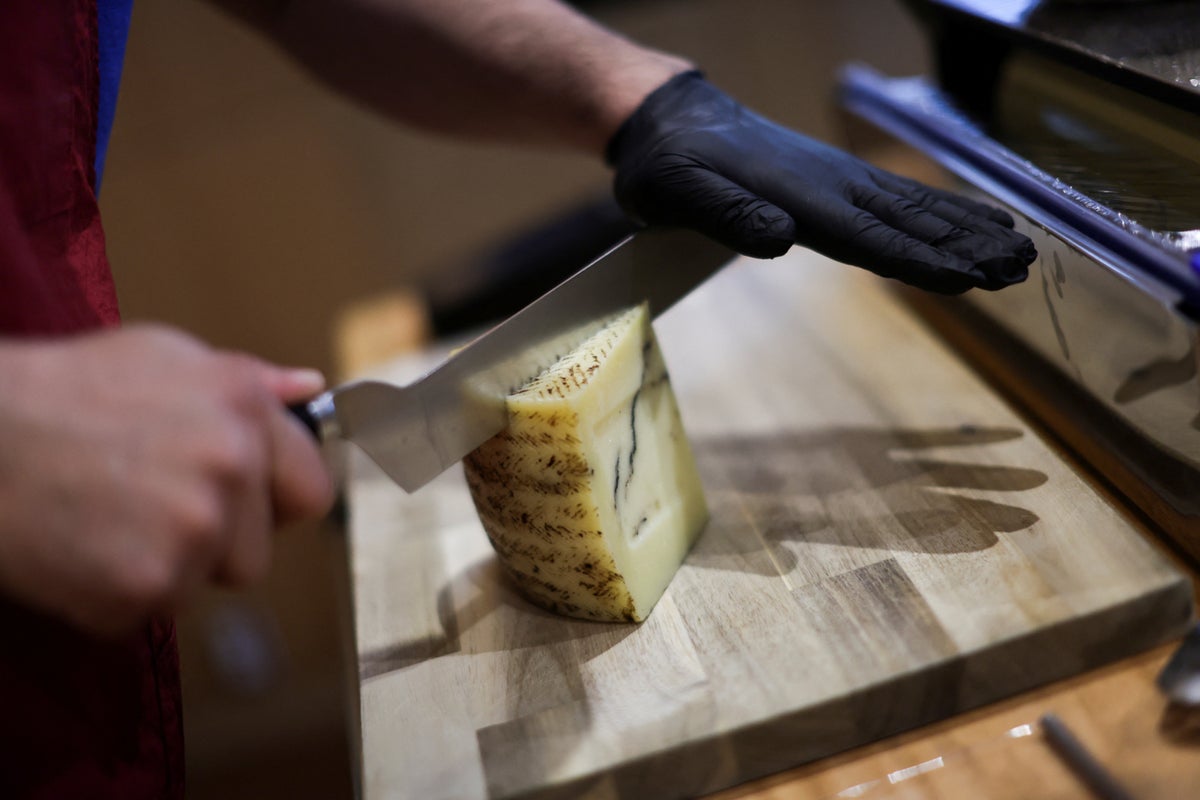
Disagreements over cheese nomenclature have become a major point of friction in trade negotiations between the United States and Mexico, according to two Mexican government sources speaking on condition of anonymity because of the delicate nature of the diplomatic talks.The friction stems from American objections to a newly signed trade arrangement between Mexico and the European Union. Under that agreement, special legal protections are granted to hundreds of European products linked to specific geographic origins, including Parmigiano Reggiano, feta, and manchego, alongside legal mechanisms to enforce compliance.Truffle-cured cheese imported from Spain is cut by an employee in a store as a dispute over protected cheese names has emerged as a flashpoint in trade talks involving Mexico, the United States and the European Union (Reuters)Officials in Washington argue that the pact, finalized in May, threatens to curtail American dairy producers' ability to sell common varieties like parmesan and feta in the Mexican market. While the U.S. treats these labels as generic terms, the EU maintains that names like parmesan should strictly refer to Parmigiano Reggiano from northern Italy, and feta to designated regions in Greece."It's absolutely wrong what Mexico did," said Jaime Castaneda, executive vice president of the U.S. Dairy Export Council. "The Mexican government has to make it absolutely certain that the United States and the Mexican manufacturers of common cheese names will continue to be able to be in the market."Washington argues that the deal, signed in May, would restrict future U.S. producers from selling cheeses in Mexico under names such as parmesan and feta (Reuters)The dispute arises as the U.S. and Mexico pursue a bilateral interim trade deal this year, while also conducting parallel talks to review the U.S.-Mexico-Canada Agreement, a cornerstone of Mexico's economic framework.U.S. negotiators have leveraged these high-stakes discussions to defend an export market valued at approximately $1 billion for American cheesemakers, leaving Mexican authorities in a difficult position.Although Mexico has signed the deal with the European Union, it must complete internal procedures before implementation can occur, while the EU has finalized its steps, according to a European Commission spokesperson. A spokesperson for Mexico's economy ministry confirmed the agreement requires legislative ratification.U.S. cheese has a reputation for poor quality, exacerbated by the continuing popularity of the processed slices known as American cheese (Getty Images)The European Commission told Reuters the treaty's terms cannot be renegotiated, noting it had "taken note of the U.S. actions" opposing the geographical protections.Neither Mexico's economy ministry nor the Office of the U.S. Trade Representative answered requests for comment, though the American trade agency has repeatedly criticized the EU's Geographical Indication (GI) framework."The EU continues to seek to expand its harmful GI system within its territory and beyond," the trade office said in an April report.Mexico is among the world's top consumers of cheese, favoring domestic varieties such as stringy Oaxaca cheese, often melted on quesadillas, and queso fresco, ideal for crumbly breakfast toppings (AFP/Getty)The agency stated that forcing dairy producers outside the bloc to adopt alternative labeling such as "imitation feta" or "asiago-style" imposes unnecessary financial burdens and worsens the $1.2 billion U.S. cheese trade deficit with the European bloc.Cheese plays a prominent role in the Mexican diet, with consumers traditionally favoring domestic varieties like stringy Oaxaca cheese for quesadillas or crumbly queso fresco as a food topping.Foreign imports have steadily expanded since the 1980s and now account for nearly 30% of domestic consumption. American items like Kraft's Grated Parmesan and Walmart's Great Value Manchego, along with rising demand for pizza across the country, have driven growth.The U.S. and Mexico are in the midst of thorny bilateral talks to secure an interim trade deal this year (Getty)U.S. dairy producers ship around $1 billion in cheese to Mexico each year, vastly outstripping the EU's total annual dairy exports to the nation, which stand at $200 million.European producers view the dispute as a clash of agricultural philosophies, contrasting industrial mass production with protected regional culinary traditions."The U.S. has always been a nation of high-volume consumption, which is precisely the opposite of what designations of origin represent," said Antonio Martinez, head of an organization that protects manchego's regional designation. The smaller scale of manchego producers in Spain gives them their "charm and unique identity," he added.Local distributors in Mexico, such as Rodolfo Navarro of a family-owned cheese distributor, favor the deal with the EU because it lowers import tariffs on European goods.An employee holds a piece of Parmesan cheese imported from Italy in Mexico City (Reuters)"These cheeses will serve different markets. European cheese will be sold in a higher niche," he said.Navarro and other local producers express greater concern over American imports, accusing U.S. suppliers of undercutting domestic pricing.The Institute for Agriculture and Trade Policy warned in 2023 that Mexican dairy producers were vulnerable to cheap U.S. exports.While American cheese products face criticism for lower quality—particularly highly processed slices composed of dairy leftovers and emulsifying salts, as well as aerosol products—U.S. producers note their cheeses have won accolades in global competitions. Supporters also point to the affordability, extended shelf life, and utility of processed options."The U.S. is flooding the Mexican market with its cheeses because they can sell them very cheap," said Georgina Yescas Trujano, co-founder of Mexica cheesemonger Lactography."I'm glad tariffs on European cheese are being lowered, because Mexicans can learn to eat better cheese."
Make America Grate Again? U.S. and Mexico locked in $1 billion cheese war
Full Article
Original Source
Read the full article at Independent →KhanList aggregates and links to publicly available news content. We do not host full articles from third-party sources. Always verify important information with original sources.