
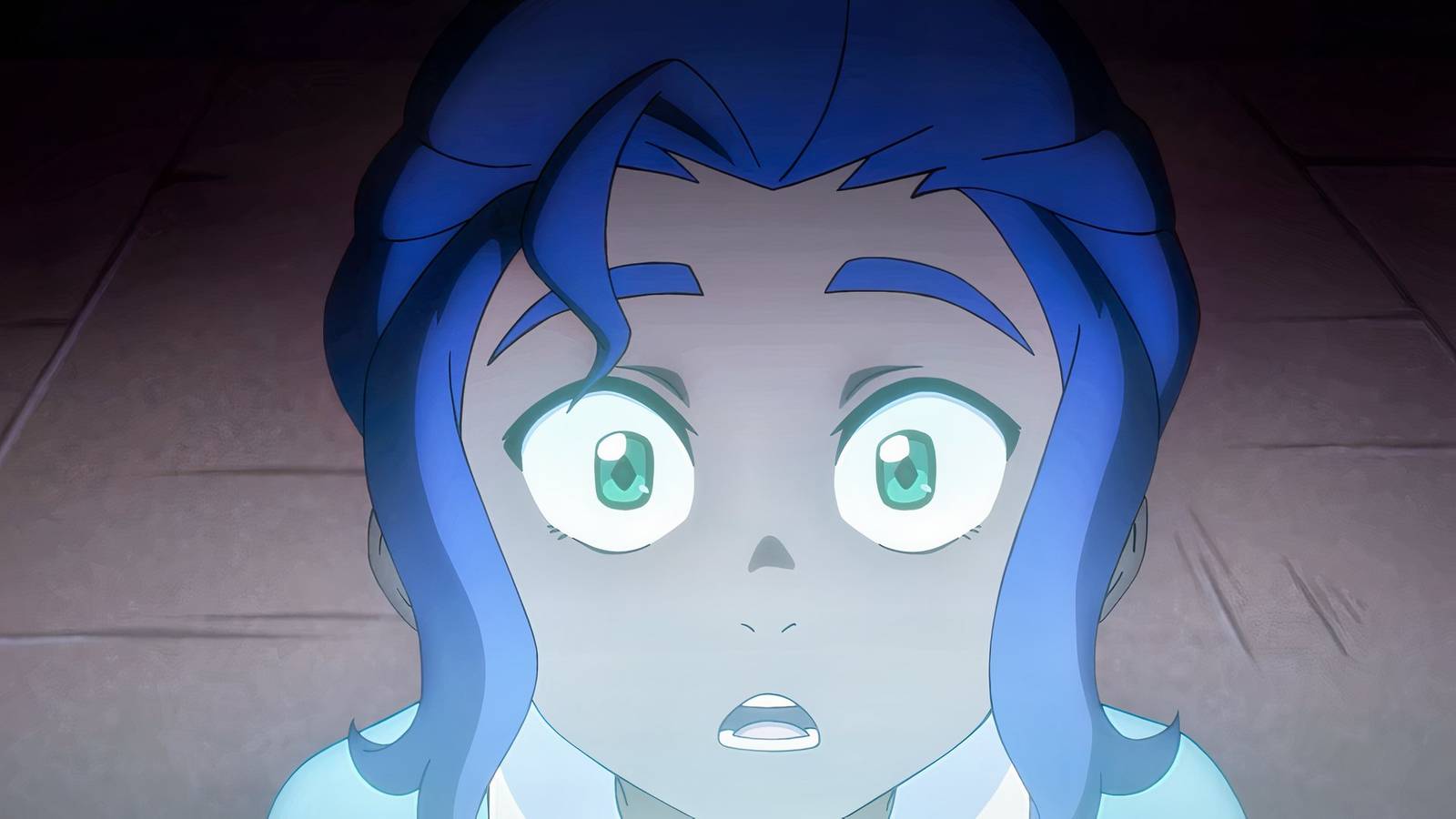
Published Oct 27, 2026, 12:00 AM EDT Is Korra really the great destroyer that the world remembers her as? Avatar: Seven Havens’ big Korra reveal feels like a total fakeout Image: Paramount Plus For more than two centuries, the world of Avatar: Seven Havens has remembered Korra as the Avatar who destroyed everything. Everybody from Ellora to New Ba Sing Se has grown up hearing that story, and episode 7 seemingly gives Pavi (Saheli Khan) and Nisha (Aishu Devan) them proof: They witness their predecessor in the Avatar State, tearing apart Republic City as spiritual energy whips through its burning streets. At face value, the evidence looks pretty damning. But the more closely you examine what the vision actually shows, the less straightforward Korra’s apparent rampage becomes. She isn’t visibly attacking people. She isn’t leveling buildings. She’s targeting pipes carrying what appears to be spiritual energy through a city that’s already on fire. And a change in her clothing suggests that the vision skips over an unknown amount of time before the destruction begins. We may finally be seeing what Korra did. That doesn’t mean we understand why she did it. Spoilers follow for Avatar: Seven Havens episode 7. What the old-world movie tells us about Korra and Asami In “What Lies Beneath,” Pavi, Nisha, and Jae (Major Curda) discover a subterranean industrial facility after they break open a growing chunk of Anomaly crystals. After Geet rubs his head against a random switch, a movie begins playing. (“An old-world mover!”) It features technicians wearing white coats and protective gloves, followed by an older Asami at a ribbon-cutting ceremony. Then we see a large building that bears the Future Industries logo, linking the project to the company she inherited from her father. Then we see Korra and Asami onstage, and the two embrace. To the twins, who know the previous Avatar primarily as a terrifying figure from history, her warmth comes as a surprise. The footage establishes that Korra and Asami remained together well beyond the events of The Legend of Korra. It also suggests that Korra supported at least one major Future Industries project. Whatever the facility was intended to accomplish, this is a public celebration, not a confrontation. Notably, this building appears to be different from the Future Industries building that we later see erected directly over the Republic City spirit portal. That distinction seems important. Korra’s vision leaves out crucial context Image: Paramount Plus Deeper inside the facility, Pavi discovers a reservoir of liquid spirit energy that appears to be the source of the Anomaly. Once she communes with it, she’s drawn into another one of her memories — although this time it’s actually one of Korra’s memories. Republic City is recognizable in the distance from the enormous statue of Aang. But its skyline has changed since The Legend of Korra, lit up with bright lights and even taller building. We see one large Future Industries building constructed directly over the spirit portal. An older Korra appears nearby, looking sad and contemplative. She then flies toward Republic City with her glider staff. When she intervenes, she joins her sister inside the vision as it shifts into a new scene. Suddenly, they’re standing in a burning street as a heavy Republic City police truck barrels toward them, strikes a fire hydrant, and speeds away. Another burning vehicle crashes nearby. Then they see Korra in the Avatar State, wearing an expression that looks unnervingly like a smirk. She metalbends the pipes around her, releasing bright pink spiritual energy that lashes through the street — the same color as Kuvira's spirit energy cannon. For Pavi and Nisha, the conclusion is obvious. This is the monster they’ve been warned about, and they vow to be nothing like her. But there’s an important visual discrepancy: Korra is wearing a different outfit from the one she wore outside the city. That could mean some amount of time passed between these two scenes. We also don’t know for sure if Korra actually started the fires. What it does show is remarkably specific: Korra repeatedly targets the energy pipelines. Whatever other destruction that leads to doesn’t seem like a concern. Does Korra’s missing necklace mean anything? The outfit change includes one very important change that could be the key to all of this. In the archival recording and in Pavi’s vision outside the city, Korra is seen wearing a betrothal necklace that’s part of the Water Tribe’s romantic traditions. Asami also appears to be wearing a matching necklace, which makes it seem like they were at least engaged. The pendants appear to incorporate a spiral which likely represents Republic City’s spirit portal. The Legend of Korra ended with Korra and Asami stepping through that portal together, which is when their relationship truly began. Notably, when Korra appears wreaking havoc in Republic City, she’s not wearing the necklace. There are a number of possible explanations here, but the one I like the most is that Korra found out that Asami was somehow involved in using the portal and/or spirit vines to use spirit energy as fuel — or at the very least she turned a blind eye to someone in Future Industries doing exactly that. They got in a fight, Korra tore off her necklace, and then the Avatar went on a rampage destroying the spirit energy infrastructure in the city. Was Korra trying to stop the Cataclysm? Image: Paramount Plus Assuming the pool of spirit energy below Ellora is indeed the source of the Anomaly, then it’s probably tied to whatever triggered the Cataclysm. The Anomaly seems to be showing Pavi and Nisha memories so that they can better understand how the world wound up this way. Seven Havens has seemed like an allegory warning about the dangers of climate change from the very beginning in a way that resonates deeply with real-world concerns about fossil fuels, but also other fantasy stories like Final Fantasy 7. In that game, the creation of Mako as an energy source is literally draining the planet of its life force. In a world like Avatar with explicit connections to the spirit world, what impact does a similar development have on the world and its magic? Image: Dark Horse Comics The Legend of Korra book 4 established that spirit vines could power devastating technology. Varrick’s research became the foundation for Kuvira’s enormous cannon, and Korra’s attempt to stop its uncontrolled blast is what tore open the Republic City portal. Almost immediately, in the sequel comic Turf Wars, industrialists try to exploit the spirit portal. Developer Wonyong Keum wanted to commercialize the surrounding land, while the Air Nation sought to protect it. Korra could probably have closed the portal, yet she remained committed to people and spirits finding a way to coexist. Ultimately, Keum gave up the surrounding property, and Seven Havens seems to confirm that Asami and Future Industries assumed direct control over it. The licensed Avatar Legends roleplaying game develops that precarious arrangement further. Its Republic City sourcebook establishes that Korra opposed spirit-vine research and President Zhu Li imposed a general ban, even as scientists and corporations continued pursuing the technology illegally. Image: Paramount Plus At some point after the stories we already know, humanity apparently constructed some major infrastructure around a source of spiritual energy Korra had insisted on protecting. We don’t know exactly what the building does. But the pipes carrying energy suggest that someone found a way to extract, channel, or distribute that power on a much larger scale. Maybe Korra and Asami initially believed the process was safe. But then Korra later learned that it was damaging the spirit world and/or destabilizing the balance between the two realms. Because Pavi and Nisha are so taken aback by all the fire and carnage around them, punctuated by the crashing vehicle, they just assume it’s wanton destruction. But they fail to notice that there are no people anywhere. There are no screaming victims. Not even any sirens. What if an evacuation had already taken place? One fan theory that popped up online as soon as the mover from the old world hit the internet was that Future Industries scientists ostensibly “did a Chernobyl.” They used experimental technology to try and develop a new source of energy, only for things to go catastrophically wrong. Maybe scientists wanted to but couldn’t shut the system down, and Korra was a last resort sent in to dismantle it entirely? But in doing so, she triggered the Cataclysm that had already been set in motion. Image: Paramount Plus Pavi and Nisha enter the vision already believing Korra was a monster. They emerge convinced that they’ve witnessed the evidence themselves. Yet what they actually see is a handful of disconnected moments without any of the context surrounding them. Seven Havens shown us Korra tearing Republic City apart. But it hasn’t really given us a sense of why the city possibly deserved it. Rest assured, there’s no way that this is the last we’ve seen of these flashbacks to Korra’s era.
Major 'Avatar: Seven Havens’ Korra Reveal May Be Hiding the Truth About the Cataclysm
Full Article
Original Source
Read the full article at Polygon →KhanList aggregates and links to publicly available news content. We do not host full articles from third-party sources. Always verify important information with original sources.