
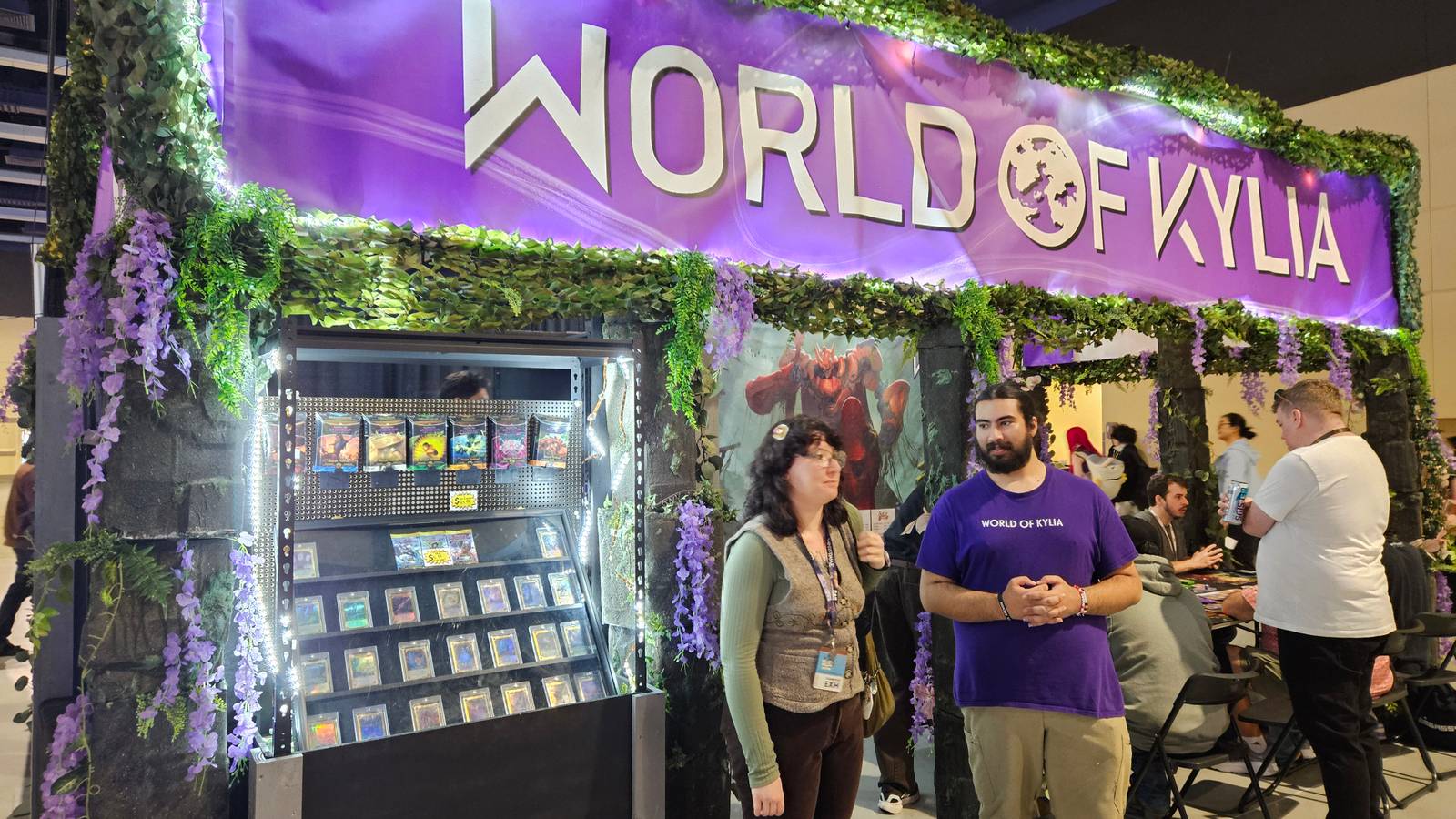
Published Sep 26, 2026, 10:30 AM EDT Thomas is a writer and author from Chicago, working out of Washington state, with subspecializations in comic books, horror movies, zombie outbreaks, and tabletop RPGs. His work has appeared in Lifewire, GameRant, Digital Trends, and Prima Games, including several official strategy guides. Ascendant made a splash at PAX West 2026 World of Kylia: Ascendant combines TCG strategy with the uncertainty of a D20 The World of Kylia booth at PAX West 2026Photo: Thomas Hindmarch for Polygon 2026 has been, in several crucial ways, an HD remake of the late '90s and early 2000s. My old boot-cut jeans are inexplicably back in fashion, live-action Spider-Man and Resident Evil movies are hitting theaters, no one will shut up about Wolverine, and the last nerd convention I went to hosted a direct battle between several competing collectible card games. At PAX West in Seattle, most of that battle unfolded inside Summit, the newer of the Washington State Convention Center's two buildings. Its tabletop floor featured official booths for Riftbound, OverPower, Rush of Ikorr, and the Gundam Card Game. In previous years, it had struck me that Magic: The Gathering had more or less taken over the TCG space, at least at PAX. Now there are multiple contenders visibly gunning for its throne. One of the more interesting challengers, however, was hiding a few blocks away. The World of Kylia booth was half-hidden in the Arch building's expo hall. Here, the local Washington company iQ Pictures was showing off their card game Ascendant, which just celebrated its second anniversary. According to its creator, Chase Lambert-Crittenden, the world of Kylia as a whole began as a side project while he was working towards an animation degree in California. Kylia is an inhabitable world in a distant galaxy, which naturally produces a valuable plasma-like substance called Genki. In the present day, Kylia is home to multiple native and alien species, who exist alongside one another in seven separate nations. The initial plan had been for Kylia to be the setting for a series of cartoons, if not a full-length movie. That hasn't been abandoned, but the card game got developed first, funded by iQ Pictures’ animation work. Battling to ascend An assortment of cards and starter decks for Ascendant. Center left: Storm-Forged Blaster, the dual-wielded energy revolver card that won me my first game.Source: iQ Pictures Ascendant can be played 1v1, 2v2, or as a battle royale. If you've ever played another deckbuilder, you should be on familiar ground from the start, but there are a couple of rules in Ascendant that do take some getting used to. The first big one is how it handles resources. The cost indicated on each card represents the number of copies of that card you need in order to put it into play. If the cost is 2, as shown in the card's upper right-hand corner, you need 2 copies; if it's 8, you need 8, in the same spirit as some auto-battlers I've played. Fortunately, hands in Ascendant have no upper limit, and every player draws a card at the start of every turn. So even if you don’t build your deck for rapid card draw, you still work through your arsenal pretty quickly. Some cards also require you to generate an additional resource, which is done via Generators. These can be tapped each turn to generate Genki, which can be spent to fuel several cards' abilities. Trying out Ascendant at home with 4 pre-made starter decksPhoto: Thomas Hindmarch/Polygon Alternatively, it's entirely possible to build a deck that doesn't need Genki at all. I played my first game of Ascendant against Lambert-Crittenden at PAX West using a deck made by iQ Pictures. It was entirely based around equipment, machines, and a pair of steampunk energy revolvers, with no complicated cards or Generators at all. In a world of wizards, summoned monsters, and alien warlords, I was apparently playing as Cowboy Batman. I won that game, incidentally, which was down to pure dumb luck (and also possibly being Batman). Ascendant uses 20-sided dice to resolve attacks, and I consistently rolled higher than Lambert-Crittenden did. That and a timely dose of Pocket Sand let me pull off a win. I won my first game of Ascendant entirely off of this card.Source: iQ Pictures When one player attacks another in Ascendant, both sides roll a 20-sided die. The higher roll wins. If the attacker is successful, their target takes damage equal to the difference between their roll and the attacker's. If I roll an 18 and my target rolled a 10, they take 8 points of damage. All players start with 70 life, and whoever's left standing wins. The tricky part comes from all the ways in which a player can modify that roll. You don't need a specific creature or card to attack, but every card you have on the field comes with its own potential way to add or subtract from whatever you rolled. The late game is when Ascendant's strategies get complex. Tap one card, burn another, and use a couple of passive abilities, then roll your die with the highest bonuses you can manage and hope for the best. Early on, that 70 life feels like an impassable barrier, but with endgame creatures, a player in Ascendant can easily hit an opponent for 20 points of damage or more in a single turn. Ascendant has a few under-explained mechanics, such as Speed, and you can expect to spend your first two or three games constantly referring back to the manual. (There's a handy PDF linked on the back of every box of Ascendant cards via QR code.) Ascendant also has a lot more lore than actual story, at least at this point in its overall development. That being said, it's easy to pick up, it moves quickly, and the randomness of the dice rolls means that there's always room for a newer player to do well at it. If you're looking for a new TCG, Ascendant is a solid entry into the field.
Magic: The Gathering Meets D&D-Style Dice Battles in the Best New TCG at PAX West 2026
Full Article
Original Source
Read the full article at Polygon →KhanList aggregates and links to publicly available news content. We do not host full articles from third-party sources. Always verify important information with original sources.