
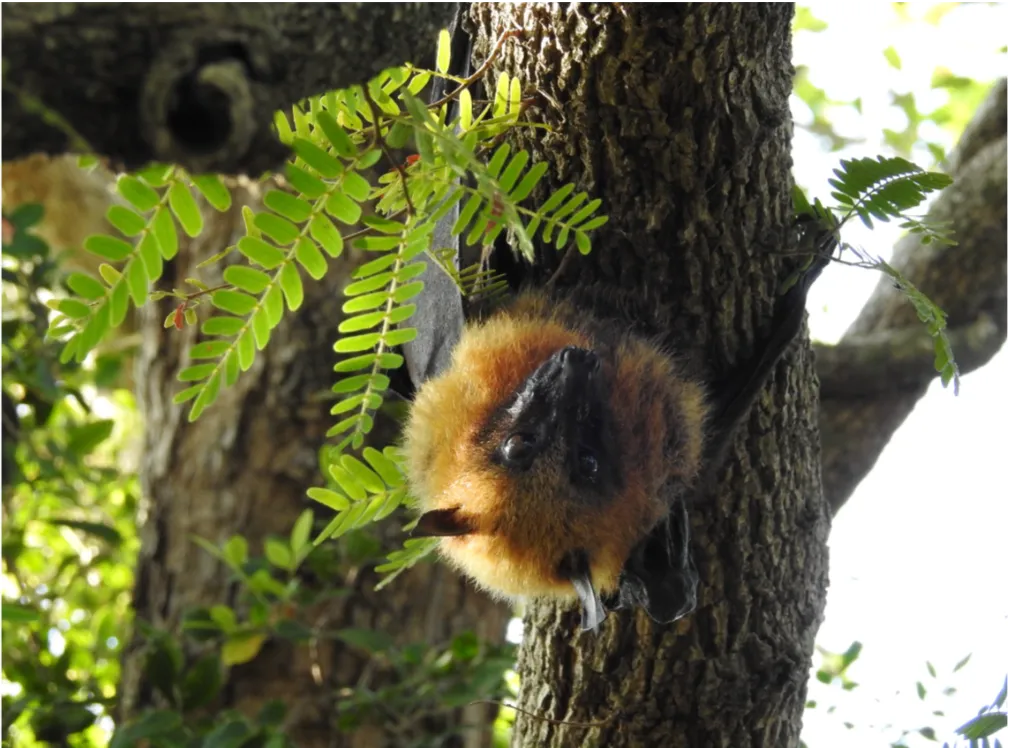
In a new study, researchers looked at museum specimens of the island’s flying foxes, spanning 150 years of history. They found a significant decline in size—right when commercial hunting ramped up October 30, 2026 3:13 p.m. A flying fox in Madagascar Angelo Andrianiaina With wingspans up to five feet, Malagasy flying foxes—among the biggest fruit bats in the world—dominate Madagascar’s skies. But new research suggests that these massive, airborne mammals may not be the behemoths they once were. In a study published in the Journal of Mammalogy on Thursday, scientists found that Madagascar’s flying foxes (Pteropus rufus) may be shrinking in size. The team compared skeleton measurements of modern bats to specimens in various museum collections dating back 150 years. The result: Modern flying fox skulls are noticeably smaller than skulls of their historical counterparts—and human hunting may be to blame. The project began in 2021, when Field Museum post-doctoral researcher Emily Cornelius Ruhs, the paper’s lead author, heard a colleague say that the flying fox skeletons in the museum’s collection seemed bigger than the bats she was encountering in the field. Intrigued, Ruhs proposed digitizing the Field Museum’s records to analyze how the mammals’ size might have changed. “Then, Steven Goodman, who’s the actual field biologist on the project, was like, ‘I can do better than that,’” Ruhs recounts. He suggested visiting other museums, too, and assessing the size of specimens in person, which would be more precise than studying the records they had on file. Comparing modern and historical skeletons would “actually test whether or not the skull and the dental measurements are changing in size through time,’” Ruhs adds. Researcher Emily Cornelius Ruhs measures the skull of a Malagasy flying fox in the Field Museum's collections. Field Museum Goodman, a field scientist at the Field Museum and a co-author of the study, examined 121 Malagasy flying fox specimens housed across nine museums in both the United States and Europe. He took measurements of 12 different features of the bats’ skulls and teeth, and Ruhs then analyzed the results. They noticed a significant shift in size around the 1980s: Bats collected prior to that date had skulls an average of 6 percent longer than those collected after, Jake Buehler reports for Science News. Ruhs says this lines up with the beginning of commercial hunting of flying foxes, which are a food source in Madagascar. Before the 1980s, flying foxes were hunted and eaten on a small scale—to feed a family or local village, she says. But the rise of commercial hunting saw the bats “brought to market and being more readily available on things like restaurant menus in certain locations.” It’s “not this big conglomeration that you’re seeing in the U.S. of food being shipped everywhere,” she explains, but it still put pressure on the animals’ population. Climate change or deforestation may have also played a role in the shrinkage, but Ruhs says the timing points to hunting as the culprit. The work doesn’t prove that hunting has made the bats smaller. But Ruhs says it’s likely that hunters are targeting the bigger, more mature bats, which offer more meat. So far, the team isn’t sure if there is a genetic component to the change or whether the largest bats are just hunted and removed from the forests prematurely, before they can effectively reproduce—or end up in museum collections. Did you know? Behind the nickname Flying foxes get their moniker from their dog-shaped faces. The fruit bats have bright eyes, pointy ears and woolly fur—just like man’s best friend. Malagasy flying foxes are currently considered a “vulnerable” species. In the early 2000s, Madagascar was home to an estimated 300,000 flying foxes—a number researchers estimate has since dropped by two-thirds, Science News reports. Flying foxes often only bear a single pup per year. So, given the slow reproduction rate, Ruhs says there can be real impacts when the species’ largest, most sexually viable members are taken out of the genetic pool. “We’re removing these sexually mature and reproductively active bats from the population,” Ruhs says, “which of course has sort of trickle-down effects for what we call population viability: how well the population can maintain and be stable through time.” The state of the flying foxes has impacts that stretch beyond the bats themselves. Vincent Florens, an ecologist at the University of Mauritius who was not involved in the research, says this fruit bat is a keystone species, or a species that has an outsized impact on its habitat compared to its overall population size. It feeds on large fruits like figs and disperses the seeds throughout the surrounding environment. “It has a big ecological role, because the dissemination of seeds is extremely important for the reproduction of plants and also for the regeneration of forests,” Florens says. “Once you have the forest, you have everything that lives inside. There’s that cascading effect.” Christian Vincenot, an engineer at the University of Luxembourg who has conducted prior research with Florens on the state of Mauritian flying foxes, says these bats’ changing size and physiology may affect their ability to fill their seed-dispersing role. “If also there is an impact on the morphology of the mouth, [the flying foxes] could end up not being able to process as large of fruits and seeds as they used to,” says Vincenot, who was not involved with the new study. “Fruit bats eat a large variety of fruit from many different native plants, but also exotic plants and trees. So, if the population decreases, there [could] be an impact on seed dispersal.” Given what this study reveals about how hunting pressures are impacting the Malagasy flying fox population, Florens says focusing on the protection and conservation of these animals should be the immediate next step. But, he adds, it’s not as easy as simply banning hunting. “For us, we want to go to the restaurant, we go to an ATM, we get the money out, we go to the restaurant,” he says. “But for many people [in Madagascar], the ATM is the forest. They are hungry, they go out there, they fish something, they get cash [for] an animal, and they can have dinner.” Ruhs recognizes this problem: Flying foxes, she says, are “an important food source for a lot of people, and we’re not saying we should stop hunting across the board. But I think it does call into question how much should this be regulated, and who’s in the position to keep these populations safe for the future.” You Might Also Like Get the latest stories in your inbox every weekday. More about: Africa Animals Bats Biology Conservation Endangered Species Hunting Mammals Museums Nature New Research Wildlife
Madagascar's Giant Bats Seem to Be Shrinking. After Measuring 121 Specimens, Scientists Suggest Hunting by Humans Is to Blame
Full Article
Original Source
Read the full article at Smithsonianmag →KhanList aggregates and links to publicly available news content. We do not host full articles from third-party sources. Always verify important information with original sources.