
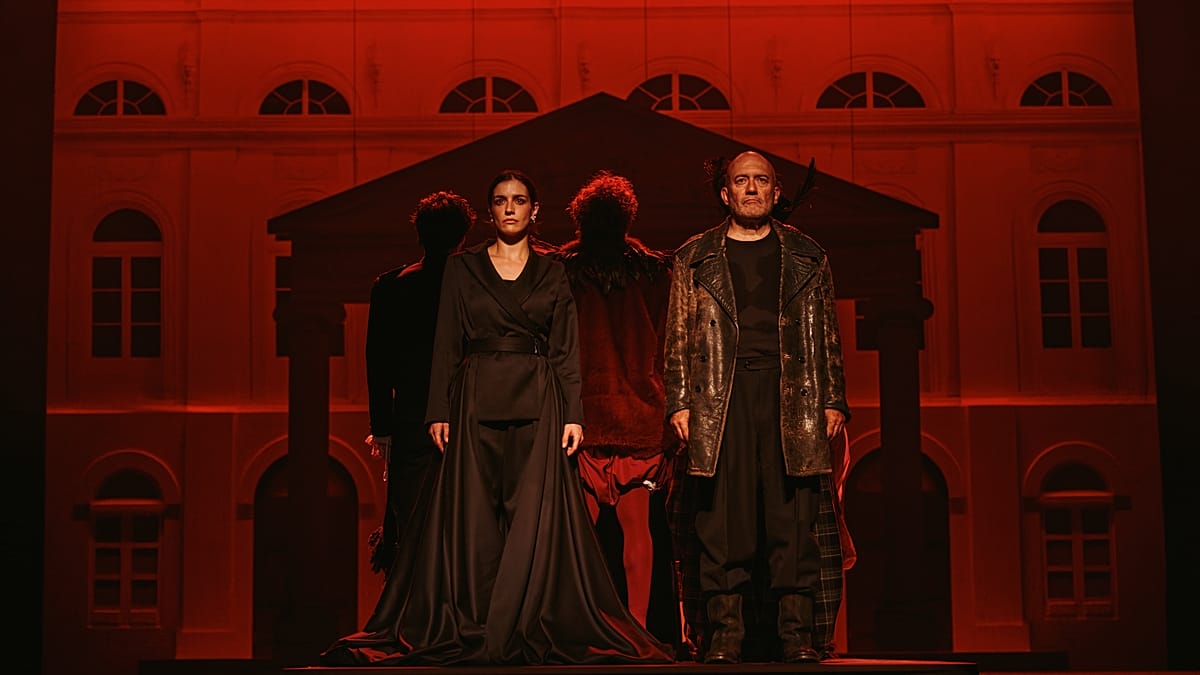
After almost four years closed, the National Theatre D. Maria II, on Rossio in Lisbon, is finally reopening its doors after the biggest renovation in decades. It is doing so with a "cursed play" and with tickets almost sold out. ADVERTISEMENT ADVERTISEMENT "Macbeth", by William Shakespeare, which was on stage at the National Theatre D. Maria II when a fire destroyed the building in 1964, is the production chosen for the reopening. It is a deliberate choice by artistic director and director Pedro Penim and serves as a provocation in the face of the many productions that have been plagued by accidents. In the show he signs, real fire is used on stage in a symbolic gesture, recalling the tragedy that reduced the theatre to ashes. "It was a kind of trauma in the theatre's history, it was a very defining moment, and this play, which is believed to be a cursed play, full of superstitions, was never staged again," says Pedro Penim, director and artistic director of the National Theatre D. Maria II, in an interview with Euronews. The Shakespearean tragedy has, over the centuries, accumulated stories of disasters backstage: injured actors, props swapped for real weapons, spectacular falls and deaths on stage. "Whenever this play is staged, some misfortune seems to happen. So I decided to challenge not only fate but also to draw a parallel with the theatre's own history, given that we are reopening as the National Theatre D. Maria II celebrates its 180th anniversary," the director adds. But putting together a production of this scale did not come without setbacks. The initial intention was to use the translation by Brazilian poet Manuel Bandeira, the same used by the Rey Colaço-Robles Monteiro company in the ill-fated 1964 staging. However, the holders of the poet's rights never responded to the requests and Pedro Penim found himself 'cornered' into translating Shakespeare's text himself. The translation signed by Penim will now be published as a book. "The idea was to find a Portuguese that retained the decasyllabic verse while at the same time looking for words that would not be inaccessible to a contemporary Portuguese audience and, in that way, to find something that did not lose the poetry." As for the staging, it seeks to leave the work open to interpretation by audiences. "It is a work that allows thousands of readings." However, there is an inevitable parallel that connects this tragedy to the 21st century. "There is a dimension linked to the idea of fascination with evil, the way evil shows itself off, struts around our society; it is present in our lives when we turn on the television, look at our mobile phone, in people's conversations. Suddenly, evil is no longer ashamed to show itself," Penim explains. "The seductive language Macbeth uses is a kind of poetry that enchants, but which at the same time carries a very significant weight in terms of the execution and the imagining of the crime," reflects the director. This production also pays tribute to the theatre itself: Joana Sousa's set reproduces the façade of the emblematic building on Rossio, and one of the characters is Queen Maria II herself. The refurbishment work on the building has also improved the technical and artistic conditions of the main auditorium, breathing new life into "Macbeth". The stage now rotates and can be raised. There have also been upgrades to lighting, sound and stage machinery. "It is a play that has been staged many times with many different visions, many different casts and very diverse directors, as well as very different set designs. In this case, we wanted to bring this proposal right to the heart of the National Theatre D. Maria II and turn the theatre itself into the set after so many years in which this play was, in fact, not staged or not presented on this stage," Pedro Penim explains. To give substance to this two-and-a-half-hour curse, Pedro Penim has opted for a cast he has worked with before, with particular emphasis on the leading pair. In the role of Macbeth is José Raposo, "one of the country's most beloved actors", as the director is keen to point out, who plays one of the greatest villains in drama. "It is a production that carries a lot of weight, also because of the symbolism of this whole bridge that Pedro Penim has built with the fact that the theatre burned down in 1964. And now, after these works, it has that charge that makes us feel an even greater sense of responsibility," the actor tells Euronews. Taking on the role of Lady Macbeth is actor Bárbara Branco, who drives the plot. "Technically, it is a hugely ambitious production. Pedro [Penim] is making full use of all the features the theatre has, the platforms, fire, water, etc. We are making use of everything, and I think that technical difficulty means the responsibility goes beyond the play itself, beyond these characters. Beyond the reopening of the theatre." The cast also includes Ana Coimbra, Ana Tang, Bernardo de Lacerda, Hugo Van Der Ding, João Grosso, José Neves, June João, Sandro Feliciano, Stela and Vítor Silva Costa. "Macbeth" premieres this Friday, the 18th, and will run until 31 October. The anticipation surrounding the return to the Garret auditorium at the D. Maria II is already visible at the box office: with a season longer than usual, tickets have sold out quickly, leaving only seats with restricted visibility.
"Macbeth" defies curse as Lisbon's Teatro D. Maria II reopens
Full Article
Original Source
Read the full article at Euronews →KhanList aggregates and links to publicly available news content. We do not host full articles from third-party sources. Always verify important information with original sources.