
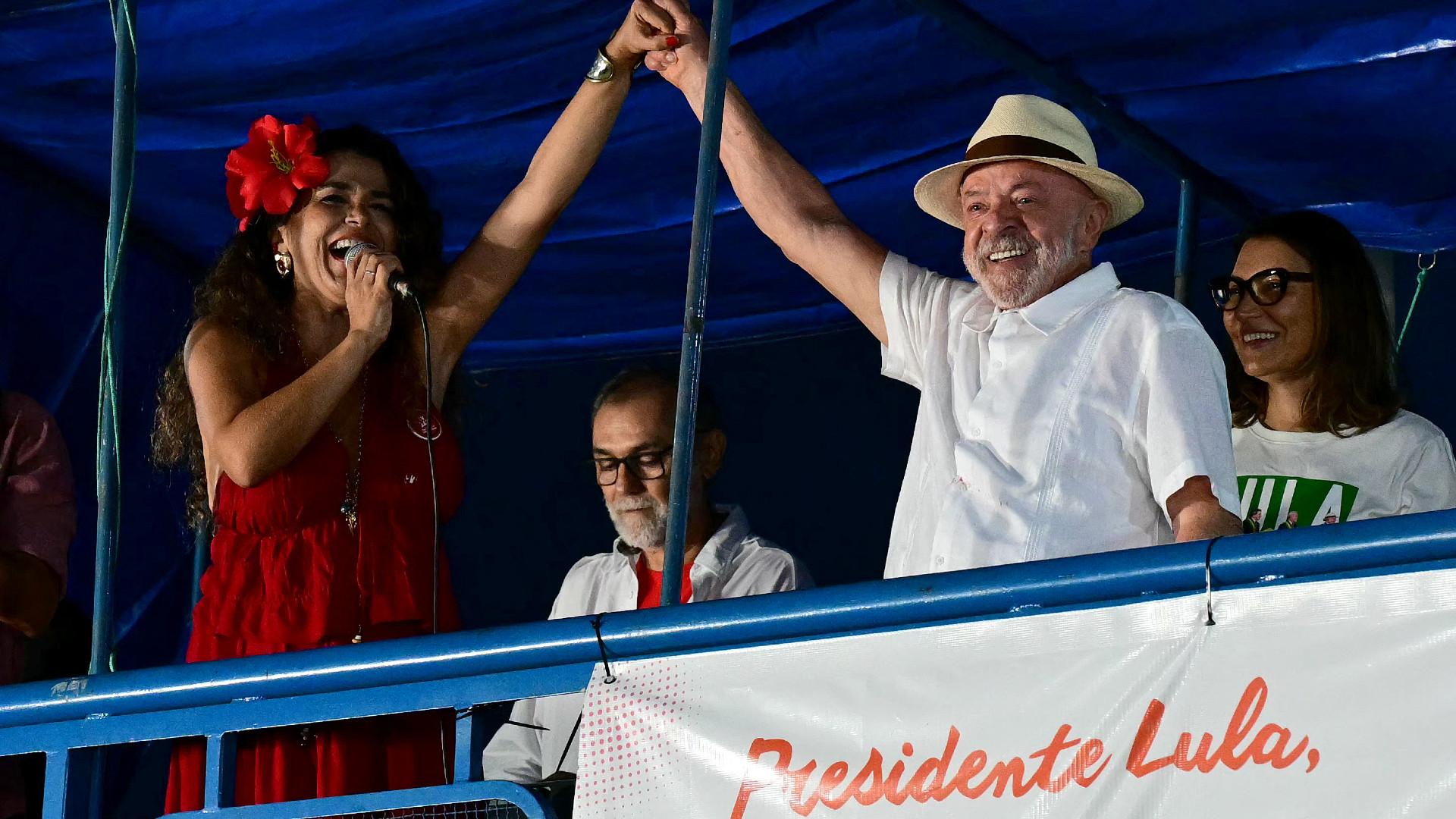
"Lula won! Lula won!" a Brazilian student shouted at a language school in Cairo. An Argentine activist sent a similar message. A pan-Arab news channel filled the screen with images of packed streets in Sao Paulo. The excitement over Brazilian President Luiz Inacio Lula da Silva's fourth term is real, and it is shared by his supporters at home and by progressives across neighbouring countries. It is also exaggerated, especially when paired with hopes of a regional swing to the left and a distancing from the US and Israel. Argentina, the homeland of exaggeration, offers a quick example. After Alberto Fernandez defeated incumbent Mauricio Macri in 2019, a jubilant Peronist movement began imagining a regional realignment. A Trotskyist activist from the southern suburbs of Buenos Aires captured the mood: "We already have AMLO [Andres Manuel Lopez Obrador] in Mexico, and now we must go for Brazil. Can you imagine Lula being re-elected? Latin America would be leftist once again!" New MEE newsletter: Jerusalem Dispatch Sign up to get the latest insights and analysis on Israel-Palestine, alongside Turkey Unpacked and other MEE newsletters The optimism was understandable. Lula walked out of prison two weeks after the Argentine vote, and a candidate endorsed by US President Donald Trump had lost for the first time. Fernandez took office in December 2019 and did not live up to the hype. A month later, he made his first foreign trip as president to Israel, a gesture that one seasoned Argentine-Israeli foreign policy analyst read as a bid for Washington's goodwill ahead of talks over a $44bn debt to the International Monetary Fund. The excitement is real. It is also exaggerated, especially when paired with hopes of a regional swing to the left Fernandez had also inherited a hostile neighbourhood. Jair Bolsonaro had taken office in Brasilia in January 2019, and Jeanine Anez took power in La Paz that November, consolidating the region's conservative Blue Tide. Most importantly, Trump had entered the White House in January 2017 with Republican majorities in both houses of Congress. That September, Benjamin Netanyahu became the first sitting Israeli prime minister to visit Latin America, touring Argentina, Colombia and Mexico, and returned for Bolsonaro's inauguration. Fernandez's victory, in short, did not deliver the realignment the optimists had imagined. In the little time he had before the Covid-19 pandemic, he used Israel to draw closer to the US. This is not to say that Lula will follow in his footsteps. It is to point out the limits that domestic, regional and global politics impose, and to moderate expectations accordingly. A divided electorate Lula's latest victory is no small feat. He is the first democratically elected president of Brazil to win a third and now a fourth term, and the first since 1985 to win a runoff after finishing second in the first round. Laudable as they are, these achievements reveal how hard his party has found it to renew its leadership, and not for want of trying. The Workers' Party (PT) made its first attempt at renewal in 2010, electing Dilma Rousseff to succeed Lula as president. She was re-elected in 2014, impeached in 2016 and failed to win a Senate seat in 2018. Her return looks all the more distant now that she presides over the New Development Bank, established by Brics. The party then passed the baton to Fernando Haddad, who became its presidential candidate in 2018 after the electoral court barred the imprisoned Lula from running. Haddad lost to Bolsonaro. Lula returned as the PT's candidate to defeat Bolsonaro in 2022 and, four years later, Bolsonaro's son, Senator Flavio Bolsonaro. In both cases the margins were razor thin: less than two percentage points the first time, under four the second. Three days before the final vote, Datafolha had the two candidates tied at 50 percent of valid votes. More telling still were the rejection rates: 46 percent for Flavio Bolsonaro and 45 percent for Lula. These figures reveal the frustration and polarisation behind Lula's victory. The polarisation is written on the map, too, along the historical divide between the wealthy south and the poor north. Flavio Bolsonaro swept the three southern states, Sao Paulo, Rio de Janeiro and the centre-west, while Lula took all nine states of the northeast. Compared with 2022, only two states changed hands. Lula's victory leaves the PT's succession problem unresolved and Brazil's electorate deeply divided, while offering little evidence of the wider leftward shift his supporters hope to see across Latin America. Trump's second term is a reminder of what entrenched leaders and polarised electorates can do to a democracy. The reactionary international Lula's victory is the exception in Latin America: it follows a wave of right-wing election wins across the continent since Trump returned to the White House in January 2025. The right has won elections in Chile, Bolivia, Colombia, Honduras, Peru and Ecuador. The Argentine scholar Juan Gabriel Tokatlian has described the rise of a "reactionary international": an Anglo-Saxon invention with peripheral franchises, driven by anger at history, politics and morality, and always in search of a scapegoat. Trump, former British Prime Minister Boris Johnson and Reform UK leader Nigel Farage have found their matches in Jair Bolsonaro, Argentine President Javier Milei and Colombian President Abelardo de la Espriella. This network of populist, socially conservative and economically liberal leaders has revitalised relations between Latin America and the US. Trump endorsed presidential candidates Nasry Asfura in Honduras and de la Espriella in Colombia, as well as Flavio Bolsonaro, and embraced presidents Jose Antonio Kast of Chile, Nayib Bukele of El Salvador and Daniel Noboa of Ecuador. Before Argentina's midterm elections in October 2025, the Trump administration arranged a $20bn lifeline to prop up the peso and Milei's coalition. In September 2026, it diverted $52m in military aid from Iraq, Tunisia and two Nato members to right-wing governments in Colombia, Ecuador, Panama and Peru. Indeed, the Trump administration has invested heavily in the reactionary international, above all in Latin America. Such meddling, electoral and financial, is itself a trait of the network: a cross-border solidarity that tramples on state sovereignty and international law. How Trump, Israel and big tech are driving Latin America to the right Read More » Most worrying is the "Donroe Doctrine", Trump's message that all means necessary will be used to support and propagate the network across Latin America. In its name, US forces have been bombing boats in the Caribbean since September 2025, killing more than 100 people in extrajudicial strikes. In January, they kidnapped Venezuelan President Nicolas Maduro from Caracas, killing 100 soldiers in the raid. Since February, they have enforced a fuel blockade on Cuba that UN experts have called "energy starvation". Washington wants to dominate the hemisphere and lead its wing of the reactionary international by political, economic and military means. Governments in the region now face rising, and sometimes deadly, costs for refusing to yield to US demands. Lula has already defied Trump, with results and bruises to show for it. When Trump hit Brazil with 50-percent tariffs in 2025 to punish it for prosecuting Jair Bolsonaro, Lula refused to bend. The US Supreme Court struck down those emergency tariffs in February, only for Washington to replace them with a 25-percent duty in July. Lula took the case to the World Trade Organization, and within a month Trump called Lula and bilateral talks resumed. Impressive, yes. Cost-free, no. Lula has been unable to return US tariffs to their previous rates and has been forced to find new markets. Israel's foothold If Lula has struggled to hold his ground against Washington, progressive forces elsewhere in the region have fared worse, unable to push back against the Blue Tide and the reactionary international. That failure keeps the door open for Israel's continued presence in Latin America. Relations between Latin America and Israel have had their ups and downs, reflecting the wider mood of international politics. Diplomatic missions opened in the 1950s. In the decade that followed, the abduction of Adolf Eichmann from Argentina in 1960 and the spread of leftist governments created friction. Even so, when the UN General Assembly declared Zionism a form of racism in 1975, most governments in Latin America and the Caribbean voted against the resolution or abstained. Only Brazil, Mexico, Cuba, Guyana and Grenada supported it. Netanyahu's man: How Israel is betting on a Bolsonaro comeback in Brazil Read More » At the same time, Israel was finding customers. From the 1970s, it armed some of the region's most brutal regimes, among them Argentina's military junta, Augusto Pinochet's Chile, El Salvador's death-squad governments and Anastasio Somoza's Nicaragua. The progressive Pink Tide of the 2000s then tried to strike a balance. One after another, countries from Brazil to Honduras recognised the state of Palestine in 2010 and 2011, and a growing number of leaders criticised Israel's conduct during its 2009 and 2014 wars on Gaza. In 2014, Brazil, Chile, Ecuador, Peru and El Salvador recalled their ambassadors. Then came Trump, elected as the Pink Tide receded, followed by Netanyahu's tour. Guatemala moved its embassy to Jerusalem in 2018 and Honduras did the same in 2021. In 2019 and 2020, Argentina, Paraguay, Guatemala, Honduras and Colombia declared Hezbollah a terrorist organisation at Washington's urging. In 2019, Jair Bolsonaro and Chile's then-president, Sebastian Pinera, both visited Israel. Underpinning all of this, once again, are arms sales and surveillance technology. Argentina has bought Israeli gunboats, Colombia an air defence system and Mexico the NSO Group's Pegasus spyware. Flavio Bolsonaro campaigned on a promise to move Brazil's embassy to Jerusalem, and Netanyahu addressed his campaign launch by video. Lula's limits Lula may be prepared to stand up to Israel and the US. He has shown as much by confronting Trump over tariffs, withdrawing Brazil's ambassador from Tel Aviv, calling Israel's war on Gaza, which has killed more than 74,000 Palestinians, a genocide, and joining South Africa's case against Israel at the International Court of Justice. He is nearly alone in Latin America in being both willing and able to do so. Israel knows that commercial ties keep the door to political influence open, especially while Trump sits in the White House. The excitement over Lula's win as a victory for democratic and progressive values is justified, even as his party struggles to renew its leadership. The expectation that it will set off a regional domino effect, reviving the progressive movement and distancing the region from Washington and Tel Aviv, is not. Lula alone cannot roll back US and Israeli influence in the region. Not all is bad news. Argentina's 2027 presidential election offers Lula a chance to recruit an ally, and when Brasilia and Buenos Aires align, the region moves. The views expressed in this article belong to the author and do not necessarily reflect the editorial policy of Middle East Eye.
Lula's victory alone cannot loosen the US and Israeli grip on Latin America
Full Article
Original Source
Read the full article at Middleeasteye →KhanList aggregates and links to publicly available news content. We do not host full articles from third-party sources. Always verify important information with original sources.