
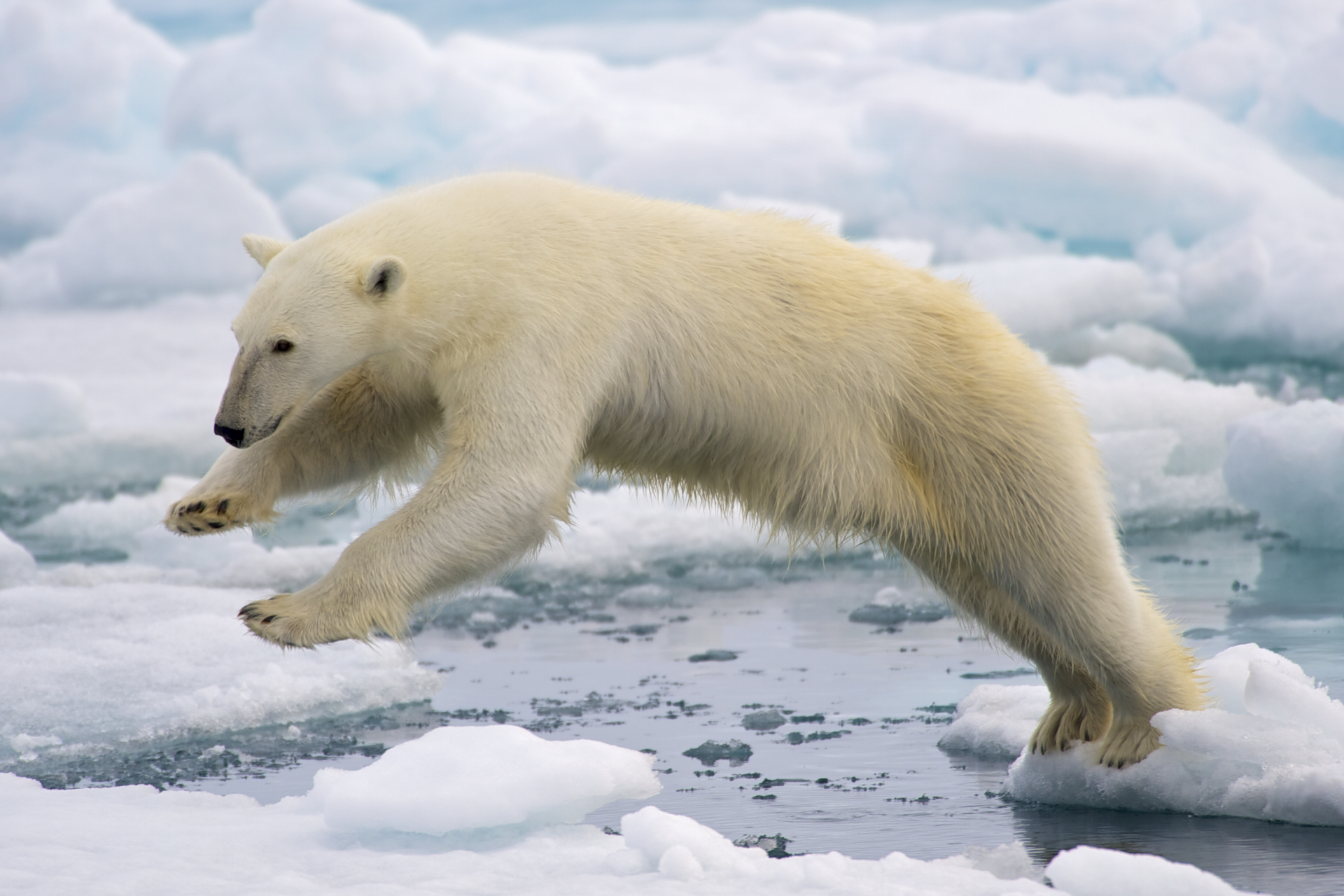
Canada’s last remaining epishelf lake has disappeared and isn’t coming back, a recent study confirms.Epishelf lakes form when an ice sheet dams a fjord, causing freshwater, melting off glaciers, to pool directly on top of seawater, instead of mixing into the ocean.There were once as many as 17 epishelf lakes along the north coast of Ellesmere Island in the Canadian Arctic, but over the past few decades all have disappeared due to warming from human-caused climate change.The loss of the epishelf lake at Milne Fjord exposes the fragility of the Last Ice Area, an area of the Arctic thought to be among the most resilient to climate change. When an ice shelf blocks a polar fjord, it sparks the creation of an ecosystem like no other: the epishelf lake. Meltwater pools up behind the ice shelf, floating above the denser seawater, with both freshwater and marine species found in distinct layers within the same water column. But Canada’s last known epishelf lake, at Milne Fjord on Ellesmere Island in Nunavut, is gone. The lake drained out to sea after the Milne Ice Shelf calved in 2020, and it won’t return, according to a recent study published in Scientific Reports. Ellesmere Island lies within the Last Ice Area, a region of the Arctic that scientists have long thought would retain its sea ice longer than elsewhere as the planet warms. The changes at Milne Fjord are a signal of accelerating climate change, with implications for the entire planet. “What happens in the Arctic doesn’t stay in the Arctic,” study co-author Derek Mueller, a professor at Carleton University in Ontario, told Mongabay in a video call. Meltwater lakes form in the depressions of Milne Ice Shelf every summer. Image by Jérémie Bonneau. In the past, ice shelves dammed Ellesmere’s many fjords, with an estimated 10 to 17 epishelf lakes perched along its north coast as recently as the 20th century. But over the past several decades, dramatic warming, driven by the burning of fossil fuels, has transformed this region. One by one, giant ice shelves have split and calved, allowing the epishelf lakes to drain away. When the massive 65-meter-deep (213-foot) epishelf lake in neighboring Disraeli Fjord drained in 2002, following the calving of the Ward Hunt Ice Shelf, the epishelf lake in Milne Fjord became the last of its kind in the Canadian Arctic. Epishelf lakes are still found in Greenland and Antarctica. Prior to the recent calving, the Milne Ice Shelf spanned an area of 186 square kilometers (72 square miles) and was 85 meters (278 feet) thick — an agglomeration of sea ice nearly twice the expanse of Paris and double the height of the Arc de Triomphe. Andrew Hamilton, a co-author of the recent study and researcher at the University of Alberta, recalled his first sight of the ice shelf, in 2008. Imagine the windswept dunes of the Sahara Desert, he said, frozen and covered in snow. In the distance, steep mountains lined the fjord, with a glacier sloughing its length. “It still gives me tingles when I think about it,” Hamilton told Mongabay in a video call. “It’s just these huge undulating waves of frozen sea ice.” Researchers began regular monitoring of the epishelf lake in 2011. They bored a hole through the snow-covered layer of ice that blanketed the lake (and prevented the fresh- and seawater from mixing), and installed a fixed mooring with sensors to measure things like temperature and salinity at various depths. At the time, the freshwater layer was 10 m (33 ft) deep. They returned each summer to haul up the mooring and retrieve the data. The northeast portion of the Milne Ice Shelf. Much of this ice broke away in July 2020. Image by Adrienne White. In July 2020, the Milne Ice Shelf calved, losing nearly half its surface area. A 64-km2 (25-mi2) free-floating chunk split off from the ice shelf, which split again into two uneven pieces. The fracture happened very close to an area where researchers regularly set up camp, Mueller said, but COVID-19 travel restrictions meant they missed the 2020 and 2021 field seasons. “If we had been there during that time, it would have been a very big panic,” Mueller said. In 2022 the team again traveled to Ellesmere Island and downloaded the data from the sensors. The data showed that the freshwater had drained out of the epishelf lake within a few months of the calving event, and was not being replenished. Researchers estimate the ice shelf and epishelf lake at Milne Fjord had been there for about 4,000 years. “This is basically the extinction of a really unique ecosystem in Canada … and it’s not going to come back on any reasonable human timescale,” Hamilton said. Back in 2017, researchers lowered a remotely operated vehicle (ROV) into the channel where lake water drained under the ice shelf. About 20 m (66 ft) down, they unexpectedly hit an expanse of ice. Video recorded by the ROV revealed sea anemones, brittle stars, and fish, all surviving in darkness beneath the ice shelf. Hamilton said it’s likely the epishelf lake fed this surprising assemblage of life, either through the transport of macrofauna or upwelling caused when the freshwater entered the ocean at depth. They had hoped to do a more comprehensive study of the phenomenon, but that chance is now lost. Ultimately, the warming of Earth’s atmosphere and oceans is behind the ice shelf’s collapse, Hamilton said. Both 2019 and 2020 were very warm years. That led to larger volumes of meltwater pooling on the ice shelf and running into the lake, with the rush of water incising the outflow channel. Elevated ocean temperatures also led to melting on the underside of the ice shelf. And, in the weeks prior to the calving event, there was a large expanse of open water in front of the ice shelf, leaving the ice edge vulnerable to battering waves. “The ice shelf could only hold out for so long,” Hamilton said. Derek Mueller pulling up the epishelf lake mooring. Image by Jérémie Bonneau. A view up the 2020 rift to the eastern side of the Milne Ice Shelf. Image by Cameron Fitzpatrick. With the Milne Ice Shelf diminished and the epishelf lake gone, Hamilton said he expects to see further changes in the fjord. At some point, the rest of the ice shelf is likely to float away, and Milne Fjord, the only one left on Ellesmere that’s still covered by perennial ice, would become ice-free in the summer. “When you combine the observations of the breakup of all these ice shelves, the loss of these epishelf lakes, negative surface mass balance of glaciers, et cetera, it all adds up to the same train of evidence for rapid climate warming in the last 20 years or so,” Hamilton said. The recent study is among the latest to show that the Last Ice Area may be more vulnerable to warming than previously thought, said Brandon Laforest, WWF Canada’s lead specialist for Arctic conservation. The Last Ice Area is fed by ocean circulation patterns that encourage the buildup of multiyear sea ice. Previously, the area was projected to retain sea ice much longer than elsewhere. But newer models show that the Last Ice Area could become seasonally ice-free within the next 40 years or so, according to a 2025 study published in Nature Communications Earth & Environment. “It’s not a static area that is … an exception to climate change,” Laforest, who wasn’t involved in the recent Scientific Reports study, told Mongabay in a video call. Nevertheless, the area will continue to provide a refuge for ice-dependent wildlife like polar bears and ringed seals. Climate change remains the overarching threat. But it’s also critical to protect the area from additional pressures like deep-sea mining, oil extraction, and ice breaking, Laforest said. Drew Friedrichs preparing the ROV for some under-ice exploration in 2019. Image by Jérémie Bonneau. In 2019, 300,000 km2 (about 116,000 mi2) of the Last Ice Area, including the north coast of Ellesmere Island, was formally protected as the Tuvaijuittuk Marine Protected Area (MPA). Tuvaijuittuk, which means “the place where the ice never melts” in Inuktuk, was jointly established by the Qikiqtani Inuit Association along with the territorial government of Nunavut and the federal government of Canada. “It’s about giving the last ice area as pristine of a chance as possible to persist, while we also work jointly on regulating the climate emergency,” Laforest said. The Arctic can feel remote, but changes here matter. Mueller likened the Arctic to a “planetary refrigerator”: If those systems break down, we’ll all feel it. Both Hamilton and Mueller say they’ve witnessed dramatic changes in a relatively short space of time, with places they’ve walked over many times now floating somewhere in the Arctic Ocean. “It’s pretty sad, and quite astounding, the scale of the change,” Hamilton said. “The Arctic is a very different place than when I started working up there about 20 years ago.” Researchers’ basecamp on the Milne Ice Shelf, July 2018. Image by Jérémie Bonneau. Banner image:Ellesmere Island is home to one of the most northerly populations of polar bears (Ursus maritimus) in the world. Image by Arturo de Frias Marques via Wikimedia Commons (CC BY-SA 4.0). No new record low for Arctic sea ice loss in 2025 Scientists weigh giant sea curtain to shield ‘Doomsday Glacier’ from melting Citations: Bonneau, J., Hamilton, A. K., Mueller, D., Laval, B. E., Forrest, A. L., Crawford, A. J., … Vincent, W. F. (2026). Regime shift in high Arctic fjord signals the vulnerability of the Arctic’s last ice area. Scientific Reports. doi:10.1038/s41598-026-68201-6 Fol, M., Tremblay, B., Pfirman, S., Newton, R., Howell, S., & Lemieux, J. (2025). Revisiting the last ice area projections from a high-resolution Global Earth System Model. Communications Earth & Environment, 6(1). doi:10.1038/s43247-025-02034-5 Laidre, K. L., Schweiger, A., Zhang, J., Cohen, B., Steele, M., Ferguson, S. H., & Moore, G. W. K. (2026). Revisiting the status of the Arctic’s last ice area as a refuge for marine predators. Ecosphere, 17(7). doi:10.1002/ecs2.70688 Cite this articleRuth Kamnitzer (2026). Loss of a rare lake reveals how warming has hit the Canadian Arctic’s ‘planetary fridge’. Mongabay Conservation news. DOI: https://doi.org/10.66709/news-333108 Credits Topics
Loss of a rare lake reveals how warming has hit the Canadian Arctic’s ‘planetary fridge’
Full Article
Original Source
Read the full article at News →KhanList aggregates and links to publicly available news content. We do not host full articles from third-party sources. Always verify important information with original sources.