
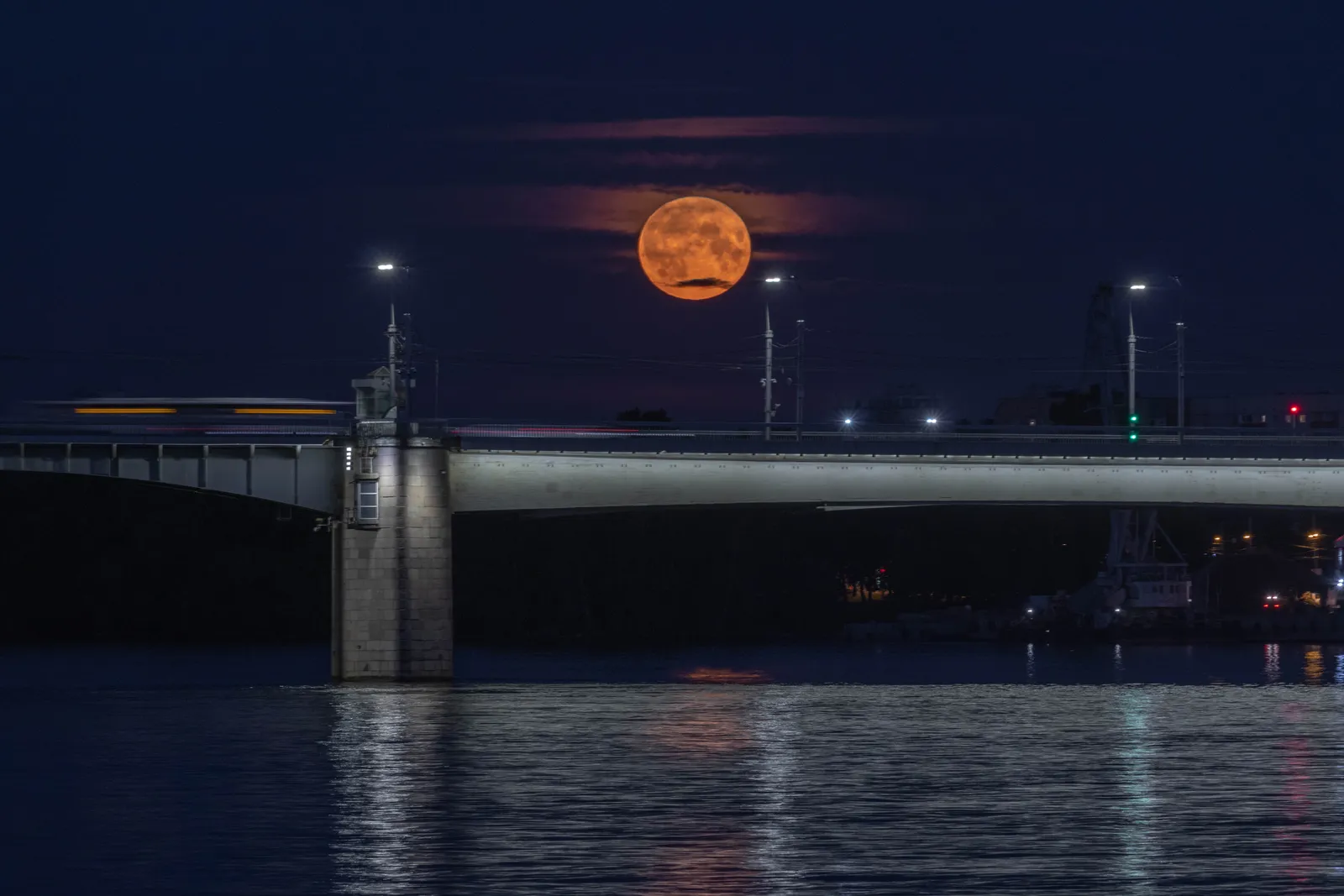
The next one will occur on Christmas Eve, which, according to a stricter supermoon definition, is a rare coincidence that hasn’t happened since 1787 November 23, 2026 3:43 p.m. A supermoon photographed over the Neva River in Russia Kuzpunk via Wikimedia Commons under CC BY 4.0 We’re in for a dazzling treat over the next few months. Four consecutive supermoons will grace our skies from November through February. The second in the series—and the last of 2026—will fall on Christmas Eve and represents the closest full moon to Earth since 2018, according to Live Science’s Jamie Carter. The supermoon sequence starts with this month’s full moon on the 24th, which will reach peak illumination at 9:53 a.m. Eastern time. The orb won’t be visible from North America then, so the best time to see it is after sunset on the day before or day of. The next supermoons in the spectacular series will take place on December 24, January 22 and February 20, according to AstroPixels.com, a website by the late astrophysicist Fred Espenak. But what exactly is a supermoon? The moon’s 27-day orbit around our planet is shaped like an oval, which means it drifts closer and farther from us as it transitions through its phases. The closest point along its orbital path, or perigee, is around 226,000 miles from Earth, while its farthest point, or apogee, is around 251,000 miles away. When perigee roughly “coincides with a full moon, it is called a supermoon,” Devon Salasin, head astronomer and site manager at Stargazing Moab, tells National Geographic’s Stefanie Waldek. In other words, a supermoon is a full moon that occurs when the moon is near its closest point to Earth. What Makes a Supermoon Super? (Animation) While the term suggests an impressive celestial display, a supermoon is actually only 7 percent bigger than an average full moon, according to Josh Morley at the Farmer’s Almanac. It can look up to 14 percent brighter and 30 percent bigger than the faintest moon of the year, which happens at apogee. However, skywatchers probably won’t notice a difference if viewing our celestial companion with the naked eye. Additionally, supermoon is not an official astronomical term, so which moons count as one depends on who you ask. According to NASA and the Royal Observatory Greenwich in London, a supermoon is a full moon that occurs within 10 percent of perigee. Some astronomers have stricter guidelines, however, saying that supermoons only occur when the moon is within about 223,694 miles of Earth, says Carys Herbert, an astronomer at the Royal Observatory Greenwich, to BBC Newsround. November’s full moon will be 224,171 miles away from Earth; December’s will be 221,668 miles away; January’s will be 222,230 miles away; and February’s will be 225,748 miles away. Some astronomers using the more rigid definition don’t consider the last one to be a supermoon. Which guidance you follow also determines just how rare the December 24 supermoon is. “Taking the stricter definition, the most recent Christmas Eve full moon perigee was 1787, but with the more generous definition which appears to increasingly be the standard, then this also occurred in 2007 and 1912,” Herbert tells BBC Newsround.Whether or not it’s a supermoon, November’s full moon is always dubbed the “beaver” moon. During this month, the furry animals reinforce their lodges and dams for winter, which is a popular Algonquin and colonial explanation for the name, according to Daniel Higgins at the Farmer’s Almanac. Another possible reason is that November kicks off trapping season: It’s cold enough for the large rodents to have grown their thick winter coats, but there’s little snow on the ground to get in trappers’ way. Tomorrow’s celestial event might get in the way of Thanksgiving travel, unfortunately. The alignment of the sun, Earth and moon produces full moons that cause a greater difference between high and low tides than usual, meteorologist Brian Lada writes for AccuWeather. The effect can be stronger when full moons are closer to Earth, so the beaver moon might contribute to coastal flooding just before the holiday. You Might Also Like Get the latest stories in your inbox every weekday. More about: Astronomy Moon NASA Sky Watching Guide Solar System
Look Up This Week to See November's Full Beaver Moon—the First of Four Back-to-Back Supermoons Over the Coming Months
Full Article
Original Source
Read the full article at Smithsonianmag →KhanList aggregates and links to publicly available news content. We do not host full articles from third-party sources. Always verify important information with original sources.