
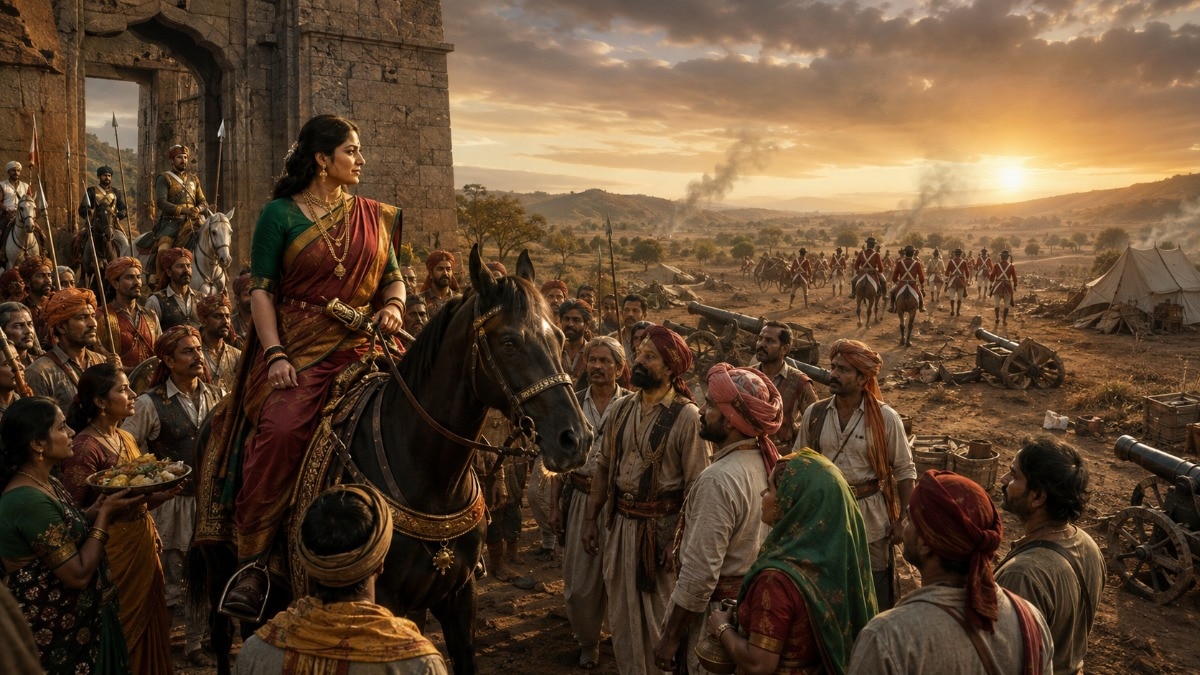
Days before India marks its 80th Independence Day, the story of Kittur deserves another look. In 1824, a small principality led by Queen Chennamma challenged the East India Company after it refused to recognise her adopted heir, becoming one of India's earliest armed struggles against British rule.Days before India marks its 80th Independence Day, the story of Kittur deserves another look. In 1824, a small principality led by Queen Chennamma challenged the East India Company after it refused to recognise her adopted heir. (AI-generated image)Rani Chennamma had already buried her husband.She had buried her only surviving son.Now the young boy she had adopted to save her kingdom was being declared illegitimate by people who had arrived in India as traders.The East India Company refused to recognise young Shivalingappa as the rightful heir to Kittur despite the established Indian tradition that recognised adopted heirs as rightful successors. For the British, it was an administrative decision. For Rani Chennamma, it was nothing less than the seizure of her kingdom.She did not pause to write another petition. Instead, she prepared for war. (AI-generated image) The Revolt of 1857, also known as the Sepoy Mutiny, is widely remembered in India as the First War of Independence, a term popularised by Vinayak Damodar Savarkar. Yet it was not the first armed resistance to British expansion on the subcontinent.More than three decades before the Revolt of 1857, before the Indian National Congress existed, before there was Mahatma Gandhi, Bhagat Singh, or Rani Lakshmibai, and long before India's freedom struggle became a nationwide movement, the small kingdom of Kittur in present-day Karnataka took up arms against the East India Company.As India prepares to celebrate its 80th Independence Day, this forgotten rebellion reminds us that resistance to British rule did not begin in 1857. Some of the earliest cries for freedom came from places history does not mention often enough.WHEN THE BRITISH SAID NOKittur was a prosperous principality in what is now Belagavi district of Karnataka. Its ruler, Mallasarja Desai, had strengthened the state through trade and agriculture, while his queen, Chennamma, earned admiration for her intelligence, administrative skill and training in horse riding and weaponry from an early age.Then tragedy struck.After the death of Mallasarja and later their only surviving son, Chennamma adopted a young boy, Shivalingappa, as heir in keeping with a long-established Indian custom.The East India Company refused to recognise the adoption. (AI-generated image) Although the famous Doctrine of Lapse would be formally associated with Governor-General Lord Dalhousie decades later, Company officials had already begun challenging adopted successors in some princely states.At Kittur, the local administration under Collector St John Thackeray declared that the kingdom should pass under Company control.For Chennamma, accepting that decision meant surrendering her kingdom without a fight.She refused.THE DAY KITTUR FOUGHT BACKIn October 1824, British troops marched towards Kittur expecting a quick victory.Instead, they encountered fierce resistance.The queen's soldiers, supported by local people, defended the fort with determination. During the battle, St John Thackeray was killed, an extraordinary setback for the East India Company at a time when its military authority seemed almost unquestionable.For a brief but remarkable moment, Kittur had defeated the British. (AI-generated image) The victory sent shockwaves through Company officials.Reinforcements soon arrived in far greater numbers. After a prolonged siege, Kittur eventually fell. Queen Chennamma was captured and imprisoned at Bailhongal Fort, where she died in 1829.The rebellion did not end with her imprisonment.Her trusted commander, Sangolli Rayanna, continued a determined guerrilla campaign against the British for several years before he was captured and executed in 1831. (AI-generated image) A STORY THAT STILL LIVESThe British ultimately took control of Kittur.They did not erase its memory.Today, Queen Chennamma is celebrated across Karnataka as one of India's earliest women to wage armed resistance against colonial rule. Historians widely regard the Kittur Rebellion of 1824 as one of the earliest organised military challenges to the East India Company's expanding authority. A section of Kittur Fort (Photo: Getty Images) Nearly two centuries later, her story still asks an uncomfortable question -- who gets remembered as the first to fight for freedom?As India marks 80 years of Independence, Kittur deserves its place in that conversation. Before the great national movements, before 1857 became a symbol of resistance, one queen, one adopted child and one determined community chose to stand against an empire.For a moment, they even made it retreat.- EndsPublished On: Aug 14, 2026 18:14 IST
Long before the Revolt of 1857, Rani Chennamma's village defeated the British
Full Article
Original Source
Read the full article at Indiatoday →KhanList aggregates and links to publicly available news content. We do not host full articles from third-party sources. Always verify important information with original sources.