
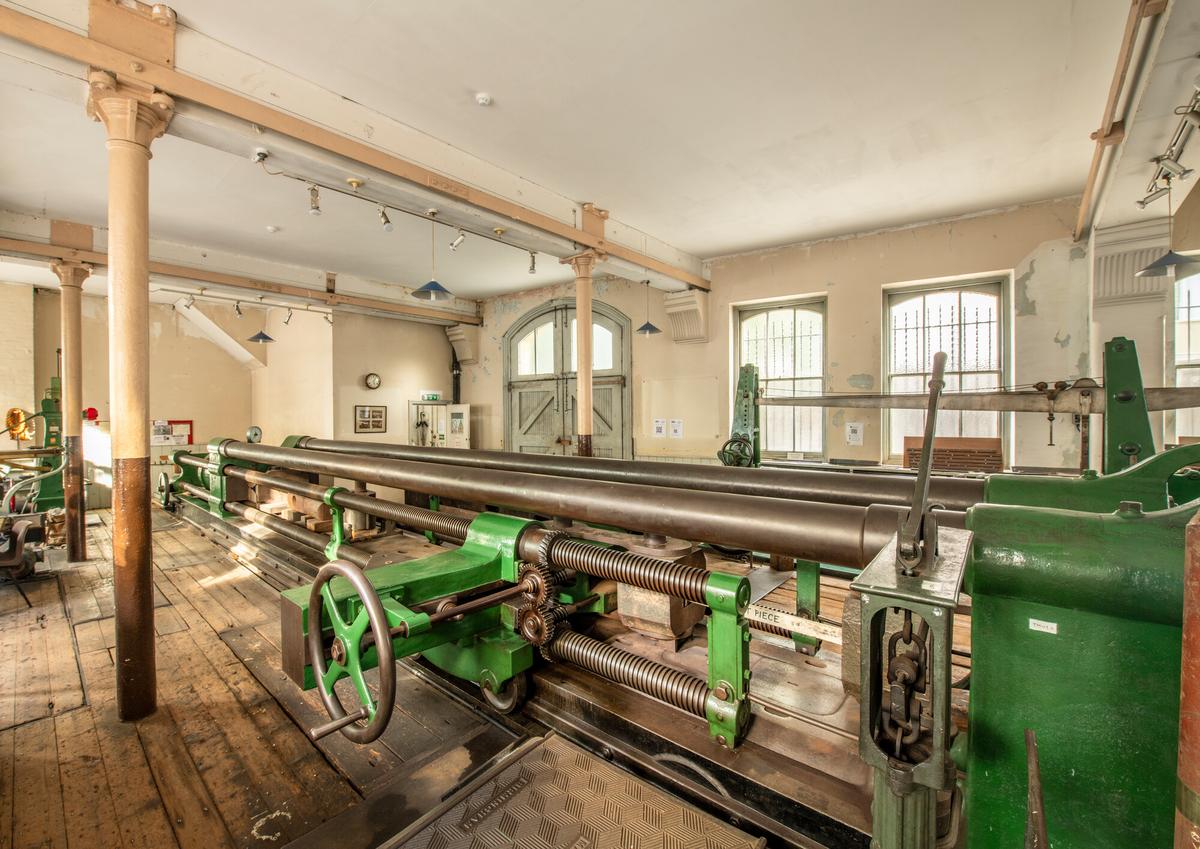
From a Tudor building created for Henry VIII's water supply to a pioneering Victorian engineering laboratory and a crumbling former police station in Chelsea, some of London's most fascinating historic sites are facing an uncertain future.Historic England has added 16 sites across the capital to its 2026 Heritage at Risk Register, the annual list highlighting buildings and monuments threatened by neglect, decay, structural problems or uncertain futures.The new additions bring the total number of at-risk heritage assets in London to 596. Yet there is reason for optimism, as last year alone, 24 London sites were rescued and removed from the register.Many of the newly listed sites are little-known gems hidden in plain sight. Others are some of the capital's most important historic buildings. Together they tell stories spanning nearly 500 years of London's past.Here are the 16 London sites newly added to Historic England's Heritage at Risk Register.1. Kirkaldy's Testing Works, SouthwarkKirkcaldy’s Testing Works, SouthwarkHistoric EnglandPerhaps the most remarkable addition this year is Kirkaldy's Testing Works on Southwark Street. The Grade II*-listed building is regarded as the world's earliest purpose-built independent commercial materials testing laboratory.Built in 1873 for engineer David Kirkaldy, it houses a giant hydraulic testing machine that survives in largely original condition and remains one of the oldest working examples of its kind anywhere in the world. Elements of major Victorian engineering projects were tested here, while investigations into disasters including the infamous Tay Bridge collapse were carried out at the site.The laboratory played a hugely important role in establishing modern scientific methods for testing construction materials. Historic England says the building is suffering from water penetration and extensive damp, leaving it in poor and declining condition.2. Gallows Tamkin, Kingston upon ThamesGallows Tamkins was part of the water supply for Hampton Court PalaceAFP/GettyHidden within Coombe Wood Golf Course is one of London's oldest surviving pieces of infrastructure.Gallows Tamkin was built between 1538 and 1540 as part of Henry VIII's ambitious project to provide Hampton Court Palace with a reliable water supply after he seized the former cardinal's residence. The small brick building acted as an inspection point on a sophisticated Tudor conduit system stretching several miles across Surrey.The scheduled monument survives remarkably intact, complete with its characteristic stone archway and steeply pitched tiled roof. Despite its royal connections and rarity, Historic England says the site now faces high vulnerability and a declining outlook.3. Fulham Palace South RangeThe south range of Fulham Palace has been added to the listFew buildings on this year's list are as historically important as the South Range of Fulham Palace.Read MoreThe palace served as the home of the Bishops of London for centuries and contains layers of history dating from the medieval period through to the Victorian era. The South Range includes parts of a great hall built around 1480, Tudor service rooms and Georgian additions.Now classified as Priority A, Historic England's highest level of concern, the Grade I-listed structure faces an immediate risk of further deterioration. Ornate panelled interiors, heraldic glass and historic fireplaces are among the features under threat.4. Fulham Palace ChapelThe chapel at Fulham Palace (pictured) is also under threatGetty ImagesAnother part of the Fulham Palace estate has also been added to the register.Designed in 1866 by celebrated Victorian architect William Butterfield, the chapel is a striking example of Gothic Revival architecture. Its red brick exterior, decorative stonework and stained glass were intended to complement the wider palace complex.Inside are historic mosaics, Victorian fittings and an elaborate reredos. Historic England has also classified the site as Priority A, noting there is an “immediate risk of further rapid deterioration or loss of fabric; no solution agreed.”5. Former Police Station, Walton Street, ChelseaThe former police station at 60 Walton Street, ChelseaGoogle StreetviewMany Chelsea residents will know the imposing former police station on Walton Street without realising it is now in what Historic England describes as "very bad" condition.Dating from the mid to late 19th century, the building combines Italianate styling with unusually muscular architectural detailing. Its yellow brick façade, rusticated stonework and corner oriel window make it a distinctive local landmark.The Grade II-listed building has suffered significant decline and is now among the most vulnerable sites added to the register this year.6. King Edward Hall, FinchleyKing Edward Hall is one of Finchley’s most conspicuous buildingsGoogle StreetviewThis prominent civic building has stood at the heart of Finchley since 1912.Designed by local architects Turner and Higgins, King Edward Hall combines a community hall with a parade of shops and is crowned by an eye-catching clock tower. For generations it has served as a focal point on Regent's Park Road.Despite its prominence, the building is now in poor condition and has been assessed as having high vulnerability. Historic England fears further deterioration unless action is taken.7. Tower Hamlets Local History Library and ArchivesTower Hamlets Local History Library and ArchiveGoogle StreetviewThere is a certain irony in the fact that one of London's best-known sanctuaries for local history has itself become a heritage site at risk.The Victorian building on Bancroft Road is believed to have been completed in around 1865 and is distinguished by elaborate classical detailing, rusticated stonework and decorative Italianate pilasters. It has long housed collections documenting the history of the East End.The local history library remains open and functional although Historic England describes its condition as poor, raising concerns about the future of a building dedicated to preserving the capital's past.8. Coroner's Court, LewishamCoroner’s Court, LewishamGoogle StreetviewThe former Coroner's Court and mortuary on Ladywell Road is one of London's more unusual additions.Built between 1895 and 1899 on the site of Lewisham House, a 17th century stately home, this gothic-style building features traceried windows, elaborate stone detailing and steeply pitched gables. It was designed specifically to support the administration of justice in south-east London. The mortuary closed in 2009 and the building has stood largely empty since then, although it was temporarily used as a cinema. It is owned by the local authority, which declared it a surplus asset in 2024 with the possibility of future sale.Now in poor and declining condition, it risks becoming another neglected civic building unless a sustainable future can be found.9. Foreman's House, College Farm, FinchleyForeman’s House, College Farm, Finchley (Google Streetview)Google StreetviewThis quaint red-brick house was built in 1883 and was once part of the pioneering Express Dairy Company's model farm, which produced the country's very first bottled milk in 1884. The farm was open to the public for generations but closed in 2001. The site’s future appeared uncertain but in recent years, it was acquired by charity College Farm Trust, which aims to fund the refurbishment and partial rebuilding of the farm for future generations.The building survives as an important reminder of Victorian London's food supply network. Its decorative tile-hanging, steep roofs and picturesque gables make it a classic example of late-Victorian domestic revival architecture.Historic England says the building is in poor condition and faces high vulnerability.10. House of Reeves, CroydonHouse of Reeves, CroydonGoogle StreetviewFew buildings in Croydon are as closely associated with the borough's identity as the House of Reeves, now on the Heritage At Risk Register.The furniture business first came to national attention after its premises was severely damaged during the 2011 riots. The Grade II-listed building is an early 18th-century house later converted for commercial use.Historic England says the building is in poor condition and showing signs of further decline.11. Warren Farm Barn, Chadwell HeathWarren Farm Barn, Chadwell HeathGoogle StreetviewAt first glance, Warren Farm Barn appears modest compared with some entries on this list.Yet the large red-brick agricultural building is an increasingly rare survivor from 18th-century Essex farmland, long before the area was consumed by suburban growth. Its wagon entrance and traditional tiled roof remain key features.The Grade II-listed barn is currently categorised as suffering slow decay, with no long-term solution agreed.12. 68 Silver Street, Enfield68 Silver Street, EnfieldGoogle StreetviewThis complex, elegant historic building contains layers of London's architectural history. Parts of the structure date from the mid-17th century. Historic England highlights rare surviving features including an unusual projecting porch and elements of the original farmhouse-style layout.A blue plaque reveals it was once the home of Joseph Whitaker (1820-1895), the editor of famous yearbook Whitaker’s Alamanac, who lived and died there. For over 100 years, it was the base of GP surgery White Lodge Medical Practice until 2021. The building now requires significant work to improve accessibility, fire safety and circulation while preserving its historic fabric.13. Livesey Hall Boundary Wall, LewishamLivesey Memorial HallGoogle StreetviewEven a boundary wall can tell an extraordinary London story.The wall is all that survives of a wider complex commemorating Victorian industrialist Sir George Livesey, a pioneering engineer and advocate of employee profit-sharing. The memorial hall was built for workers at the South Suburban Gas Company.Historic England says the structure is in poor and declining condition despite its important industrial heritage associations.14. Elis David Almshouse, CroydonElis David Almshouse and railings, CroydonGoogle StreetviewFounded in 1447, the Elis David Almshouse represents almost six centuries of charitable provision in Croydon.The present red-brick buildings largely date from the late 19th century, although the institution itself is far older. Decorative railings, gates and gabled brickwork contribute to its special character.While Historic England says the almshouse remains broadly stable, signs of deterioration have led to its inclusion on the register.15. Former Police Station, Rainham Road South, Dagenham621 Rainham Road South, DagenhamGoogle StreetviewThis former mid-19th-century police station is a surprisingly elegant civic building.Its yellow stock-brick façade features distinctive round-headed windows, decorative brick arches and unusual detailing around the upper storey openings. It remains one of the borough's more striking Victorian public buildings.Historic England describes the structure as suffering slow decay and says its condition has deteriorated to the point where intervention is needed.16. 16 Lonsdale Square, Islington16 Lonsdale Square, IslingtonGoogle StreetviewThe final addition is part of one of Islington's most distinctive Georgian and early Victorian squares.Designed by renowned Gothic architect R.C. Carpenter during the 1830s and 1840s, the terrace is celebrated for its unusual Tudor Gothic styling. Historic England describes Lonsdale Square as a unique and immaculately composed piece of design.Many original features survive both inside and out, including decorative mouldings, fireplaces and iron railings. However, the Grade II-listed house is now considered to be in poor condition and vulnerable to further deterioration.Historic England chiefs Claudia Kenyatta and Emma Squire said: "Our historic buildings and places help tell the story of where we live and contribute to the character and identity of local communities."The most effective way to protect our buildings is to bring them back into use as places that create connection and enjoyment for local people."
London's endangered landmarks: 16 heritage treasures now at risk of being lost
Full Article
Original Source
Read the full article at Standard →KhanList aggregates and links to publicly available news content. We do not host full articles from third-party sources. Always verify important information with original sources.