
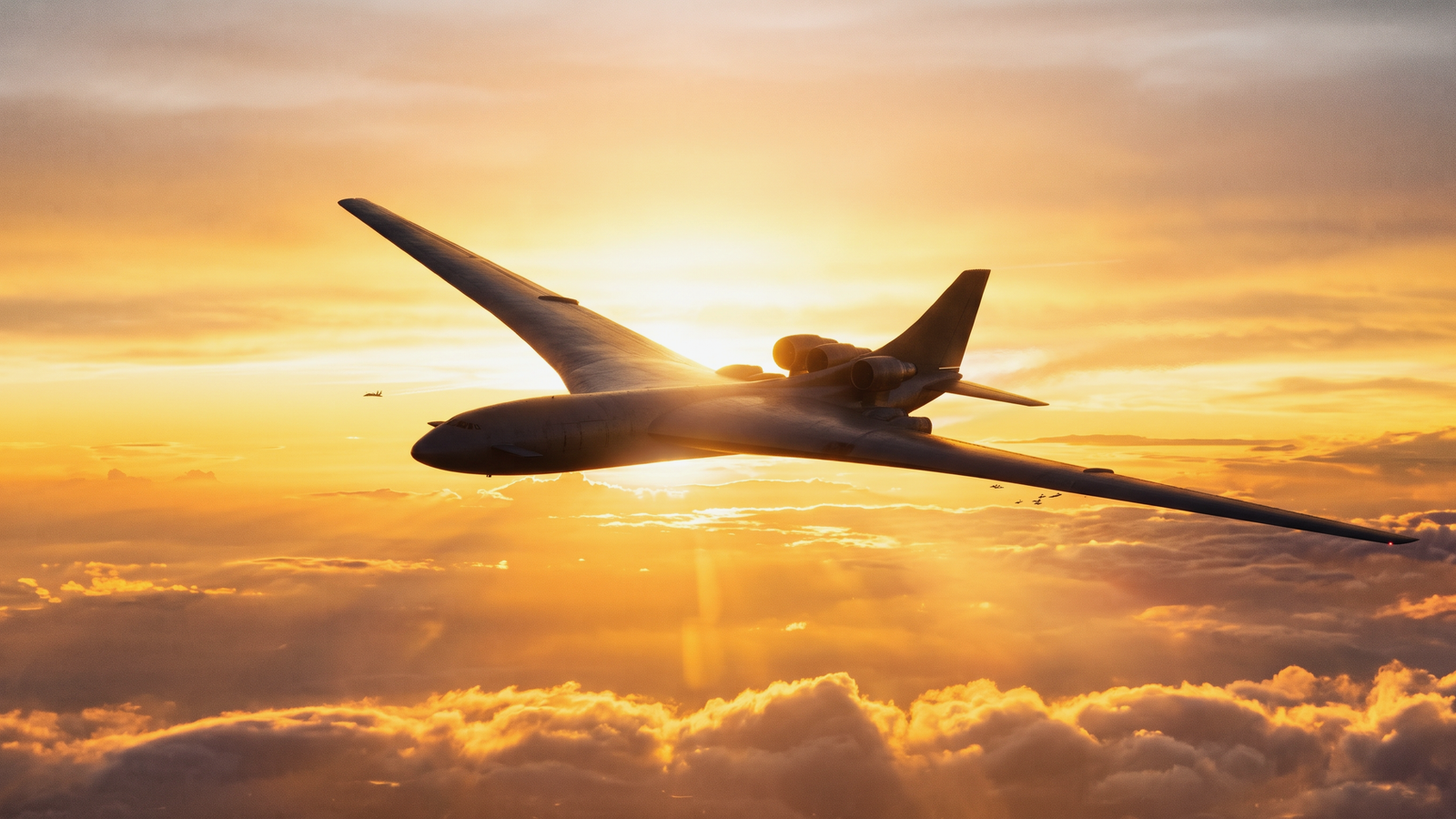
In the early jet era, Lockheed had a full docket of pioneering aerospace programs, but even among the iconic airplanes in the Skunk Works portfolio, the CL-1201 stands out for its scale and ambition. Locked in the endlessly escalating arms race with the Soviet Union, the US Air Force has commissioned an engineering study into a flying, nuclear-powered aircraft carrier. On September 12, 1969, Lockheed engineers G. Daniel Brewer, S. Dalton, and P. J. Sibley filed a company report LR-22802, outlining a machine that seemed to defy physics. It was a nearly 6,000-ton (5,375 metric tons) flying wing that spanned 1,120 feet (341 meters) in an audacious technical leap to rewrite strategic air mobility and power projection over foreign soil. The mothership was expected to haul at least 22 McDonnell Douglas fighter jets on massive underwing pylons in the same way that the smaller planes carried missiles. Designated the CL-1201, the behemoth 'lightning' carrier would be capable of reaching any conflict zone in hours and promised to cruise for 41 straight days without resupply. Although the aerodynamics and physics of constructing such a flying colossus sound like the greatest technical hurdle to its success, the failure of its nuclear power source stopped any progress. Popular accounts of the program claim that the USAF did in fact commission an active service example. However, no records to date, including the most detailed public file NASA, recorded as Memorandum X-2386, show that any order was officially lodged. The Nuclear Airborne Carrier: Bypassing Overseas Bases Via Atomic Power Credit: NASA The CL-1201's propulsion abandoned standard jet fuel logistics in favor of an unproven liquid-metal-cooled reactor delivering 1,830 megawatts of thermal energy. That staggering heat drove four mammoth aft turbofans at Mach 0.8 at 30,000 feet (9,144 meters), offering effectively unlimited global range. The design aimed to bypass the need for any overseas airfields and reliance on allied partners entirely by maintaining an airborne presence for over a month, limited only by crew endurance and engine oil. The primary CL-1201-1-1 Attack Aircraft Carrier variant would house a crew of 845 to operate 22 fighters beneath its wings. Meanwhile, the alternative CL-1201-1-3 Logistics Support Aircraft traded strike fighters for a cavernous cargo bay. It was proposed with the capacity to deploy an entire combat brigade of 3,896 soldiers with 6,207 tons (5,631 metric tons) of equipment to any hot spot on the globe. Eight years before Lockheed's engineers filed their report, US President John F. Kennedy had already canceled the US aircraft nuclear propulsion program. After 15 years of research, it was finally called off in 1961. The numbers had never successfully solved all the safety issues with installing an active nuclear reactor in an airplane. Two airships, the USS Akron and Macon, preceded the C-1201 as early motherships, and one Convair NB-36H had been equipped with nuclear power plants for test flights. Yet, scientists were unable to ever create an atomic engine considered safe enough to not have a devastating environmental impact in the event of a mishap. Furthermore, turning the CL-1201 concept into an airworthy airframe demanded solving the immediate physics problem of how to lift nearly 12 million lb (5.4 million kg) into the sky. No airport on Earth could handle the landing gear footprint, forcing the design team to adopt a complex propulsion compromise. Midair Docking Fighters: Trapeze Booms and Long-Range Air Defense Threats The retrieval system of the CL-1201 lowered a hydraulically stabilized pantograph hook 35 feet (10.7 meters) beneath the airframe into clean, undisturbed air. A docking fighter pilot engaged the hook with a dorsal latch, allowing heavy winches to haul the aircraft up against cradle stops before swinging it into internal maintenance bays. This acrobatic aerial recovery demanded precision flying in high-altitude crosswinds, turning routine combat patrols into dangerous flight-test maneuvers that risked pilot lives. Docking a 40,000-lb (18,140 kg) fighter beneath a 125,000-square-foot (11,613 sq m) wing generated lethal aerodynamic turbulence that tested the limits of human piloting. Incoming flight crews had to fly through a violent boundary layer wake and wingtip vortex wash, with velocity spikes exceeding 120 feet (37 meters) per second. The chaotic upwash threatened to smash approaching jets against the lower wing skin, prompting designers to engineer an articulated trapeze boom. Beyond the docking challenges, Cold War missile advances made the carrier extraordinarily vulnerable to long-range Soviet surface-to-air missile networks. The tailless 560-foot (171-meter) airframe would look like staring into the sun on an enemy's radar scope. Its gigantic profile would create an immense radar target that air defense systems like the Soviet S-200 Angara could spot hundreds of miles away. A single missile strike could instantly wipe out an entire combat wing and crack open the central atomic reactor. The 182-Engine Vertical Takeoff: The 12-Million-lb Runway Problem Credit: NASA At a gross weight of 11.85 million lb (5.4 million kg), roughly fifteen times the mass of a Boeing 747 or Lockheed C-5 Galaxy, the CL-1201 exceeded the limits of every runway in the world. Standard concrete aprons would be crushed under its landing gear, while constructing dedicated five-mile runways around the world negated the strategic autonomy that justified it. To eliminate runway dependence, engineering lead Brewer and his team adopted an extreme vertical takeoff and landing design. Rather than routing reactor thermal energy to lift fans, the configuration housed 182 dedicated jet-fuel-powered turbojets in retractable forward fuselage bays and inner wing banks. It would dramatically scale up the multi-engine vertical lift concept of experimental aircraft at the time, like the Dornier Do 31 and Yakovlev Yak 38. Each turbine was rated for 90,000 pounds of thrust for a combined vertical output of 16.38 million pounds. In operational practice, this propulsion created severe liabilities at every launch site. Simultaneous ignition of 182 lift jets projected a 1,400°F downward exhaust plume capable of spalling reinforced concrete, liquefying asphalt, and generating severe foreign object damage hazards across massive areas. Furthermore, the lift engines would consume nearly 1.9 million lb (0.8 million kg) of JP-5 fuel during a single five-minute departure sequence, burning the equivalent fuel capacity of six fully loaded C-5 Galaxies before the nuclear engines engaged. Additionally, synchronizing 182 independent turbines during the low-speed transition from jet-borne hover to wing-borne aerodynamic flight introduced an alarmingly long list of potential failure points. A compressor stall or flameout within an outboard wing bank would generate violent asymmetric roll moments far exceeding the control authority of aerodynamic flight surfaces at near-zero airspeed. Ultimately, the CL 1201 was simply unviable due to its inability to break away from conventional infrastructure and limitations because of its size and not its power source, relegating the concept to a Cold War 'flight of fancy.' The Containment Dilemma Of Airborne Reactors: Losing Out To ICBMs And Tankers Credit: The National Archive Catalogs In the 1940s and 1950s, the USAF and Atomic Energy Commission spent roughly $1 billion over 15 years on the Aircraft Nuclear Propulsion (ANP) program, hoping to build bombers that could stay airborne for weeks. The Convair NB-36H Crusader flew 47 test missions over Texas and New Mexico carrying an operational, air-cooled 1-to-3 megawatt reactor in its aft bomb bay. The bomber's entire nose had a 12-ton lead and rubber shield, complete with 12-inch-thick lead-glass windows. Adding the 17.5-ton reactor meant the aircraft had to haul nearly 30 tons of nuclear hardware and shielding before carrying any weapons. Every test flight was shadowed by a C-97 transport plane carrying a platoon of US Marines trained to parachute into the crash site and cordon off radioactive debris. Engineers could not solve the dilemma of making a reactor light enough without sacrificing containment. Furthermore, advances in intercontinental ballistic missiles and aerial refueling made nuclear bombers strategically obsolete. Lockheed aimed to overcome those limitations with an atomic propulsion plant rated at an astonishing 5,470 megawatts in a dual-circuit closed loop. Liquid lithium circulated through the primary reactor core at temperatures reaching 2,000°F (1,093°C), carrying thermal energy into an intermediate heat exchanger mounted inside a central structural containment cell. The secondary circuit circulated non-radioactive liquid alloy through pipes to four massive trailing-edge turbofans. The engines used single-stage titanium fan disks spanning an unprecedented 28 feet (8.5 meters) across. The liquid metal radiators sat directly behind the 14-stage axial compressors, transferring heat into the compressed air stream to produce 300,000 pounds of thrust (1,334 kN) per engine. Containing the energy required a titanium keel and trusses that were eight inches (20 cm) thick, as well as a shield of lead, tungsten, and borated water weighing 1.2 million lb (544,300 kg). Early Airborne Carrier Trials: 1930s Navy Rigid Airship Carriers Commissioned in the early 1930s, the USS Akron (ZRS-4) and her sister ship USS Macon (ZRS-5) were 785-foot-long rigid helium airships. Each airship housed an internal hangar bay holding up to five Curtiss F9C-2 Sparrowhawk biplanes. To launch, a mechanical 'trapeze' lowered a fighter beneath the airship's hull into the slipstream, where the pilot released a skyhook and flew away. To recover, the pilot matched the airship's 70-knot speed and snagged the trapeze bar with a hook mounted above the upper wing. On April 4, 1933, the Akron was caught in a violent thunderstorm off the coast of New Jersey. Downdrafts forced the tail into the Atlantic Ocean, breaking the airship apart. Less than two years later, on February 12, 1935, the Macon encountered a storm off Point Sur, California. Wind shear tore away her upper tail fin, puncturing rear gas cells and causing her to lose buoyancy and settle into the Pacific. Before the tragic and catastrophic demise of each airship, the trapeze system actually worked well, and the Navy never lost a plane during an in-flight catch. Despite successful fighter operations, the loss of the Macon ended the US Navy's permanent pursuit of flying aircraft carriers, and there's no indication that they ever showed interest in the massive Lockheed concept. Meanwhile, the CL-1201 aimed to take this ill-fated earlier attempt and supersize it.
Lockheed’s CL-1201 Was A Nuclear-Powered Flying Aircraft Carrier That Never Left The Drawing Board
Full Article
Original Source
Read the full article at Simpleflying →KhanList aggregates and links to publicly available news content. We do not host full articles from third-party sources. Always verify important information with original sources.